BSE’s Strong April Performance Triggers Fresh Buzz in India’s Derivatives Market
India’s derivatives market witnessed an unusual shift in April as BSE moved ahead of National Stock Exchange in equity derivatives turnover and total contracts traded — a development that quickly caught the attention of traders and market participants across Dalal Street.
For years, the NSE has dominated the Futures & Options (F&O) segment with a commanding market share. But April’s trading data painted a different picture, sparking conversations around whether India’s derivatives landscape is gradually becoming more competitive.
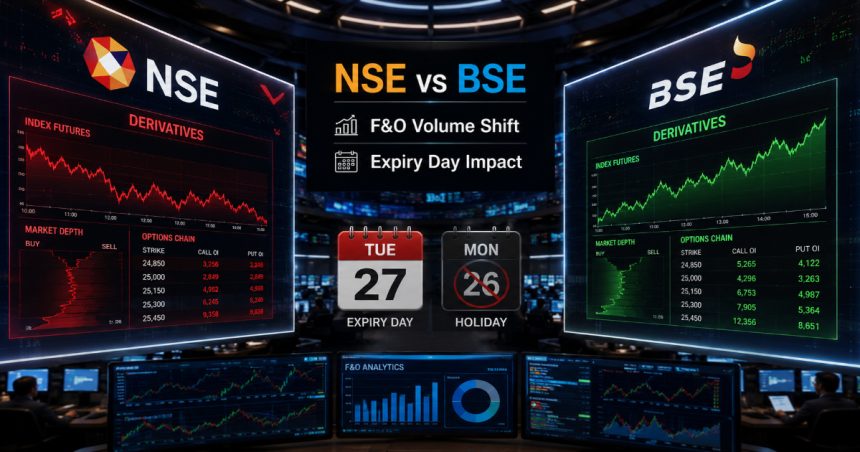
However, the NSE has now clarified that the decline in trading activity was largely due to market holidays falling on its weekly expiry days.
The exchange believes the disruption was temporary and not a sign of weakening market leadership.
Read More : Bank Nifty Rally Sparks Investor Optimism After Govt’s Big Credit Guarantee Push
List of NSE Expiry-Day Holidays That Impacted April F&O Volumes
| Date | Day | Holiday | Impact on NSE |
|---|---|---|---|
| March 31, 2026 | Tuesday | Shri Mahavir Jayanti | Weekly/monthly expiry trading disrupted |
| April 14, 2026 | Tuesday | Dr. Baba Saheb Ambedkar Jayanti |
Here’s What Happened Today and Why Traders Reacted
Since NSE’s weekly and monthly derivative contracts expire on Tuesdays, these holidays directly impacted some of the most active trading sessions of the month.
Meanwhile, rival exchange BSE’s expiry contracts fall on Thursdays, which remained unaffected.
This created a temporary imbalance in derivatives activity.
A spokesperson from the NSE said:
“In contrast, rival contracts expiring on Thursdays were unaffected, creating a temporary imbalance in reported activity.”
That explanation helped ease some concerns among traders who initially viewed the April numbers as a major shift in market leadership.
BSE vs NSE: Contracts Traded Comparison (2025 vs 2026)
| Exchange | April 2025 (Estimated Base)* | April 2026 | Year-on-Year Change |
|---|---|---|---|
| BSE | 279 crore contracts | 351 crore contracts | ▲ 26% Growth |
| NSE | 370 crore contracts | 289 crore contracts | ▼ 22% Decline |
BSE Registers Sharp Growth in Turnover and Contracts Traded
April turned out to be a strong month for BSE in the derivatives segment.
Key data points showed:
- BSE’s notional average daily turnover rose 20 percent month-on-month to Rs 269 lakh crore
- Total contracts traded on BSE climbed 26 percent to 351 crore
- NSE’s contracts traded declined 22 percent to 289 crore
As a result:
- BSE’s share in notional turnover increased to 55 percent
- NSE’s share slipped to 45 percent
The numbers surprised many market participants because the NSE has traditionally maintained a dominant position in India’s F&O ecosystem.
The sharp jump in BSE activity also reflected rising trader participation and growing liquidity migration in select derivatives contracts.

NSE Says Notional Turnover Does Not Show the Full Picture
In the F&O market, both Notional Turnover and Premium Turnover are used to measure trading activity, but they represent very different things.
Underlying Index/Stock Price × Lot Size × Number of Contracts
Example
Suppose:
- Sensex = 81,500
- Lot size = 10
Then:
- Notional value = 81,500 × 10
- = ₹8,15,000
Even if the trader pays only a small premium, the entire ₹8.15 lakh gets counted in notional turnover.
According to the exchange, higher index levels can artificially inflate turnover calculations and create misleading market share comparisons.
The spokesperson stated:
“Premium turnover aligns with global best practices and is used by regulators such as SEBI and institutional investors.”
Premium turnover reflects the actual premium amount paid for option contracts.
Example
Suppose:
- Option premium = ₹375
- Lot size = 10
Then:
- Premium turnover = ₹375 × 10
- = ₹3,750
So while the notional value is ₹8.15 lakh, the actual premium traded is only ₹3,750.
This is an important point for investors because premium turnover is widely considered a more realistic measure of actual trading activity and liquidity.
Market experts say institutional participants often focus more on premium turnover rather than headline notional values while evaluating exchange performance.
Why Traders and Investors Are Watching This Closely
The competition between India’s two largest stock exchanges has become increasingly important for traders, brokers, and institutional investors.
Here’s why this matters:
Key Takeaways for Traders
- Expiry-day liquidity heavily influences short-term trading activity
- Volume migration between exchanges may create arbitrage opportunities
- Weekly expiry sessions remain crucial for options traders
Key Takeaways for Investors
- Strong derivatives activity often supports overall market liquidity
- Rising competition between exchanges may improve product innovation
- Exchange-related stocks could remain in focus if market share shifts continue
The April data also highlighted how operational factors such as trading holidays can temporarily distort market statistics.
NSE Maintains Market Position Remains Strong
Despite the April decline, the NSE said its broader trend remains positive.
The exchange pointed out that its index options market share improved steadily during the first quarter of 2026:
- January: 66.7 percent
- March: 72.1 percent
That increase of nearly 540 basis points indicates strong underlying growth momentum before the holiday-related slowdown.
An exchange representative added:
“The broader trend signals recovery and strengthening market position.”
This suggests the NSE expects trading activity to normalize in the coming months as expiry sessions return to regular schedules.
What Could Impact the Market Going Forward?
Market experts believe traders will now closely monitor upcoming expiry sessions to see whether BSE can maintain its momentum or if NSE regains lost ground quickly.
Several factors may influence the next phase of competition:
- Liquidity trends in index options
- Institutional participation
- Retail trader activity
- Future expiry-day structures
- Regulatory developments in the F&O market
For now, April’s data has added a fresh layer of competition in India’s booming derivatives market.
While the NSE maintains that the weakness was temporary, BSE’s strong performance has undoubtedly intensified the battle for market share in one of the world’s busiest trading ecosystems.