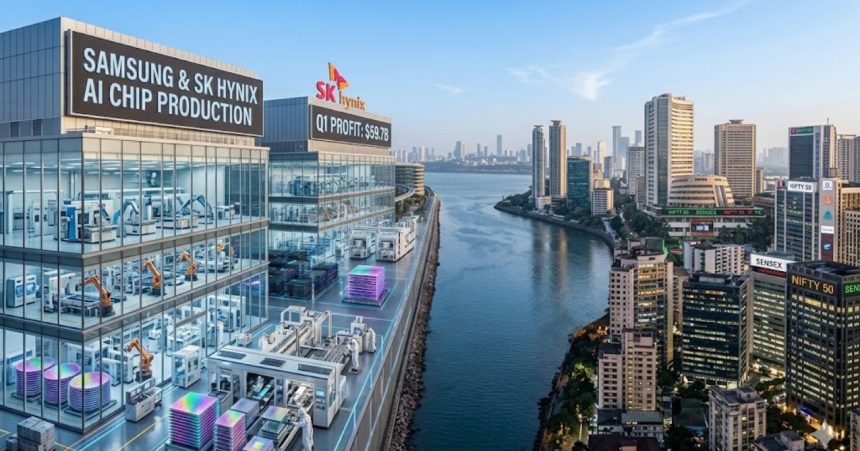
Two Korean Chipmakers Out-Earned Every Listed Indian Company in a Single Quarter
Samsung Electronics and SK Hynix together reported a combined net profit of $59.7 billion in the January–March 2026 quarter, according to Bloomberg data. Samsung’s operating profit for Q1 2026 hit 57.2 trillion Korean won, a 750% jump year-on-year and a new all-time record, exceeding the company’s entire full-year 2025 operating profit of 43.6 trillion won, per CNBC.
Also Read: Samsung Hits $1 Trillion as KOSPI Breaks 7,000 Record
SK Hynix posted 37.61 trillion won in operating profit for the same period, up 405% year-on-year, at a 72% operating margin, also per CNBC. India’s best-ever quarterly net profit, recorded across 3,723 listed companies in December 2025, was ₹4.5 lakh crore, or approximately $49 billion, per Capitaline data compiled by the Economic Times. Two companies. One quarter. More profit than all of India’s listed universe combined.
What Is Driving the Numbers: HBM, Not Just AI
The profit surge is not a generic AI story. It is specifically about high-bandwidth memory, or HBM, the specialised chip architecture required by every AI server GPU, with no current substitute and no spare manufacturing capacity. Meta, Microsoft, Amazon, and Alphabet collectively raised data centre capital expenditure from $217 billion in 2024 to approximately $360 billion in 2025, and analysts at IDC estimate that figure will reach $650 billion in 2026. Every dollar of that spending creates demand for HBM that the industry cannot yet meet.
In April 2026, Goldman Sachs raised its 2026 DRAM supply-demand gap forecast from 3.3% to 4.9%, calling it the most severe memory shortage in 15 years. SK Hynix holds approximately 70% of Nvidia’s HBM orders, per Counterpoint Research analyst Jeongku Choi. Samsung’s chip division, the DS division, contributed 53.7 trillion won of the company’s Q1 operating profit, accounting for roughly 94% of Samsung’s total quarterly earnings. Every other Samsung business, smartphones, home appliances, and displays, was a rounding error against chips alone.
The Margin Gap Between Korean Chips and India Inc
| Metric | SK Hynix Q1 2026 | Samsung Q1 2026 | India Inc Q1 2026 | TCS Q4 FY26 |
|---|---|---|---|---|
| Operating Profit / Net Profit | $27.5B (net) | $32.2B (net) | ~$49B (net, all listed cos) | ~$1.46B (net) |
| Operating Margin | 72% | ~70%+ | ~20% (aggregate) | ~24% (net margin) |
| Revenue Base | Part of $127B combined | Part of $127B combined | ~$500B+ (aggregate) | ~$7.2B |
| YoY Profit Growth | +405% | +750% | — | ~+4.5% |
SK Hynix’s 72% operating margin in Q1 2026 exceeded Nvidia’s 65% operating margin for the same period and set a new record for the semiconductor manufacturing industry, per TradingKey. Samsung’s operating margin similarly exceeded 70%, surpassing both Nvidia and TSMC in the quarter. On a combined revenue of approximately $127 billion, less than one-fourth of India Inc.’s aggregate quarterly revenue of over $500 billion, the two Korean firms generated more absolute profit. That ratio is what structural pricing power in a supply crunch looks like.
For context: TCS, India’s largest IT company by market capitalisation, reported a net profit of approximately ₹12,224 crore for Q4 FY26, roughly $1.46 billion. SK Hynix alone earned $27.5 billion net in Q1 2026. That is 19 times TCS’s quarterly profit from a single Korean chipmaker.
Hyperscalers Are Now Funding the Factories
The relationship between chip buyers and chip makers has structurally changed. In early May 2026, Microsoft, Google, and Amazon are among the companies planning to submit investment proposals to SK Hynix, offering to fund capacity expansion directly in exchange for guaranteed HBM allocations in future years, per TradingKey. This is not a normal procurement arrangement. The world’s three largest cloud companies are pre-financing chip fabs because they cannot risk being left without supply.
SK Group Chairman Chey Tae-won stated in March 2026 that the global chip wafer shortage is likely to persist until 2030. New wafer fabrication plants take a minimum of four to five years to come online, and SK Group projects a supply shortfall exceeding 20% of demand, per CNBC. SK Hynix has committed 19 trillion won to a new South Korean manufacturing plant, but no meaningful capacity relief is expected before 2028 at the earliest, per industry consensus.
The Hidden Consequence: AI Is Crowding Out Consumer Chips
A second-order effect is receiving insufficient coverage. As Samsung, SK Hynix, and Micron redirect cleanroom capacity toward high-margin HBM for enterprise AI customers, wafer supply available for mid-range consumer DRAM, used in smartphones, laptops, and tablets, contracts. HBM demand is forecast to increase 70% year-on-year in 2026, per TrendForce, consuming 23% of total DRAM wafer output, up from 19% in 2025. Every wafer allocated to an HBM stack for a GPU data centre is a wafer denied to a mid-range Android phone or consumer laptop. Consumer device prices will rise as a direct consequence. AI is eating the chips first.
SK Hynix’s Nine-Quarter Compounding Run
SK Hynix reported a net loss in each of the five quarters ending December 2023. By March 2024, it had returned to a $1.4 billion net profit. Over the nine quarters since that inflection point, net profit has compounded at 44.6% per quarter, per Economic Times analysis of company filings. Samsung’s equivalent compounded quarterly growth rate over the same period was 26%.
A Samsung executive stated during the Q1 2026 earnings call: “Our demand fulfillment rate is now at a record low, and unlike previous years, customers who are concerned about supply shortages are actually bringing forward their demand for 2027,” per CNBC. Forward demand pull, with customers buying 2027 allocations in 2026, confirms that the shortage is structural, not cyclical.
What Indian Investors Can and Cannot Access
There is no direct Indian listed play on HBM. India has no memory chip manufacturer of scale. Indirect domestic exposure exists through three channels: data centre infrastructure companies supplying the AI buildout in India, power equipment manufacturers serving hyperscaler construction projects, and IT services firms with significant AI deployment revenues from hyperscaler clients.
For direct HBM exposure, Samsung Electronics and SK Hynix are listed on the Korea Exchange (KRX). US-listed access includes Micron Technology (NASDAQ: MU), which competes in DRAM, NAND, and HBM and is operating in the same tight supply environment. Indian retail investors can access these via international mutual funds or the LRS (Liberalised Remittance Scheme) route, subject to the $250,000 annual limit.
Wall Street consensus ratings on both Samsung and SK Hynix are Strong Buy as of May 2026, with SK Hynix holding a marginal advantage given its 70% share of Nvidia’s HBM orders, per Computing.net and Counterpoint Research.
Read Next: Stocks to Watch: Nifty 23,816 — Key Supports, Buy Levels
What to Watch in Q2 2026
Samsung passed Nvidia’s final quality certification for HBM4 chips in early May 2026, with full-scale supply expected from June 2026, per CNBC. This is the first meaningful competitive challenge to SK Hynix’s near-monopoly on Nvidia’s HBM orders. If Samsung captures HBM4 share from SK Hynix at scale, margin compression could follow for both companies as pricing power distributes. SK Hynix plans to begin supplying samples of its next-generation HBM4E to customers in the second half of 2026, targeting mass production in 2027.
The single data point that changes the investment thesis: Samsung’s Q2 2026 HBM shipment volume to Nvidia. Watch that number when Q2 earnings are reported in July 2026.
Frequently Asked Questions
How does Samsung’s and SK Hynix’s Q1 2026 profit compare to Indian IT companies’?
TCS reported Q4 FY26 net profit of approximately $1.46 billion. SK Hynix alone reported $27.5 billion net profit in Q1 2026, approximately 19 times TCS’s figure. The gap reflects a fundamental difference in business model: TCS operates a services business at roughly 24% net margin; SK Hynix is a hardware manufacturer operating at 72% operating margin in a structural supply shortage.
Will the memory chip shortage end in 2026?
No. SK Group Chairman Chey Tae-won stated in March 2026 that the shortage is expected to persist until 2030. New fabrication plants require four to five years to reach production. SK Hynix’s new South Korean plant, funded with 19 trillion won, will not deliver meaningful supply before 2028. Goldman Sachs projects a 4.9% DRAM supply-demand gap for 2026, the worst in 15 years.
Is Samsung or SK Hynix the better HBM investment now?
SK Hynix currently holds approximately 70% of Nvidia’s HBM orders and posted a 72% operating margin in Q1 2026. Samsung has passed Nvidia’s HBM4 quality certification and is expected to begin supply from June 2026. If Samsung’s HBM4 ramp is successful, the margin gap between the two companies could narrow in H2 2026. Both carry Strong Buy consensus ratings on Wall Street as of May 2026.
Can Indian investors buy Samsung or SK Hynix directly?
Yes, via the LRS route (up to $250,000 per year) or through international mutual funds that hold Korean or global semiconductor exposure. US-listed Micron Technology (MU) provides partial HBM exposure on an Indian-accessible exchange.
This article is for informational purposes only and does not constitute investment advice.