
GST at 10: How AI Is Transforming India’s Tax System for Businesses
India’s biggest indirect tax reform is entering a new era. As GST at 10 becomes a major milestone on July 1, the government’s focus is no longer just on expanding the tax base. The next phase is about making the Goods and Services Tax (GST) smarter, faster and easier through artificial intelligence (AI), integrated technology and simplified compliance.
For businesses, especially MSMEs, the shift could mean fewer notices, quicker refunds and lower compliance costs. For investors, it signals a stronger formal economy and better tax efficiency that could benefit corporate earnings over the long term.
The bigger question now is whether technology can deliver the seamless tax system that GST originally promised.
Track Live : Quarterly Results Calendar
GST at 10 Marks a New Phase of Tax Administration
As GST at 10 begins, the Centre is increasingly using AI and digital technology to improve tax administration.
Authorities are integrating GST, income tax and customs databases to identify mismatches automatically, reduce tax evasion and speed up verification processes.
The objective is clear—reduce manual intervention while making compliance easier for honest taxpayers.
This technology-driven approach is expected to improve efficiency without increasing the compliance burden on businesses.
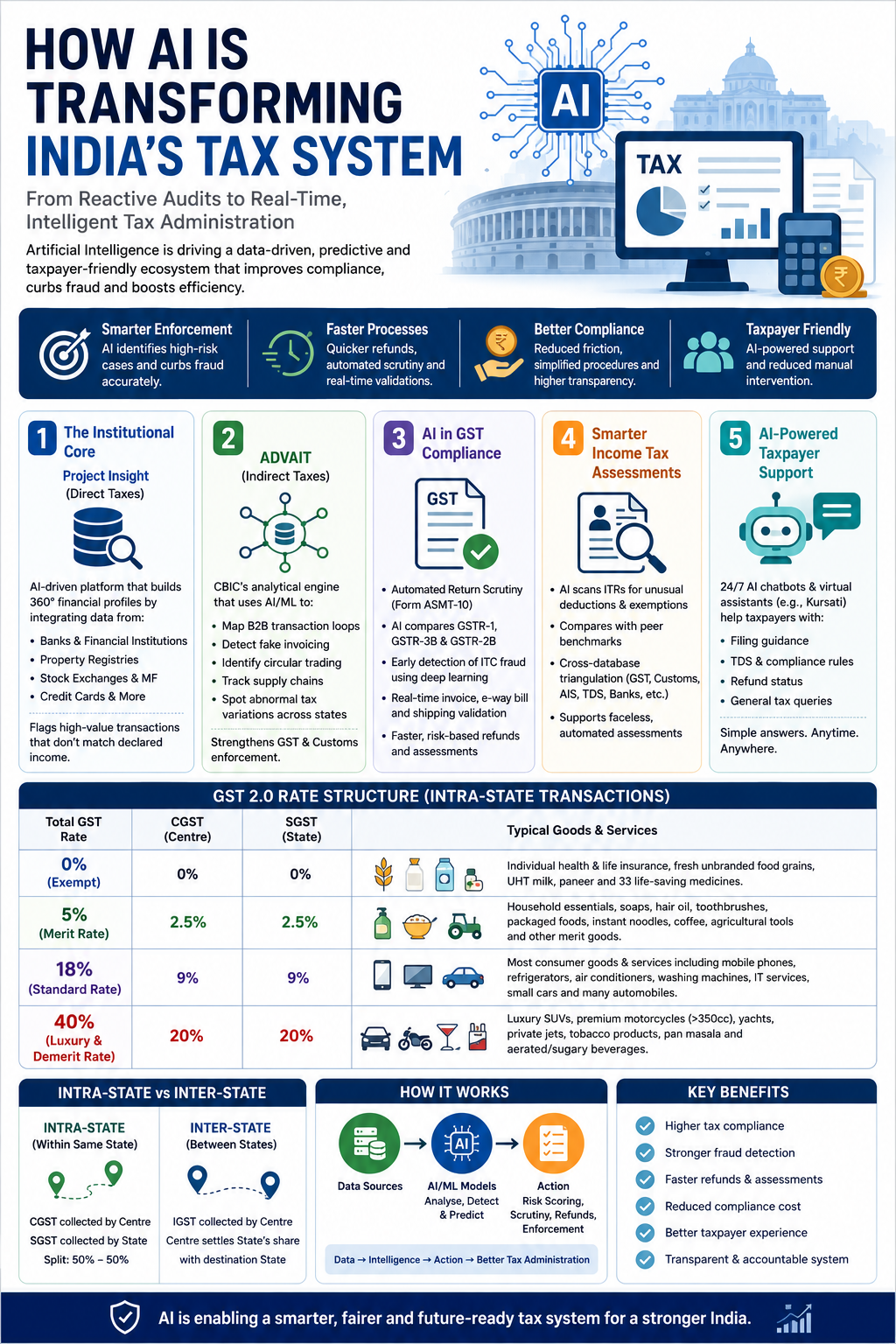
How AI Is Transforming India’s Tax System
1. Project Insight: AI for Direct Taxes
The Central Board of Direct Taxes operates Project Insight, an AI-powered analytics platform that builds a comprehensive financial profile of taxpayers by integrating data from:
- Banks
- Property registries
- Stock exchanges
- Mutual funds
- Credit card transactions
- Other financial databases
2. ADVAIT: AI for GST and Customs
The Central Board of Indirect Taxes and Customs uses ADVAIT (Advanced Analytics in Indirect Taxation) to strengthen indirect tax enforcement.
Its AI models:
- Detect fake invoice networks
- Identify circular trading
- Analyse GST supply chains
- Monitor customs declarations
- Flag abnormal tax payment patterns
The objective is to curb GST fraud while reducing unnecessary scrutiny for compliant businesses.
3. AI-driven GST Compliance
As GST enters its tenth year, compliance has become increasingly automated.
Key AI applications include:
- Automated scrutiny of GST returns
- Cross-checking GSTR-1, GSTR-3B and purchase records
- Early detection of Input Tax Credit (ITC) fraud
- Real-time invoice validation
- Faster GST refund processing
- AI-based risk scoring for taxpayers
These systems reduce manual intervention while improving the accuracy of compliance checks.
4. Smarter Income Tax Assessments
AI is also transforming direct tax administration by:
- Analysing unusual deduction claims
- Comparing taxpayer behaviour with peer groups
- Matching income declarations against financial transactions
- Reconciling GST, customs and income tax data
- Supporting faceless assessments through automated risk identification
This enables tax authorities to focus investigations on high-risk cases rather than randomly selecting returns.
5. Integrated Data Across Departments
One of the biggest changes is the integration of multiple government databases.
AI can now compare information across:
- GST filings
- Income Tax Returns (ITR)
- Customs records
- Banking transactions
- Securities investments
- Property registrations
For example, if a business reports substantial exports through customs but significantly lower revenue in its income tax return, the system can automatically identify the discrepancy.
6. AI-Powered Taxpayer Assistance
The Income Tax Department has also introduced AI-based taxpayer support tools, including conversational assistants that help users understand:
- Income tax filing
- TDS provisions
- Refund status
- Compliance procedures
- Frequently asked tax queries
These tools aim to simplify tax compliance and reduce dependence on manual support channels.
7. Businesses Are Using AI Too
As tax authorities adopt AI, companies and accounting firms are responding with their own technology.
Common enterprise applications include:
- Optical Character Recognition (OCR) for invoices
- Automated GST reconciliations
- Vendor compliance verification
- ERP-based tax validation
- AI-assisted tax risk detection
- Automated preparation of responses to tax notices
These technologies help businesses identify errors before filing and improve audit readiness.
Benefits of AI in India’s Tax System
- Faster tax return processing
- Quicker GST refunds
- Improved fraud detection
- Reduced manual audits
- Better taxpayer services
- Higher voluntary compliance
- More targeted enforcement
- Lower compliance costs for businesses
Challenges
Experts also highlight several issues that require attention:
- Protection of taxpayer privacy
- Transparency of AI decision-making
- Risk of false positives
- Algorithmic bias
- Data security
- Human oversight in important enforcement decisions
Core Shift in Strategy
- From Expansion to Efficiency: Focus moves from broadening the taxpayer base to maximizing administrative speed.
- AI-Powered Enforcement: Advanced technology now drives fraud detection, risk assessment, and data verification.
- Database Integration: Triangulation of GST, income tax, and customs databases plugs leakages.
New GST Structure (Central & State Split)
| Total GST Rate | CGST (Centre) | SGST (State) | Typical Categories |
|---|---|---|---|
| 0% (Exempt) | 0% | 0% | Selected life-saving medicines, fresh unbranded food grains, UHT milk, paneer, specified health and education-related items |
| 5% (Merit Rate) | 2.5% | 2.5% | Household essentials, agricultural inputs, packaged food items, soaps, hair oil, toothbrushes, instant noodles, coffee |
| 18% (Standard Rate) | 9% | 9% | Most goods and services including consumer electronics, mobile phones, white goods, IT services, small cars |
| 40% (Luxury & Sin Rate) | 20% | 20% | Luxury cars, premium motorcycles, yachts, private jets, tobacco products, pan masala, aerated and sugary beverages |
The earlier 12% and 28% GST slabs have been abolished, with most products shifted into either the 5% or 18% categories, while a 40% rate now applies to specified luxury and demerit goods.
Read More : SEBI Opens New FPI Gateway: Can It Bring More Foreign Money Into Indian Stocks?
GST Has More Than Doubled India’s Taxpayer Base
Since its launch on July 1, 2017, GST has transformed India’s indirect tax landscape.
The unified tax system replaced 17 central and state taxes and 13 cesses, creating a single national market and eliminating cascading taxation.
One of the biggest achievements of GST at 10 is the rapid expansion of the taxpayer base.
Registered taxpayers have increased from 66.5 lakh at launch to nearly 1.6 crore in 2026, reflecting greater formalisation of the Indian economy.
Prime Minister Narendra Modi, while launching GST during the historic midnight Parliament session, had described it as a “good and simple tax” designed to reduce the burden on traders and small businesses.
Former Finance Minister Arun Jaitley, who played a key role in building consensus, had called GST “the monumental restructuring of one of the world’s clumsiest indirect tax systems.”
Key Milestones Achieved (2017–2026)
- Taxpayer Growth: Registered taxpayers more than doubled, rising from 66.5 lakh to 1.6 crore.
- Tax Rationalization: Conserved a simpler structure where most goods now fall under 5% or 18% brackets.
- System Consolidation: Subsumed 17 central/state taxes and 13 cesses into a single national market.
Simplified Tax Structure Has Improved Compliance
The GST framework has evolved significantly over the past decade.
After initially operating with multiple tax slabs of 5%, 12%, 18% and 28%, the government introduced a simplified two-tier tax structure from September 22, 2025.
Today, most goods and services fall under either the 5% or 18% GST slab, while a separate 40% rate applies only to luxury and demerit products.
Finance Minister Nirmala Sitharaman had said the revised structure would “leave more cash in the hands of people” by reducing tax rates on several products and services.
Future Priorities
- Compliance Costs: Reduction of manual intervention to directly benefit MSMEs.
- Dispute Resolution: Industry experts urge a shift toward minimizing litigation and streamlining legal procedures.
- Refund Acceleration: Faster processing times via automated verification pipelines.
GST Collections Continue to Hit New Highs
The success of GST at 10 is also reflected in government revenues.
Average monthly GST collections have nearly doubled from ₹89,700 crore in FY18 to around ₹1.85 lakh crore in FY26.
Gross GST collections rose 8.3% year-on-year to ₹22.27 lakh crore during FY26 after recording 9.4% growth in the previous financial year.
The steady rise in collections points to stronger compliance, wider digitisation and a growing formal economy.
AI Could Become the Biggest Reform After GST
Industry experts believe the next chapter of GST at 10 will be shaped by artificial intelligence.
According to Deloitte’s GST@9 Survey, nearly 99% of businesses reported either a positive or neutral experience under GST.
The report identified digitisation and tax rate rationalisation as the biggest achievements while recommending AI-driven compliance and data-based dispute resolution as the next priorities.
EY India also believes reforms such as e-invoicing, digital return filing and operational appellate forums have strengthened the GST ecosystem.
However, the firm says further structural reforms are still needed.
“Despite these progressive changes, certain structural and procedural areas continue to warrant reform to fully realise the objective of creating a seamless, efficient and taxpayer-friendly GST system,” said Saurabh Agarwal, Tax Partner, EY India.
Petroleum Products Still Remain Outside GST
Despite a decade of reforms, some key issues remain unresolved.
Petrol, diesel, crude oil, aviation turbine fuel (ATF) and natural gas are still outside the GST framework.
Although the GST Council has discussed bringing ATF under GST, states have yet to reach a consensus.
The inclusion of petroleum products remains one of the most closely watched long-term reforms.
Traditional GST Structure (2017 – 21 September 2025)
| Total GST Rate | CGST (Centre) | SGST (State) | Applied Uniformly Across India |
|---|---|---|---|
| 5% | 2.5% | 2.5% | Maharashtra, Gujarat, Karnataka, Tamil Nadu, Uttar Pradesh and all other states |
| 12% | 6% | 6% | Same across all states |
| 18% | 9% | 9% | Same across all states |
| 28% | 14% | 14% | Same across all states |
GST 2.0 (Effective from 22 September 2025)
Following the recommendations of the 56th GST Council, India moved to a simplified structure:
| New GST Rate | CGST | SGST | Category |
|---|---|---|---|
| 5% | 2.5% | 2.5% | Merit and essential goods |
| 18% | 9% | 9% | Standard rate for most goods and services |
| 40% | 20% | 20% | Luxury and demerit goods |
The 12% and 28% slabs were abolished, with most items shifted into either the 5% or 18% categories, while a 40% demerit rate was introduced for a limited set of luxury and sin goods. These changes took effect on 22 September 2025.