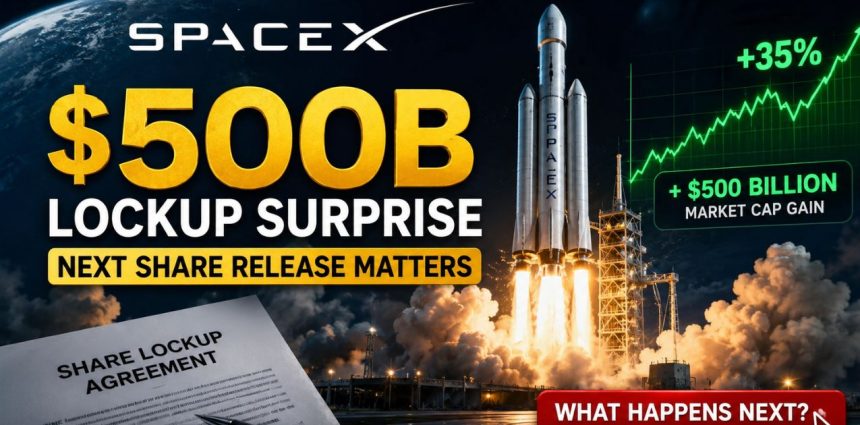
Wall Street expected SpaceX’s first major lockup expiry to unleash a wave of selling. Instead, the stock has surged about 35% in five sessions, adding roughly $500 billion in market value. But the supply risk has not disappeared, another major share release is approaching, setting up a fresh test for the rally.
SpaceX has just passed the market event investors feared most.
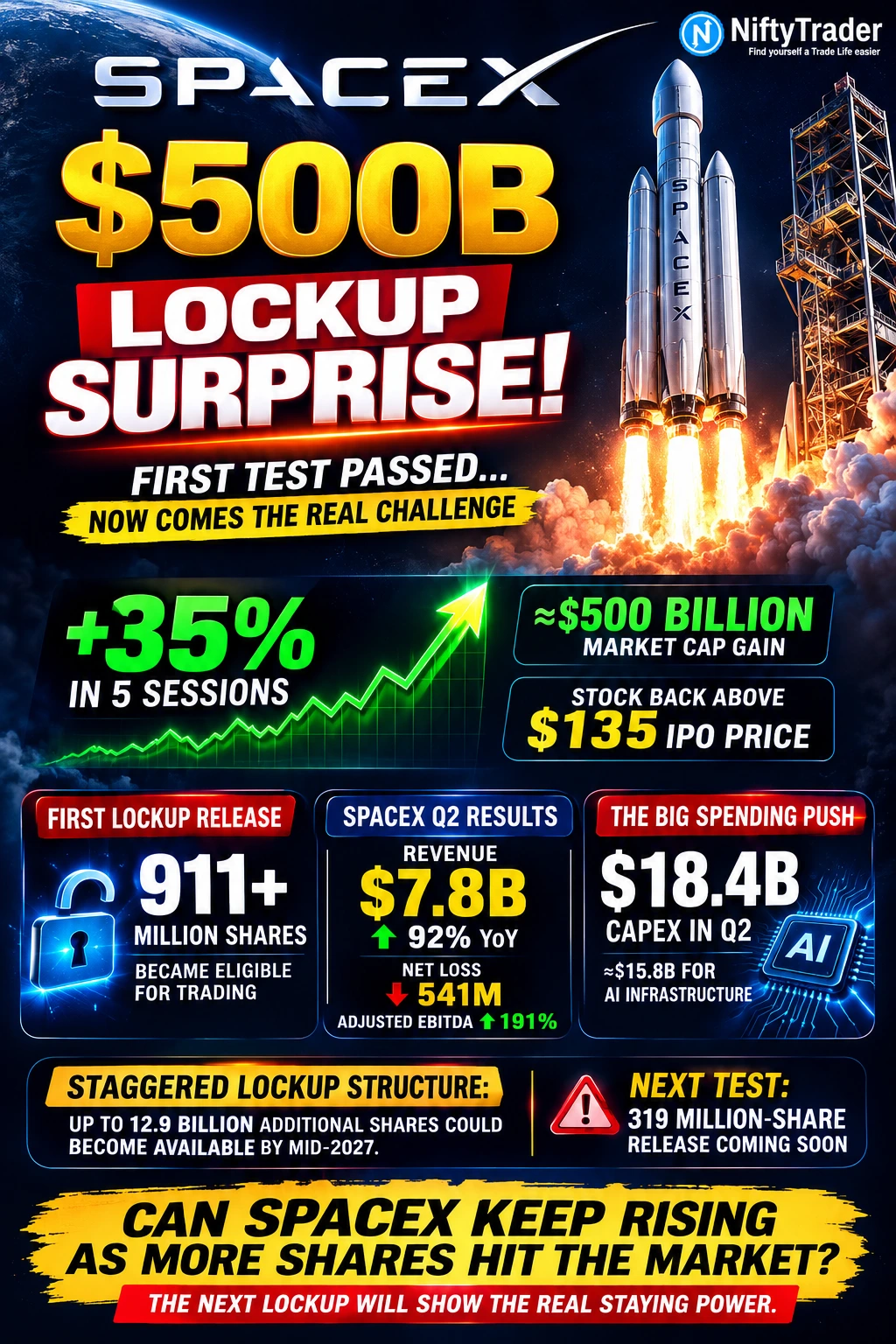
When the first post-IPO lockup expired on August 6, more than 911 million shares became eligible for trading. That represented more than 140% of the roughly 639 million shares that had initially been available to public investors after the IPO. The obvious concern was a sudden flood of supply.
Instead, SpaceX shares have moved sharply higher.
The stock has gained roughly 35% across five sessions, adding approximately $500 billion to its market capitalisation and moving back above its $135 IPO price. Fresh reporting says the rally has challenged the assumption that the first lockup expiry would automatically translate into heavy selling.
But this is where the story gets more interesting.
The first lockup did not eliminate SpaceX’s supply overhang. It only showed that buyers were strong enough to absorb the first major test.
Key Takeaways
- SpaceX shares have jumped about 35% in five sessions after the first lockup expiry.
- The rally added roughly $500 billion to market capitalisation.
- More than 911 million shares became eligible for trading in the first release.
- Another major tranche of shares is scheduled to become eligible in the coming weeks, keeping supply pressure in focus.
- SpaceX’s Q2 revenue jumped 92% to $7.8 billion, while its net loss narrowed to $541 million.
- The bullish story is being tested by enormous AI-related spending and a staggered lockup structure that could release substantially more shares over time.
The Selling Wave Wall Street Feared Never Arrived
The concern before August 6 was straightforward: SpaceX had gone public with an unusually small public float, leaving a huge number of shares locked up.
The first release changed that dramatically.
More than 911.5 million shares became eligible for sale, a volume equivalent to more than 140% of the shares that had initially been freely tradable. If every eligible holder had rushed to sell, the additional supply could have overwhelmed the relatively small public float.
That did not happen.
Instead, the stock recovered strongly after the expiry and continued climbing.
That creates the first major expectation gap in the SpaceX story:
What investors feared:
Massive newly unlocked supply → insider selling → stock pressure.
What actually happened:
More shares became tradable → demand absorbed the supply → SpaceX rallied about 35% in five sessions.
The distinction matters because an unlocked share is eligible to be sold, not necessarily a share that has actually been sold.
Why SpaceX Rallied Instead of Collapsing
One explanation is that investors had already priced in much of the lockup risk.
SpaceX shares had been under significant pressure before the expiry, falling sharply from their post-IPO highs. By the time the first unlock arrived, expectations for heavy selling were already elevated.
The stock’s subsequent rebound suggests that the market may have overestimated how aggressively early investors would cash out.
There was also evidence of continued institutional and investor demand. Barron’s reported that the increase in the free float made larger trades easier and that the stock continued rising after the first unlock.
That creates an important market question:
If investors were willing to absorb the first major supply increase, how much additional supply can the stock absorb without another major correction?
That question has not been answered yet.
Also Read: SpaceX Q2 Results: First Big Test Since IPO as Investors Await Key Updates
SpaceX’s Earnings Gave Buyers Another Reason to Stay
The lockup is only one part of the rally.
SpaceX’s first quarterly report as a public company showed powerful revenue growth.
The company reported $7.8 billion of Q2 revenue, up 92% year over year, while its net loss narrowed to $541 million from about $1 billion a year earlier. Adjusted EBITDA rose 191% to $3.5 billion.
Those numbers give bulls a fundamental argument for buying the stock even as additional shares become tradable.
But the earnings report also exposed the other side of the story.
The $18 Billion Spending Problem Bulls Cannot Ignore
SpaceX’s growth is requiring extraordinary investment.
The company spent about $18.4 billion on capital expenditure in Q2, with roughly $15.8 billion directed toward AI infrastructure, according to recent reporting.
That creates a sharp bull-bear tension.
Bulls see:
- 92% revenue growth
- rapidly expanding Starlink operations
- AI infrastructure as a potentially enormous future business
- a stronger balance between revenue growth and losses
- continued investor demand despite the lockup
Bears see:
- enormous capital expenditure
- a long runway before some AI investments generate meaningful cash flow
- a valuation that already assumes substantial future growth
- billions of additional shares potentially becoming tradable
So the recent 35% rally should not be interpreted as proof that SpaceX’s valuation debate is settled.
It may simply mean that buyers currently have more conviction than sellers.
The Next Lockup Could Be More Important Than the First
The first release was a major test. But SpaceX’s lockup structure is staggered rather than a single conventional post-IPO expiry.
Reuters previously reported that the staggered schedule could eventually make 12.9 billion additional shares available by mid-2027.
That means the first successful expiry cannot be treated as a clean all-clear.
A further 319 million-share release is the next major supply event investors are watching, although reporting has differed on the precise date of that tranche. The important point is that another sizeable block of shares is approaching eligibility.
That creates the real test:
Can SpaceX keep rising while more shares become available?
If yes, the market may increasingly conclude that demand is strong enough to absorb the staggered supply.
If no, the recent rally could prove to have been partly a relief move after investors realized the first expiry was less damaging than feared.
The Retail Investor Signal Is Also Changing
There is another wrinkle investors should watch.
Reuters reported that retail investors became net sellers of SpaceX shares on August 7 for the first time since the IPO, selling about $4.5 million of stock.
That does not necessarily signal a collapse in sentiment. It may simply reflect profit-taking or investors reducing exposure after the rebound.
But it does show that the market is becoming more two-sided.
SpaceX’s rally therefore cannot be explained simply as retail investors rushing to buy every dip.
The stock is increasingly being tested by a broader question of who is willing to own SpaceX at its rapidly changing valuation.
NiftyTrader Desk View: The $500 Billion Rally Is Not the Final Test
SpaceX has delivered the outcome that few investors expecting a lockup-driven selloff would have predicted.
More than 911 million shares became eligible. The stock did not collapse. Instead, it rallied about 35% and added roughly $500 billion in market value.
That is the bullish signal.
But the forward-looking risk is equally important.
The staggered lockup structure means more shares will become eligible over time, while SpaceX is simultaneously committing enormous amounts of capital to AI and other growth projects.
The market therefore faces a new question.
Was the first lockup expiry a genuine demonstration of strong underlying demand, or was it simply the easiest hurdle in a much longer series of supply tests?
For now, SpaceX has passed the first test.
The next release will show whether the $500 billion rally has real staying power.
Read Next: Paytm SEBI Notice Reopens 2023 Loan Disclosure Question