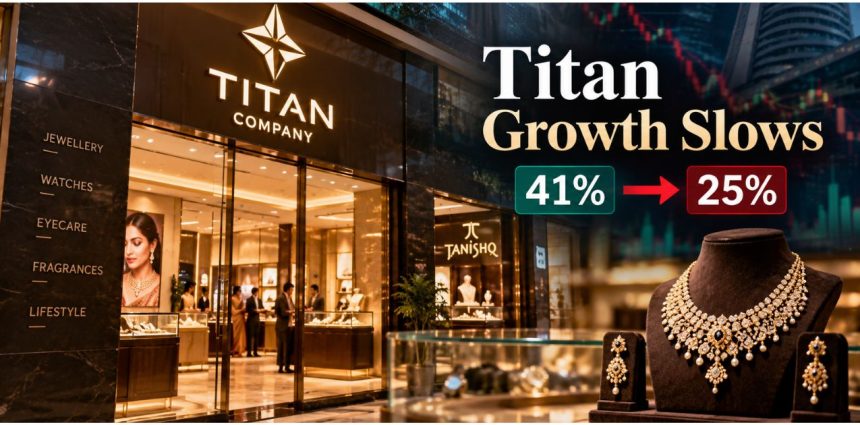
Titan’s consumer businesses grew about 25% year on year in Q2 FY27, down from 41% growth in Q1. Jewellery rose 21%, but buyer growth stayed in the mid-single digits while average ticket sizes increased at a double-digit rate. Meanwhile, watches and EyeCare grew faster, and Titan’s retail network expanded to 3,758 stores.
Titan Company’s Q2 FY27 business update looks strong on the headline numbers.
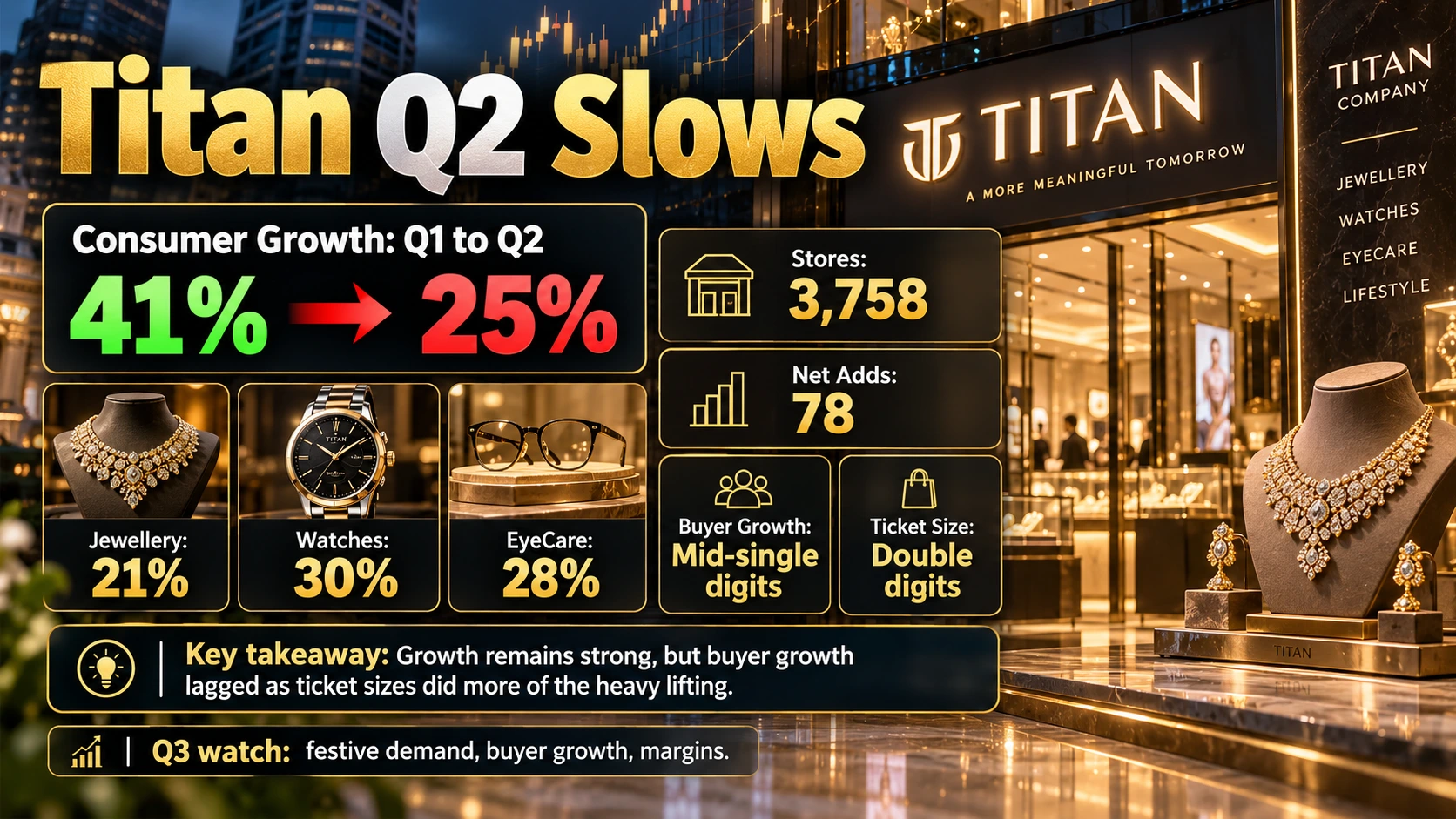
Its consumer businesses grew approximately 25% year on year, jewellery expanded 21%, watches grew 30%, EyeCare increased 28%, and the company added 78 net stores during the September quarter.
But the more important story sits below the headline.
Titan’s jewellery buyer count grew only in the mid-single digits, while average ticket sizes increased at a double-digit rate.
That means higher spending per transaction contributed significantly more to jewellery’s value growth than a sharp increase in the number of buyers.
The contrast becomes even more interesting when compared with Q1 FY27, when Titan’s consumer businesses had grown about 41% and jewellery had risen 39%.
So is Q2 simply a moderation after an exceptionally strong first quarter and a tougher comparison base — or is Titan moving towards a more normal growth rate?
Titan Q2 FY27: Numbers at a Glance
| Metric | Q2 FY27 | Q1 FY27 |
|---|---|---|
| Consumer businesses | ~25% | ~41% |
| Domestic business | 22% | 37% |
| International business | 97% | 128% |
| Jewellery | ~21% | 39% |
| Watches | ~30% | 23% |
| EyeCare | ~28% | 23% |
| Net stores added | 78 | 77 |
| Total retail network | 3,758 | 3,680 |
The table shows why Q2 should not simply be labelled a weak quarter.
Jewellery and overall consumer-business growth moderated sharply, but watches and EyeCare accelerated.
That suggests Titan’s growth story is becoming broader even as its largest business comes off a very strong Q1.
Track Live: Titan Company (TITAN) Option Chain Live
Growth Slows From 41% to 25%—But the Base Is Much Larger
Titan’s consumer businesses grew approximately 41% year on year in Q1 FY27. In Q2, growth moderated to about 25%.
Jewellery followed a similar pattern, slowing from 39% in Q1 to around 21% in Q2.
The drop is significant.
But looking only at those two percentages can exaggerate the apparent slowdown because Q2 is being measured against a much larger year-ago base.
In Q2 FY26, Titan’s consumer businesses had already grown about 20%, while jewellery grew approximately 19%.
Compounding roughly 20% growth followed by another 25% means Titan’s consumer businesses are approximately 50% larger than two years earlier, assuming comparable bases.
For jewellery, 19% growth followed by another 21% translates into approximately 44% cumulative growth over two years.
So the moderation is real, but it is occurring after a substantial expansion in the underlying business.
That is an important distinction for investors assessing whether 25% represents weakness or simply a more normal growth rate on a higher base.
Jewellery Grows 21%, But Buyers Grow Only Mid-Single Digits
Titan’s jewellery portfolio grew approximately 21% year on year in Q2 FY27.
Studded jewellery grew in the early thirties, while plain gold jewellery increased around 20%.
Investment-led demand for gold coins, however, declined at a high-single-digit rate from a strong base.
The more revealing customer metric was buyer growth.
Titan reported mid-single-digit growth in jewellery buyers, while average ticket sizes increased at a double-digit rate.
That creates an important distinction between value growth and customer growth.
Higher ticket sizes can lift reported sales even when the number of customers is growing more slowly. Elevated gold prices can also raise transaction values while simultaneously making jewellery less affordable at lower price points.
Premiumisation may support the same trend by encouraging higher-value purchases.
For Titan, the strongest long-term combination would be healthy growth in both customer numbers and ticket sizes, rather than value growth depending disproportionately on larger transactions.
The Q1-to-Q2 Buyer Shift Is Worth Watching
The Q1 comparison makes the buyer-growth data more significant.
During Q1 FY27, jewellery buyer growth was in the early double digits, while average ticket sizes increased in the high-double-digit range.
In Q2, buyer growth moved back to the mid-single digits, while ticket sizes continued to grow at a double-digit pace.
That suggests some moderation in customer momentum.
Titan has offered an important explanation.
The company said consumer demand remained healthy through most of Q2 but softened towards the end of the quarter as part of the festive calendar shifted into Q3 FY27.
That makes the October-December quarter particularly important.
If purchases were delayed rather than lost, stronger festive demand should show up in buyer activity during Q3.
If customer growth remains subdued even during the festive period, investors may begin to view Q2 as more than a calendar-driven slowdown.
Also Read: Titan Q1 Results Beat Estimates: Jewellery Business Drives 63% Profit Jump to ₹1,777 Crore
Watches Outpace Jewellery With 30% Growth
Jewellery may dominate Titan’s earnings story, but it was not the company’s fastest-growing major business in Q2.
The watches segment grew approximately 30% year on year, up from 23% in Q1.
Analogue watches delivered growth in the early thirties, supported by premiumisation, while the smartwatch business returned to high-single-digit growth after a weaker period.
Titan also added 34 net watch stores, taking its watches network to 1,379 stores by the end of September.
The performance matters because it gives Titan another meaningful growth engine at a time when jewellery is more exposed to gold-price volatility.
EyeCare Adds Another 28% Growth Engine
EyeCare also accelerated during the quarter.
The business grew approximately 28% year on year, compared with 23% in Q1.
Titan attributed the performance to execution across its multi-brand strategy, store upgrades and merchandise portfolio.
EyeCare ended September with 847 stores.
Taken together, watches at 30% and EyeCare at 28% both outpaced jewellery’s 21% growth.
Jewellery remains Titan’s core business, but Q2 provides evidence that the company is increasingly becoming a multi-category consumer growth story rather than relying on jewellery alone.
CaratLane Continues to Outpace the Broader Jewellery Portfolio
Performance within jewellery was also uneven.
Tanishq, Mia, Zoya and beYon together grew around 20%, while CaratLane grew approximately 32% during Q2.
Titan added 42 net jewellery stores, taking the jewellery network to 1,269 stores.
CaratLane’s faster growth is significant because Titan is increasingly using multiple brands and formats to reach different customer segments and price points.
That diversification could become more important if high gold prices continue to affect affordability in parts of the traditional jewellery market.
International Growth Hits 97% — But the Comparison Needs Context
Titan’s international business grew an eye-catching 97% year on year in Q2 FY27.
North American jewellery businesses across Tanishq, Mia and CaratLane continued to show strong double-digit momentum, while Titan also reported improving trends across parts of its GCC operations.
But the 97% figure needs context.
Titan holds 67% of Damas Jewellery, and Damas is now included in the company’s consolidated international reporting base.
That means the current international business is not directly comparable with the year-ago period.
The 97% growth rate should therefore not be treated as a pure organic-growth number.
Titan’s international opportunity remains meaningful, particularly across North America and the GCC, but investors should separate underlying business momentum from the impact of the changed consolidation base.
Titan Adds 78 Stores as Network Reaches 3,758
Titan continued expanding its physical presence during Q2 despite the moderation in headline growth.
The company added 78 net stores, taking its combined consumer retail network to 3,758 stores by September 2026.
The additions included 42 jewellery stores and 34 watch stores, along with additions in emerging and international businesses.
Titan’s network stood at 3,377 stores in September 2025.
That means the company has added 381 stores over the past year, representing approximately 11.3% year-on-year network growth.
Consumer-business growth of about 25% is therefore running significantly faster than the expansion of the store base.
That suggests store additions alone do not explain Titan’s operating growth.
Existing-store productivity, premiumisation, higher ticket sizes and category performance are also contributing.
The key question over time will be whether Titan can maintain strong productivity as its physical network becomes progressively larger.
Also Check: TITAN COMPANY Options Chart
Why Q3 Will Be Titan’s Real Test
Q2 leaves investors with a straightforward question:
Was the late-quarter softness mainly a timing issue, or the beginning of a broader normalisation?
Titan has said part of the festive calendar shifted into Q3, making the October-December quarter a useful test of underlying demand.
Four indicators deserve particular attention.
Buyer growth: Can jewellery customer growth move back towards double digits?
Ticket size: Does jewellery continue to rely heavily on higher transaction values, or does buyer growth begin catching up?
Gold prices: Elevated gold prices can increase transaction values but also pressure affordability and alter customer behaviour.
Margins: Can Titan translate strong operating growth into healthy profitability despite changing gold prices, promotional activity and business mix?
The current business update does not answer those questions because it primarily provides operating data rather than Titan’s complete quarterly financial performance.
What Investors Should Watch in Titan’s Q2 Results
Titan’s full Q2 FY27 financial results will provide the next important layer of information.
Investors will be looking at whether the moderation in operating growth affected revenue, margins and profitability.
The jewellery business will remain central, but the quality of growth matters increasingly.
A 21% increase in jewellery value with mid-single-digit buyer growth tells a different story from 21% growth driven equally by customer additions and spending per buyer.
Investors will also want to see whether the faster growth in watches and EyeCare is becoming meaningful enough to diversify Titan’s earnings base.
International profitability will be another area to watch as Damas becomes more deeply integrated into the consolidated business.
For traders tracking broader institutional positioning alongside company developments, daily FII and DII activity can also be followed through the NiftyTrader FII-DII Tracker.
Bottom Line
Titan’s Q2 FY27 update is still a strong operating performance, but the 25% headline growth rate does not tell the whole story.
Consumer-business growth moderated from 41% in Q1 to approximately 25% in Q2, while jewellery slowed from 39% to 21%.
But the slowdown needs context.
Titan’s consumer businesses are approximately 50% larger than two years ago on a compounded basis, its retail network has expanded to 3,758 stores, and watches and EyeCare are now growing faster than jewellery.
The most revealing number may be jewellery’s mid-single-digit buyer growth compared with double-digit ticket-size growth.
That does not make Q2 weak.
It does, however, shift the focus from how fast Titan is growing to what is driving that growth.
The next signal to watch is whether customer growth re-accelerates during the festive quarter, rather than value growth continuing to depend heavily on larger transactions.
If festive demand brings stronger buyer growth, Q2 may look like a temporary moderation after an exceptional first quarter and against a demanding base.
If customer growth remains subdued, the market may increasingly treat the current pace as a more normal — though still strong — growth run-rate.
For Titan, the next phase of the story is therefore less about whether the company can grow and more about the quality, breadth and durability of that growth.
Read Next: Stocks to Watch Today, October 6: 24.7% Kotak Loan Growth, ₹1,012 Crore Marico Deal, Zydus US Launch
Frequently Asked Questions
What was Titan’s Q2 FY27 consumer-business growth?
Titan’s consumer businesses grew approximately 25% year on year in Q2 FY27. Domestic businesses grew 22%, while international business grew 97%.
How much did Titan’s jewellery business grow in Q2 FY27?
Titan’s jewellery portfolio grew approximately 21% year on year during the September quarter.
Why did Titan’s growth slow from 41% to 25%?
The Q1 and Q2 numbers are year-on-year growth rates measured against different comparison bases. Titan also said demand softened towards the end of Q2 as part of the festive calendar shifted into Q3 FY27.
Did jewellery buyers grow as fast as jewellery sales?
No. Jewellery buyer growth was in the mid-single digits, while average ticket sizes increased at a double-digit rate, indicating that higher transaction values contributed materially to overall growth.
Which Titan businesses grew faster than jewellery in Q2?
Watches grew approximately 30% and EyeCare around 28%, both ahead of jewellery’s 21% growth.
How many stores does Titan have?
Titan’s combined consumer retail network reached 3,758 stores by the end of September 2026 after 78 net stores were added during Q2.
Why should the 97% international growth figure be viewed carefully?
Titan’s international reporting now includes Damas Jewellery, in which Titan holds a 67% interest. The current reporting base is therefore not directly comparable with the year-ago period, so 97% should not be treated as a purely organic growth rate.
Disclaimer
This article is for informational and educational purposes only and does not constitute investment advice or a recommendation to buy, sell or hold any security. Titan Company’s quarterly business-update figures are operating disclosures and should not be treated as a substitute for its complete financial results. Investors should conduct their own research and consult a qualified financial adviser before making investment decisions.