HDFC Bank’s September-quarter business update shows deposits growing faster than loans year on year, but the mix is less straightforward: time deposits rose 22.8%, while CASA grew 10.8%. Sequentially, advances grew faster than deposits, keeping the funding mix, funding costs and margins in focus.
HDFC Bank has reported strong growth in both deposits and advances for the September quarter, but the headline numbers do not tell the entire story.
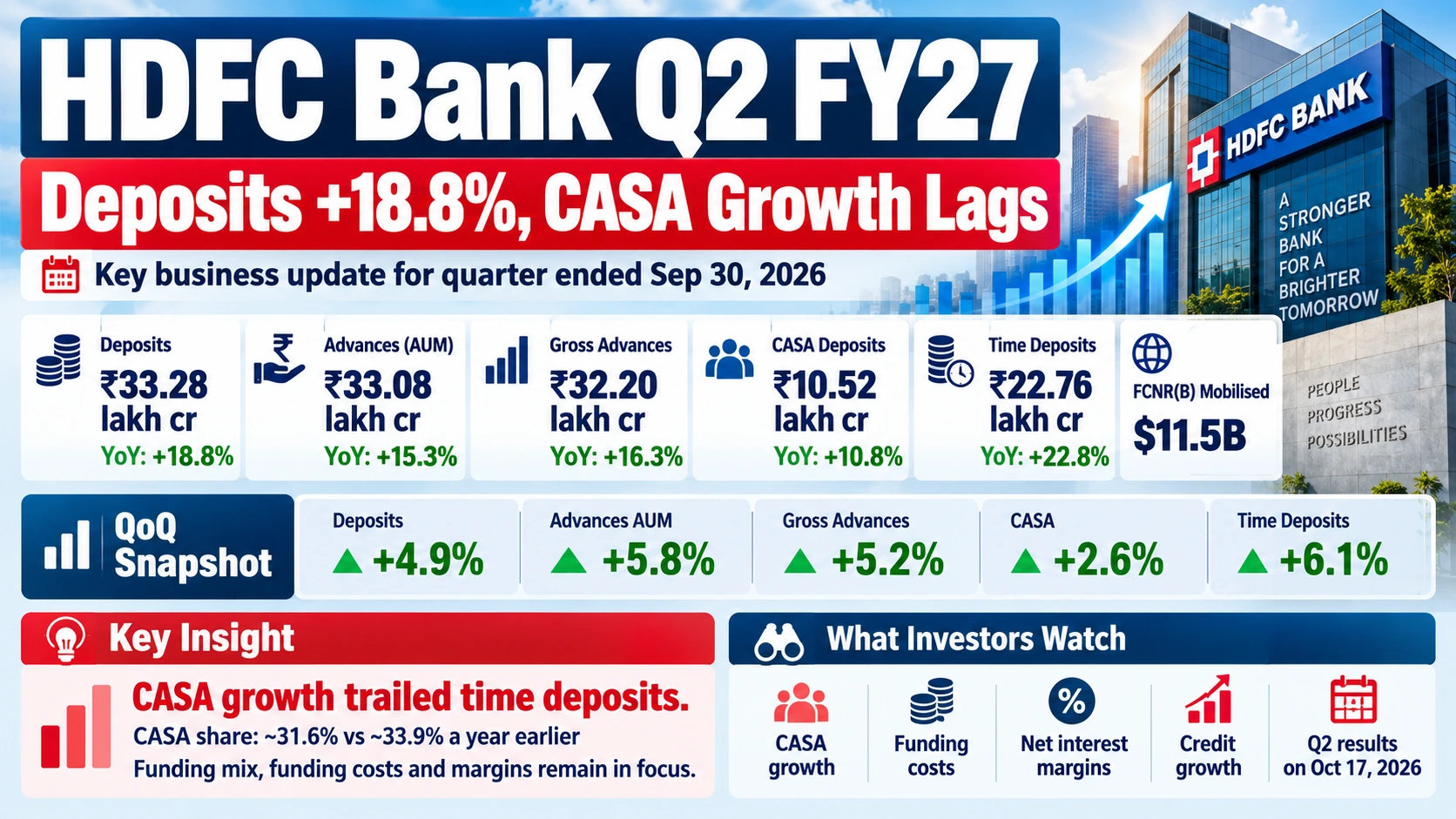
The bank’s provisional business update for the quarter ended September 30 showed period-end deposits of approximately ₹33.28 lakh crore, up 18.8% year on year. Period-end advances under management rose 15.3% to about ₹33.08 lakh crore, while gross advances increased 16.3% to about ₹32.20 lakh crore.
That means deposits grew faster than advances on a year-on-year basis. But the more important detail for investors is where the deposit growth came from.
Track Live: HDFC Bank (HDFCBANK) Option Chain — Live Strike Data, OI & Greeks
Need to Know
- Period-end deposits rose 18.8% YoY to approximately ₹33.28 lakh crore.
- Advances under management increased 15.3% YoY to about ₹33.08 lakh crore.
- Gross advances grew 16.3% YoY to about ₹32.20 lakh crore.
- Period-end CASA deposits rose 10.8% to about ₹10.52 lakh crore.
- Period-end time deposits rose 22.8% to about ₹22.76 lakh crore.
- Sequentially, advances under management increased about 5.8%, compared with roughly 4.9% growth in deposits.
- HDFC Bank mobilised $11.5 billion of foreign-currency deposits under the RBI’s FCNR(B) swap facility.
- The September-quarter figures are provisional and subject to limited review by the bank’s statutory auditors.
HDFC Bank’s 18.8% Deposit Growth Is Strong. The Mix Is the Bigger Story.
HDFC Bank’s 18.8% deposit growth is clearly ahead of its 15.3% growth in advances under management. But the composition of that growth deserves closer attention.
HDFC Bank Q2 FY27 Key Numbers
| Metric | Sep 2026 | YoY | QoQ |
|---|---|---|---|
| Deposits | ₹33.28 lakh cr | +18.8% | +4.9% |
| CASA | ₹10.52 lakh cr | +10.8% | +2.6% |
| Time deposits | ₹22.76 lakh cr | +22.8% | +6.1% |
| Advances under management | ₹33.08 lakh cr | +15.3% | +5.8% |
| Gross advances | ₹32.20 lakh cr | +16.3% | +5.2% |
At September-end, the bank had approximately ₹22.76 lakh crore in time deposits, compared with ₹10.52 lakh crore in CASA deposits.
Based on the reported period-end figures, CASA represented roughly 31.6% of total deposits, down from about 33.9% a year earlier.
So while the deposit franchise is expanding rapidly, low-cost deposits are not keeping pace with total deposits.
That creates the key market question around the Q2 update: can HDFC Bank sustain strong balance-sheet growth while improving the mix and cost of its funding base?
A weaker CASA mix does not automatically mean margins will fall. Loan yields, funding costs, asset mix, liquidity deployment and interest-rate conditions will also determine the eventual effect on net interest margins.
The Sequential Numbers Tell a Different Story
The year-on-year comparison is favourable for deposits, but the quarter-on-quarter picture is more balanced.
HDFC Bank’s period-end advances under management rose from ₹31.27 lakh crore at June-end to ₹33.08 lakh crore at September-end, an increase of about 5.8%.
Total deposits rose from ₹31.71 lakh crore to ₹33.28 lakh crore, or roughly 4.9% over the same period.
Gross advances increased about 5.2% sequentially.
This is important because it shows that loan growth has remained strong even as the bank has continued to build its deposit base.
At the same time, CASA grew only about 2.6% sequentially, while time deposits increased about 6.1%.
Period-end deposits now slightly exceed advances under management, although the latest sequential data still shows advances growing faster than deposits.
Average Numbers Add More Context
The quarter-average figures provide another useful lens.
HDFC Bank reported average deposits of ₹31,665 billion, up about 16.8% year on year, while average advances under management stood at ₹31,872 billion, up about 14%.
That means average deposits were about ₹20,700 crore below average advances under management during the quarter.
This should not be described as a standalone “funding shortfall” because banks have multiple sources of funding beyond deposits. However, it does show why the quarter-end crossover between deposits and advances should not be read as the entire funding story.
The bank ended September with period-end deposits marginally above period-end advances under management, but the quarter-average numbers remained much closer.
Also check: HDFC BANK Options Chart | Nifty Trader
CASA Growth Is the Number to Watch
The sharpest divergence in HDFC Bank’s September update is between CASA and time deposits.
Period-end CASA deposits increased 10.8% year on year, compared with 22.8% growth in time deposits.
The same pattern appears in the quarterly averages: average CASA rose 10.7%, while average time deposits increased 19.7%.
That matters because the bank is not merely growing deposits; it is growing different categories of deposits at very different speeds.
For investors, the next question is therefore less about whether HDFC Bank can grow deposits and more about whether CASA growth can begin catching up.
That will help determine how comfortably the bank can support credit growth while managing funding costs.
What the $11.5 Billion FCNR Mobilisation Means
HDFC Bank also disclosed that it mobilised $11.5 billion of foreign-currency deposits under the RBI’s FCNR(B) swap facility introduced on June 8, 2026. The facility was available for deposits mobilised through August 31.
The bank said its overseas branches extended $5.7 billion in loan facilities against these deposits. It also disclosed $3.1 billion of standby letters of credit issued to other banks in respect of loans against these deposits.
Separately, HDFC Bank said it issued $2.5 billion of US dollar-denominated senior unsecured bonds during June-August 2026.
The FCNR mobilisation is significant for the bank’s foreign-currency funding position, but it should not be treated as a permanent replacement for domestic CASA growth.
The RBI window itself was time-bound, and the economics of the funding will ultimately depend on deployment and asset returns rather than the headline amount raised alone.
That creates some uncertainty around how much of the improvement in the funding position will translate into a durable earnings benefit.
The Next Test Comes With the Formal Q2 Results
HDFC Bank’s September business update is not its final quarterly earnings statement.
The bank has said the September 30 figures are subject to a limited statutory review, while its official board calendar shows a meeting on October 17, 2026 to consider and approve the financial results for the quarter and half-year ended September 30.
That makes the formal results particularly important for investors.
The market will be looking for the actual net interest margin, cost of funds, loan mix, asset quality, profitability and management commentary before drawing stronger conclusions from the business update.
Anup Bagchi Adds a Second Catalyst
The operating update also arrives just days after HDFC Bank appointed Anup Bagchi as its next MD & CEO.
Bagchi will take charge on October 27, 2026, succeeding Sashidhar Jagdishan. Reuters reported that this is the first time HDFC Bank has selected an external candidate for the top job.
That leadership transition gives investors another reason to watch the upcoming earnings cycle, particularly for management commentary on deposit mobilisation, credit growth and profitability.
However, it is too early to assume that the leadership change itself will produce an immediate financial improvement.
What HDFC Bank Investors Should Watch Next
CASA growth: Can low-cost deposits accelerate from the current 10.8% year-on-year pace?
Deposit mix: Can time-deposit growth moderate as CASA participation improves?
Credit growth: Can the bank maintain strong sequential loan growth without a renewed funding-cost squeeze?
Margins: Does the changing deposit mix affect net interest margins once the full Q2 accounts are released?
FCNR deployment: How efficiently will the foreign-currency deposits translate into earning assets?
Q2 earnings: What do the formal financial results on October 17 reveal about profitability and funding costs?
HDFC Bank Q2 FY27: What the Update Really Says
HDFC Bank’s September-quarter business update is positive on the headline numbers: deposits rose 18.8%, advances under management increased 15.3%, and gross advances grew 16.3% year on year.
But the more useful investor insight is in the mix.
Time deposits grew 22.8%, more than twice the 10.8% growth in CASA deposits. The CASA share consequently fell to about 31.6%, from roughly 33.9% a year earlier.
At the same time, advances grew slightly faster than deposits on a sequential basis.
So the September update strengthens HDFC Bank’s balance-sheet growth story, but it does not remove the key question around funding mix, funding costs and future margin performance.
The next phase of the story will depend less on the 18.8% deposit headline and more on whether HDFC Bank can convert that growth into a more durable, lower-cost funding base while sustaining credit growth.
Read Next: Stocks to Watch Today, October 5: HDFC Bank, Bajaj Finance, TCS, DLF and 4 IPO Listings
FAQ
What were HDFC Bank’s Q2 deposits?
HDFC Bank reported period-end deposits of approximately ₹33.28 lakh crore as of September 30, 2026, up 18.8% year on year.
How much did HDFC Bank’s loans grow in Q2?
Period-end advances under management increased 15.3% year on year to about ₹33.08 lakh crore, while gross advances rose 16.3% to about ₹32.20 lakh crore.
What happened to CASA deposits?
Period-end CASA deposits increased 10.8% year on year to approximately ₹10.52 lakh crore, slower than the 22.8% growth in time deposits.
Why is the deposit mix important?
The latest figures show time deposits growing much faster than CASA. That makes the funding mix an important variable for investors to monitor alongside the bank’s eventual funding costs and net interest margin.
Is this HDFC Bank’s final Q2 result?
No. The September 30 business figures are provisional and subject to limited statutory review. HDFC Bank’s board is scheduled to consider the quarter and half-year financial results on October 17, 2026.
Disclaimer
This article is based on HDFC Bank’s provisional September 30, 2026 business update and other cited public information. The figures are subject to statutory review, and this article is for informational purposes only and not investment advice.