RBI Governor Answers: India’s Payments Are Fast and Cheap, So What’s Left?
India’s cautious stance on cryptocurrencies is not simply about the technology itself. RBI Governor Sanjay Malhotra says the central bank’s concerns go deeper, particularly when it comes to monetary policy and the idea of maintaining a “singleness of money”.
Speaking at the Kautilya Economic Conclave in New Delhi on October 3, Malhotra explained why the Reserve Bank of India continues to take a careful approach to crypto while looking at central bank digital currencies and other payment innovations as possible solutions to existing gaps.
Track Live : NSE F&O Lot Size | FII DII Data Today
RBI sees cross-border payments as the bigger challenge
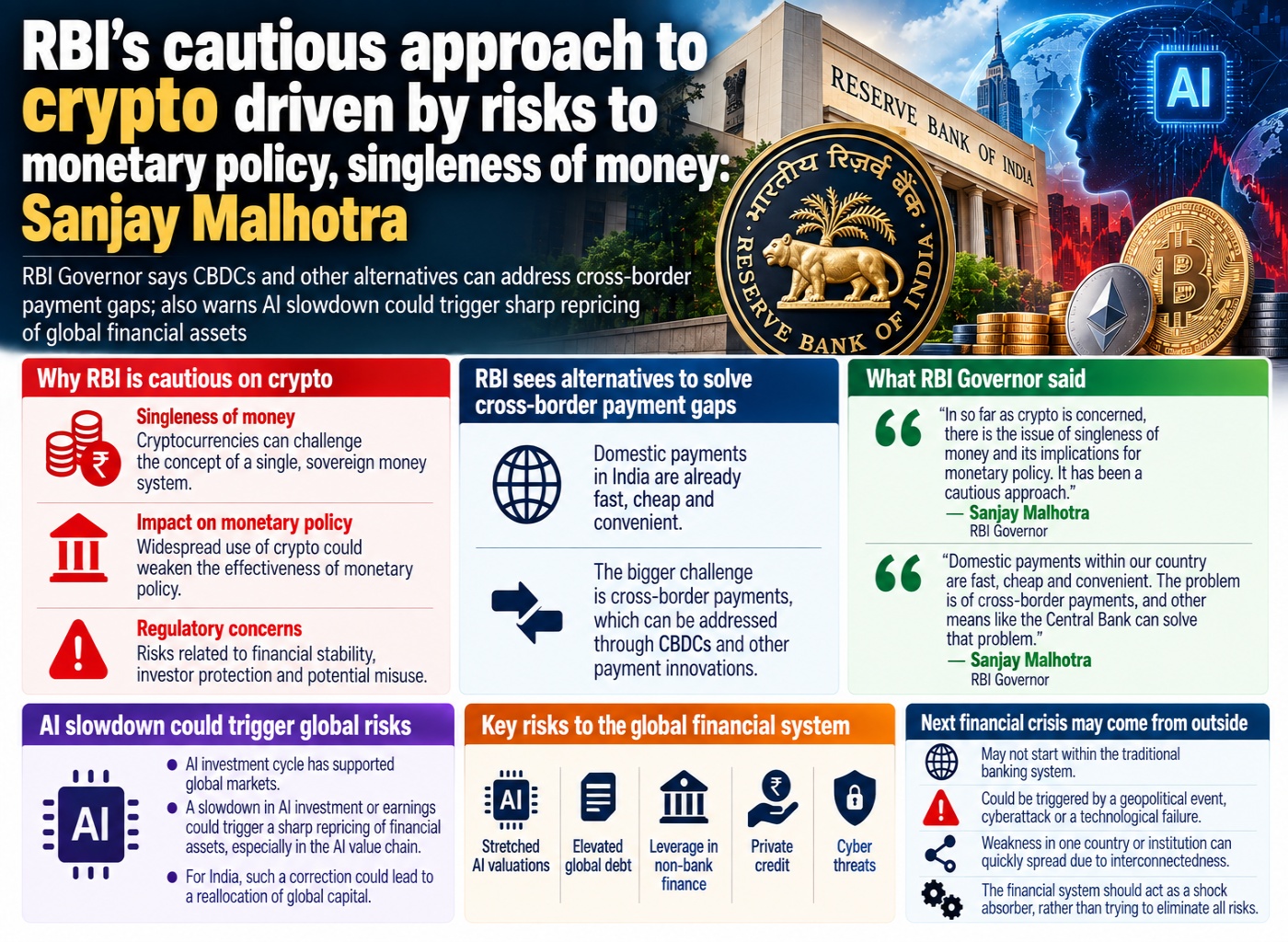
While India’s domestic payment infrastructure has developed rapidly, Malhotra said the bigger problem now lies in cross-border payments.
“Domestic payments within our country are fast, cheap and convenient. The problem is of cross-border payments, and other means like the Central Bank can solve that problem,” the RBI Governor said.
This is where CBDCs, or central bank digital currencies, could become important.
Rather than relying on privately issued cryptocurrencies, the RBI’s approach points towards regulated digital payment systems that could potentially make international transactions faster and more efficient.
Jean-Claude Trichet raises concerns over crypto growth
Former European Central Bank president Jean-Claude Trichet, who also spoke at the conclave, took a more direct view of the global expansion of cryptocurrencies.
“We let crypto gallop, which is hampering global finance,” Trichet said.
His comments add to the broader debate over how rapidly digital assets should be allowed to develop and what safeguards may be needed as their role in financial markets expands.
Track Live : Opening Price Clues – What Pre-Market Data Says Today
AI valuations become another financial stability concern
Crypto was not the only technology-related risk highlighted at the event.
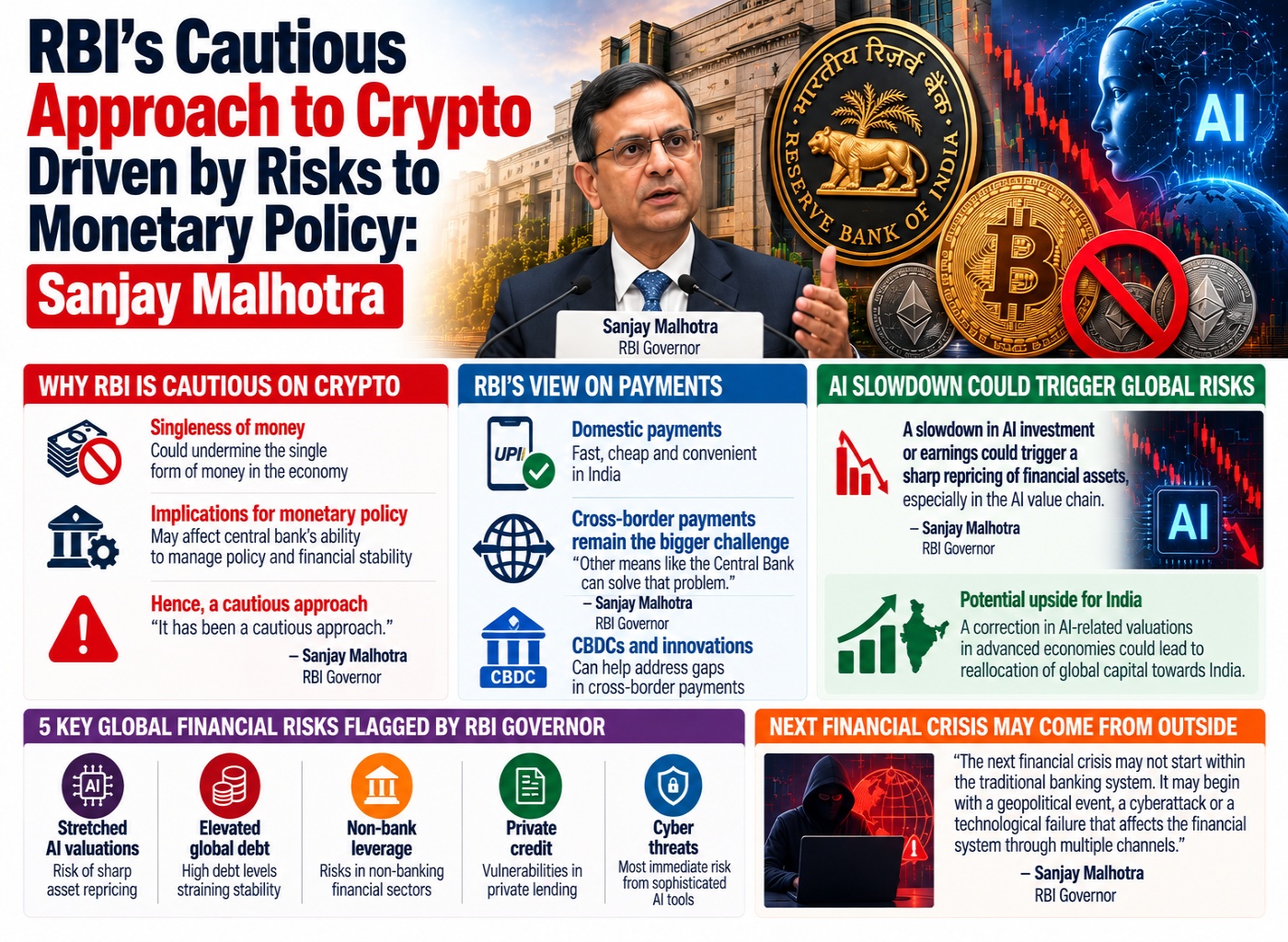
Malhotra also warned that a slowdown in the AI investment cycle or weaker-than-expected earnings could lead to a sharp repricing of financial assets, particularly companies linked to the AI ecosystem.
“The AI investment cycle has been a major support for global markets,” Malhotra said.
He warned that weaker investment or earnings could “trigger a sharp repricing of financial assets, especially in the AI value chain”.
For India, however, such a correction could have a different effect. Malhotra said a decline in AI-related valuations in advanced economies could potentially encourage a reallocation of global capital towards India.
Indian equities have already corrected from elevated valuations in recent months, although the RBI Governor said the adjustment has remained orderly.
Read More : Fed Rate Hike Bets Fall to 30%: Will September Jobs Data Change the Picture?
Crypto vs CBDC: What Investors Should Understand
The distinction between cryptocurrencies and central bank digital currencies (CBDCs) is central to understanding RBI Governor Sanjay Malhotra’s comments. The RBI is not rejecting the technology behind digital assets; it is maintaining a cautious position on cryptocurrencies while supporting technologies such as distributed ledger technology and tokenisation.
| Feature | Cryptocurrency | CBDC |
|---|---|---|
| Issuer | Typically privately issued or decentralised; structure varies by asset | Issued by a central bank |
| Monetary framework | Not issued as part of a central bank’s sovereign-money system | Forms part of the central bank’s monetary system |
| RBI’s key concern | Monetary sovereignty, monetary policy, capital flows and the “singleness of money” | Maintaining monetary-system integrity while improving payment efficiency |
| Cross-border potential | Potentially significant, but regulatory and monetary issues remain | RBI sees CBDCs as a potential tool for improving cross-border payments |
| Technology | Some cryptocurrencies use blockchain/DLT; others use different architectures | Can use DLT, tokenisation and other digital technologies |
| Role in India’s payments system | RBI maintains a cautious approach | RBI has been developing and testing the digital rupee |
Why the distinction matters
Cryptocurrency is an asset/payment technology outside direct central-bank issuance, whereas a CBDC represents digital central-bank money. That difference is particularly important for monetary policy and monetary sovereignty.
Malhotra said the RBI’s concern with crypto includes the “singleness of money” and its implications for monetary policy, particularly in emerging economies where capital-flow restrictions can matter.
CBDC addresses a different problem
According to Malhotra, India’s domestic payments infrastructure is already relatively fast, inexpensive and convenient. The larger unresolved challenge is cross-border payments.
He said CBDCs and other alternatives could potentially help address those cross-border payment problems without relying on privately issued cryptocurrencies as the solution.
The technology itself is not the problem
This is an important distinction for investors.
The RBI supports innovation in distributed ledgers and tokenisation, including applications within the central bank and through public-private partnerships. Its cautious approach is directed at cryptocurrencies and their potential monetary and financial implications, rather than a blanket rejection of the underlying technology.
Interconnected Tech Threats & The Next Crisis
RBI Governor Sanjay Malhotra warned that the next financial crisis may not begin in a bank. It could instead start with a geopolitical event, cyberattack or technological failure and spread through interconnected financial systems.
- Cyber risk: Increasingly sophisticated AI tools could amplify cybersecurity threats.
- Contagion: A technology or cyber failure in one country or institution could spread across borders.
- System-wide resilience: Regulators need to monitor banks, NBFCs, markets, payment systems and critical technology infrastructure together.
Key Details to Highlight
1. Why the RBI remains cautious on crypto
RBI Governor Sanjay Malhotra said crypto raises concerns around monetary policy, monetary sovereignty, capital flows and the “singleness of money.”
2. RBI supports the underlying technology
The RBI’s caution toward crypto does not mean rejecting distributed-ledger technology or tokenisation. Malhotra said these technologies can be used by the central bank and through public-private partnerships.
3. Cross-border payments are the bigger challenge
India’s domestic payments are already fast, cheap and convenient. Malhotra said the larger problem is cross-border payments, where CBDCs and other alternatives could offer solutions.
4. Jean-Claude Trichet’s warning
Former ECB president Jean-Claude Trichet took a stronger view, saying the global expansion of crypto was hampering global finance. This was Trichet’s assessment, not an RBI finding.
5. AI is another financial-stability risk
Malhotra warned that a slowdown in AI investment or weaker earnings could trigger sharp repricing of financial assets, particularly across the AI value chain. A correction in advanced economies could potentially redirect some capital toward India, but this is not automatic.
6. Cyber risk is an immediate concern
Malhotra identified cyber risk linked to increasingly sophisticated AI tools as a major concern. He warned that a future financial crisis could originate with a geopolitical event, cyberattack or technological failure and spread through interconnected financial systems.