
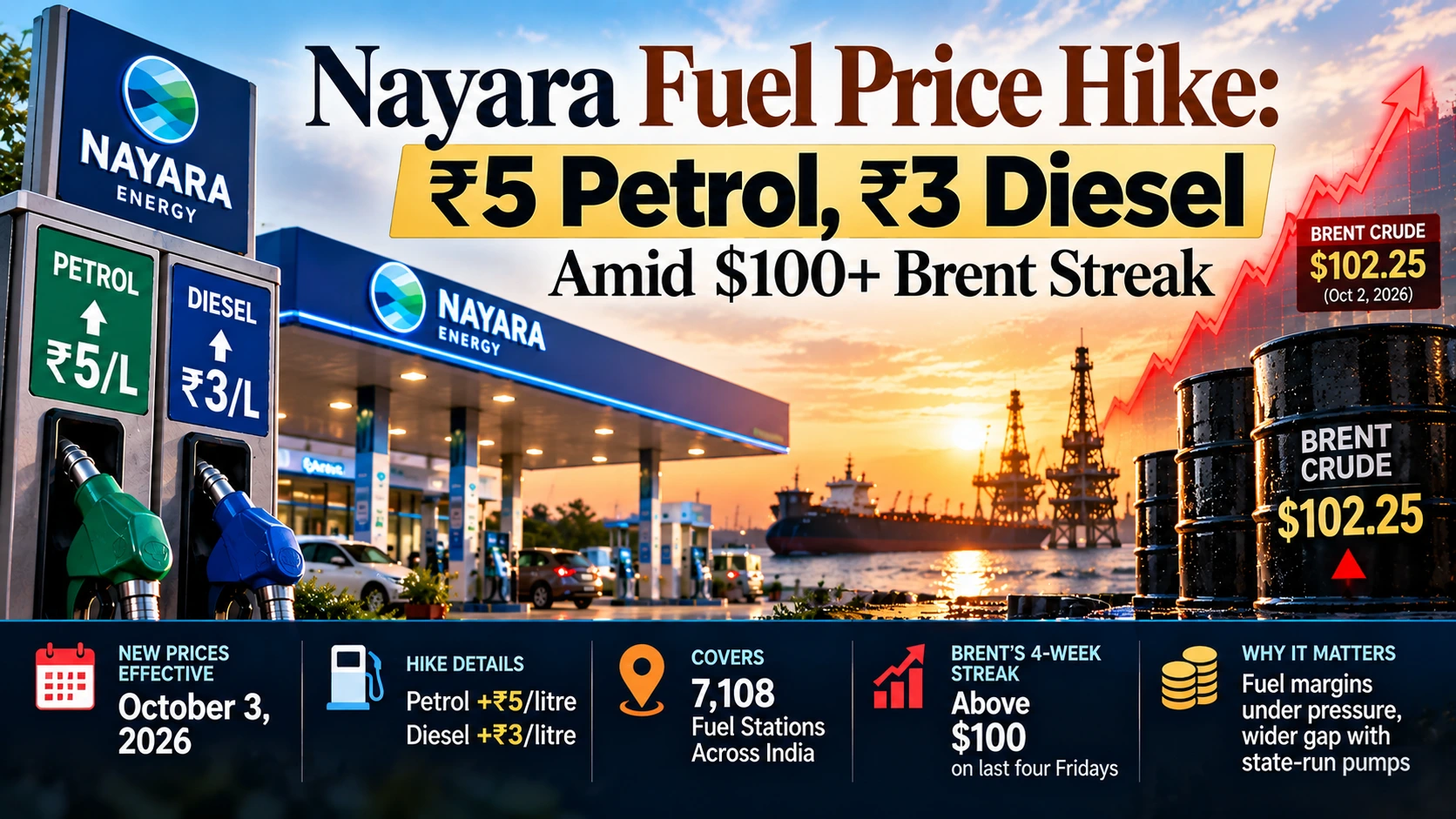
Nayara Energy fuel price hike: Nayara Energy has raised petrol prices by ₹5 per litre and diesel by ₹3 from October 3 across its 7,108 fuel stations, potentially widening the gap with state-run pumps whose retail prices have not been revised since May.
Nayara Energy has increased petrol prices by ₹5 a litre and diesel prices by ₹3 from the early hours of Saturday, according to people familiar with the matter. Nayara had not responded to an email seeking comment.
The move comes as Brent crude settled at $102.25 a barrel on October 2, and as retail diesel has become as much as ₹40 a litre cheaper than bulk diesel. That gap is pulling industrial buyers to petrol pumps and has prompted purchase limits at private outlets.
Need to Know
- Nayara has raised petrol by ₹5/litre and diesel by ₹3/litre from October 3, 2026, across 7,108 stations. The effective rise differs by state because of local taxes.
- It repeats the March 26 increase, which Nayara reversed on July 1.
- State-run pump prices have not changed since May, and Jio-bp has not revised its prices.
- Brent has settled above $100 on each of the last four Fridays.
- Retail diesel is as much as ₹40 a litre cheaper than bulk diesel, and Jio-bp and Nayara have capped diesel purchases at some pumps.
- Watch next: Jio-bp, state-run pricing and the G7 reserve release.
Track Live: Nifty Energy Sector — Live Performance, Stocks
Why Nayara Energy Raised Petrol and Diesel Prices
Nayara raised petrol by ₹5 and diesel by ₹3 on March 26 after the Iran conflict spiked international oil prices. It reversed the increase on July 1 as tensions in West Asia eased and the Strait of Hormuz reopened. The October increase restores those higher pump prices after about three months of lower rates.
After its July cut, Nayara’s Mumbai petrol and diesel rates were close to those at state-owned pumps. The new increase reopens a ₹5 petrol and ₹3 diesel gap in markets where the two had matched. With state-run pumps holding prices, motorists may shift to them, which is a volume risk for Nayara.
Brent’s Four-Friday $100+ Streak
Brent settled at $104.61 on September 11, $103.87 on September 18, $104.32 on September 25 and $102.25 on October 2. Industry sources told Moneycontrol in early September that crude staying above $100 for several weeks could force a rethink of retail prices.
ICRA’s Prashant Vasisht said earlier this month that OMCs should broadly break even on diesel from their own refineries with crude at $85-$90 a barrel. International fuel costs have moved sharply above that range while domestic retail prices have been slower to respond.
The ₹40 Diesel Gap
PTI reported on September 29 that retail diesel is as much as ₹40 a litre cheaper than diesel sold to bulk consumers. Factories, telecom firms, hotels, hospitals and data centres have been shifting purchases to petrol pumps. Some industrial users were buying 400-600 litres at a time.
According to people aware of the matter, Jio-bp capped diesel at 50 litres per customer per day, while limits at Nayara outlets ranged from 70 to 200 litres. Jio-bp attributed its limits to prevailing demand conditions. Against a gap of up to ₹40 a litre, a ₹3 diesel increase is small.
Government Pushback
On October 1, Oil Secretary Neeraj Mittal said the government would ask private retailers to stop rationing fuel sales and that nobody is allowed to cap sales. Reuters reported that Reliance Industries and Nayara had restricted diesel and gasoline sales to limit losses from selling below market-linked levels.
Nayara said on September 29 that it continues to maintain fuel supplies across its dealer network. State-run companies control more than 90% of India’s 1,04,137 fuel outlets, so they are the main alternative for customers affected by private-sector limits.
OMC Margin Pressure
ICRA estimated marketing margins of state-run IOC, BPCL and HPCL at negative ₹8 per litre on petrol and negative ₹9 on diesel in September. It put their daily loss at ₹530 crore across petrol, diesel and LPG. The Indian crude basket stood at $117.4 a barrel on September 21, against a 2025-26 average of about $66.
State-run retailers raised petrol and diesel prices in several steps in May, adding about ₹7.50 per litre by late May. They have not revised prices since. Jio-bp, which operates 2,304 petrol pumps, has also kept prices unchanged.
The ₹50 Diesel Loss Figure
Reuters separately quoted company officials as saying state-run retailers lose about ₹50 a litre on diesel. That is far above ICRA’s ₹9. Reuters did not give the basis for the officials’ figure. ICRA noted that for domestic supplies, the special additional excise duty is adjusted in the refinery transfer price, which lowers the effective product cost for OMC marketing divisions. Because the bases differ or are not stated, the two figures cannot be compared directly.
What This Means for Consumers and the Economy
Motorists at Nayara outlets pay more for petrol and diesel from October 3. Actual pump prices still differ by state because of local taxes and levies.
The wider impact depends on whether the move stays limited to Nayara. A broader rise in diesel prices could lift costs for road transport, logistics, construction and agriculture. Higher petrol prices would raise household mobility costs.
For retailers, holding prices below market-linked costs for long keeps margins under pressure and increases the incentive to cut exposure to retail sales.
What to Watch Next
- Whether Jio-bp and state-run retailers revise prices or keep them frozen.
- Whether Brent keeps settling above $100.
- Whether the retail-bulk diesel gap persists and whether purchase caps are lifted after the government’s October 1 direction.
- The G7 reserve release. The G7 agreed on October 2 to implement a coordinated release of 100 million barrels through the IEA, beginning immediately and running over four months, with a substantial diesel release front-loaded within the first 20 days. The statement says the figure takes into account commitments already fulfilled under the March IEA pledge, and G7 members will meet again in the coming days to discuss additional diesel releases if needed. The impact on prices will depend on how quickly those barrels reach the market.
If global oil and refined-product prices stay high, pressure for further retail adjustments could intensify. If they ease materially, the current tension could reduce.
Bottom Line
Nayara’s ₹5 petrol and ₹3 diesel increase puts the spotlight on the gap between international fuel costs and domestic pump prices. With Brent settling above $100 on four straight Fridays and a retail-bulk diesel gap of up to ₹40 a litre straining supplies, the risk is that prolonged high crude forces broader retail price changes across India.
Read Next: Bajaj Finance QIP: Fundraise Mix Changes as QIP Grows 33%, Warrants Jump 4.8x
FAQ
What is the Nayara Energy fuel price hike from October 3, 2026?
Nayara Energy has increased petrol prices by ₹5 per litre and diesel prices by ₹3 per litre with effect from October 3, 2026.
How many Nayara fuel stations are affected?
The revised prices apply across Nayara’s 7,108 fuel stations in India.
Did Nayara raise fuel prices earlier this year?
Yes. Nayara raised petrol by ₹5 and diesel by ₹3 on March 26, then reversed those increases on July 1 after international crude prices eased.
Why are some petrol pumps limiting diesel sales?
Retail diesel is as much as ₹40 a litre cheaper than bulk diesel, according to PTI. That has pushed industrial buyers to petrol pumps and strained station stocks. The government has said retailers cannot cap sales.
Will other fuel retailers raise petrol and diesel prices?
That remains uncertain. Jio-bp had not revised prices as of October 3, and state-run retail prices have been unchanged since May.
Disclaimer: Fuel prices vary across states because of taxes and other local levies. Margin and loss estimates cited above are third-party estimates, differ from one another, and can change with crude, product and retail-price movements. This article is for informational purposes only and is not investment advice.