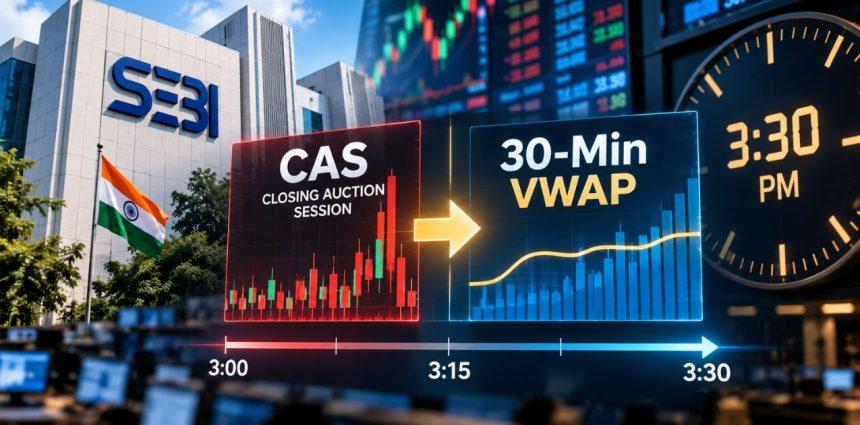
SEBI CAS Update: The regulator may stop using the Closing Auction Session for derivatives settlement for at least a year and return to the final 30-minute VWAP while retaining CAS for less-liquid cash-market stocks, according to a Reuters report.
UPDATED OCTOBER 5, 2026: SEBI may be preparing to separate the mechanism used to determine an underlying stock’s closing price from the methodology used to settle its derivatives after sharp expiry-day swings triggered a review of the new Closing Auction Session.
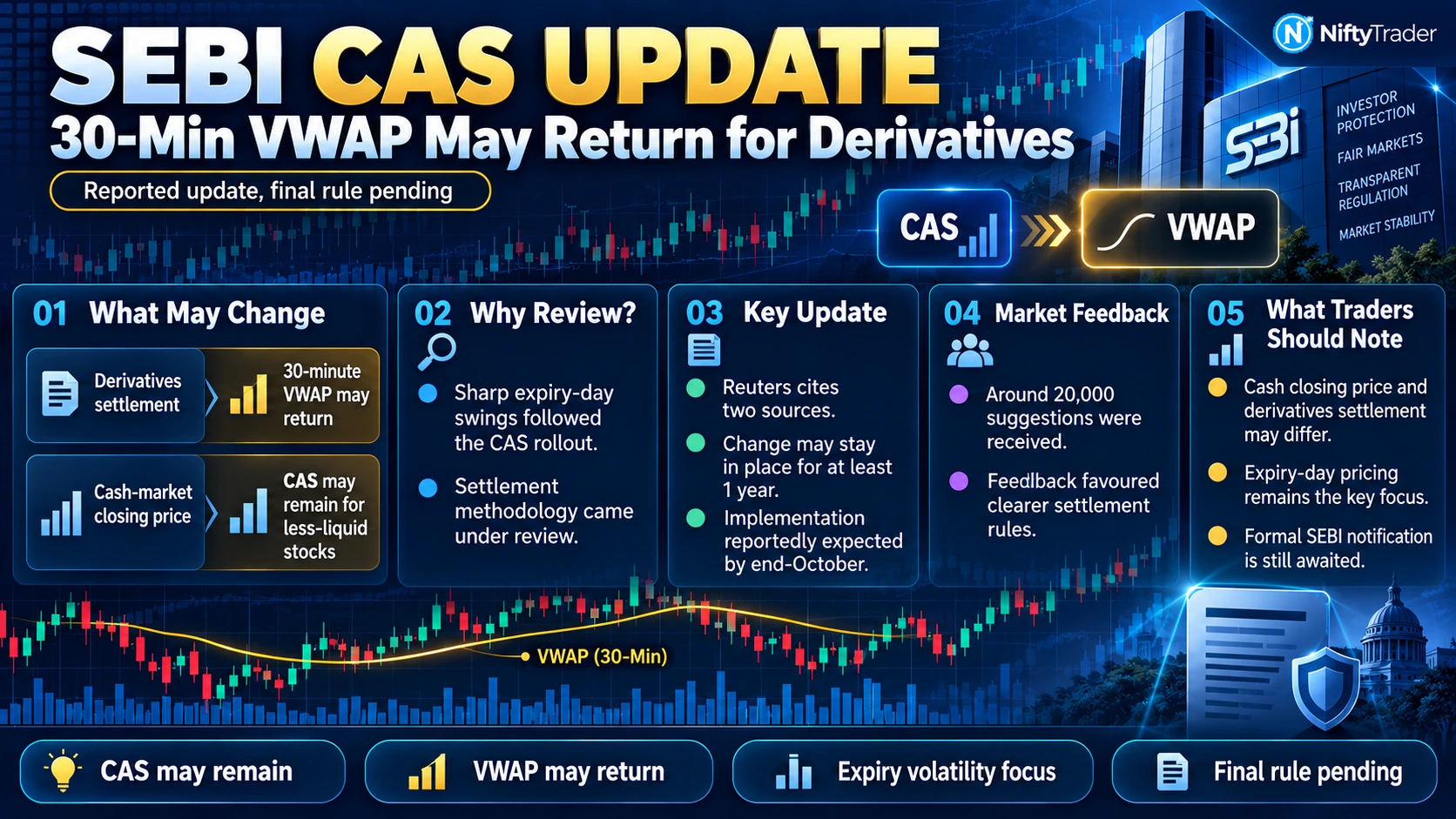
According to a Reuters report citing two sources familiar with the matter, the Securities and Exchange Board of India (SEBI) is likely to stop using CAS to calculate derivative settlement prices for at least a year. Instead, derivatives could return to the volume-weighted average price (VWAP) of the final 30 minutes of trading.
At the same time, CAS is expected to remain for underlying stocks in the less-liquid cash market. Reuters reported that SEBI is expected to implement the reported changes by the end of October.
The development is therefore more limited than a complete reversal of CAS. The regulator could retain the auction for cash-market closing-price discovery while using a different reference methodology for futures and options settlement.
That distinction could matter most on expiry days, when the final settlement reference can directly affect open derivatives positions.
What Changed Since SEBI’s September Consultation?
The October 5 development is different from the consultation-stage debate covered in NiftyTrader’s earlier SEBI CAS review.
| September 2026 consultation | October 5 reported direction |
|---|---|
| SEBI sought views on multiple settlement approaches | Sources say the final 30-minute VWAP route is now favoured |
| CAS-related settlement methodology was under review | CAS may be excluded from derivative settlement for at least a year |
| Different market-timing options were discussed | Feedback reportedly favours 3:30 p.m. cash and 3:45 p.m. derivatives trading |
| Publication of indicative index values was under review | Feedback reportedly favours retaining transparency, with greater investor awareness |
The key change is that the market has moved from “What should SEBI change?” to “Which approach is SEBI now likely to adopt?”
That makes the latest development more consequential for traders than the original consultation announcement.
Why Is SEBI Rethinking CAS?
SEBI’s Closing Auction Session framework was notified through its January 16, 2026, circular, with the CAS framework becoming effective from August 3, 2026.
Under CAS, eligible stocks move from continuous trading into a dedicated closing auction process. The mechanism was designed to improve closing-price discovery by bringing buy and sell interest together near the end of the trading session.
NSE currently shows CAS operating from 3:15 p.m. to 3:35 p.m. for eligible stocks, while non-CAS securities continue continuous trading until 3:30 p.m. Equity derivatives currently trade until 3:40 p.m..
The new mechanism was intended to bring Indian closing-price practices closer to major global markets. But Reuters reported that it was followed by sharp swings in derivatives prices on expiry days, prompting SEBI to review the settlement methodology.
SEBI formally put derivative settlement methodology under review in September following the CAS rollout.
The Big Change: 30-Minute VWAP May Return
Under the reported plan, derivatives could move away from CAS-based settlement and instead use the VWAP of the final 30 minutes of trading for at least a year.
VWAP stands for volume-weighted average price. Unlike a single auction outcome, it reflects trading across a defined period and gives greater weight to transactions executed at higher volumes.
That creates an important difference for expiry-day traders.
A closing auction concentrates price discovery into a relatively short process. A 30-minute VWAP spreads the settlement calculation across a broader trading window.
This could reduce the influence of a sharp move during the closing auction on the price used to settle derivatives.
It does not mean VWAP will eliminate volatility or manipulation risk. The eventual impact will depend on liquidity, trading behaviour and the precise methodology SEBI ultimately adopts.
SEBI Is Not Scrapping CAS
The latest report should not be interpreted as SEBI abandoning the Closing Auction Session altogether.
According to Reuters, CAS is expected to continue for underlying stocks in the less-liquid cash market, even if derivatives stop using the auction directly for settlement.
That means the emerging structure could give CAS and VWAP separate roles:
| Market function | Reported direction |
|---|---|
| Closing price for less-liquid underlying stocks | CAS likely retained |
| Derivative settlement price | 30-minute VWAP may return |
| Regular cash-market trading timetable | Future change reportedly favours 3:30 p.m. |
| Derivatives trading timetable | Future change reportedly favours 3:45 p.m. |
The last two timings need an important qualification.
These are not the current NSE timings for CAS-eligible stocks and equity derivatives. NSE currently shows CAS from 3:15 p.m. to 3:35 p.m. and equity derivatives until 3:40 p.m. The 3:30 p.m. cash-market and 3:45 p.m. derivatives timetable is the timetable Reuters says received favourable market feedback and may form part of the revised framework.
Why the CAS-VWAP Split Matters on Expiry Days
The central issue is not simply how a stock finishes the day.
It is which price becomes the reference for derivative settlement.
On expiry days, futures and options positions can be particularly sensitive to the settlement price because positions are being brought to their final valuation.
Under a CAS-based approach, price discovery is concentrated in the auction process. Under a 30-minute VWAP approach, the settlement reference would incorporate trading activity across the final half-hour of continuous trading.
That creates a potentially different relationship between the stock’s closing price and the derivative settlement price.
For traders, this means the phrase “closing price” may no longer tell the whole story. Once the revised framework is formally announced, traders will need to know whether they are looking at the stock’s CAS-derived close or the separate derivative settlement reference.
Around 20,000 Suggestions Fuelled the Review
SEBI said it had received 20,000 suggestions in response to the consultation, according to Reuters.
The scale of the feedback is important because the CAS framework had only recently become operational when the regulator began considering adjustments.
It also highlights the expectation gap surrounding the new system.
CAS was introduced to strengthen closing-price discovery and align India more closely with established international practices. Within weeks, however, the settlement implications for derivatives became the focus of a fresh review.
The latest reported direction suggests SEBI may retain the broader CAS framework while changing one of its most market-sensitive applications.
Index Transparency Is the Other CAS Debate
Derivative settlement is not the only issue under review.
SEBI had also considered stopping publication of the indicative value of an index during the 10-minute CAS window, while continuing to publish indicative prices of individual stocks.
The argument was that the index value would still be changing during the auction and could be mistaken for a final value.
Reuters reported that most feedback favoured retaining the information because sophisticated trading desks could reconstruct the index value independently. Removing the published figure could therefore reduce transparency without necessarily solving the underlying concern.
The regulator is reportedly inclined to retain the information while increasing investor awareness that the index price is only determined at the end of the CAS window.
This leaves SEBI balancing two objectives: providing enough information for market participants while avoiding confusion between an indicative number and a final market value.
What Could Change for F&O Traders?
The immediate potential change is the reference price used for derivative settlement.
Traders who have adjusted to the new CAS framework may need to reassess strategies around expiry once the revised methodology is formally notified.
The final 30 minutes of continuous trading could become more important because transactions during that period would feed into the derivative settlement calculation.
At the same time, the underlying stock could still have a CAS-derived closing price.
That means traders may need to monitor two related but distinct numbers:
the stock’s closing price and the derivative settlement reference.
The difference may become especially relevant when the underlying moves sharply near the end of the session.
Track Live: NiftyTrader: Live Options Analytics & F&O Trading Tools
What Happens to the Current CAS Framework?
For now, there is an important distinction between a reported regulatory plan and a formally notified rule.
Reuters reported that SEBI is expected to implement the changes by the end of October. However, the final methodology, transition provisions and exact applicability still depend on SEBI’s formal regulatory action.
That uncertainty should remain central to the story.
The regulator has officially documented the CAS framework and its September consultation, but the October 5 change reported by Reuters is not itself a final SEBI circular.
Traders should therefore avoid assuming that the reported 30-minute VWAP methodology is already binding.
What Traders Should Watch Next
The next formal SEBI communication will be the most important development.
Market participants should watch for confirmation of the 30-minute VWAP methodology, the duration of any temporary arrangement, the contracts covered by the change and the final treatment of CAS for the underlying cash market.
The future timetable will also need to be watched closely because the reported 3:30 p.m. and 3:45 p.m. schedule is not the current NSE timetable.
The broader picture is becoming clearer, however.
SEBI does not appear to be simply abandoning CAS. Instead, it may be moving toward a split model in which CAS remains part of cash-market price discovery while derivatives use a broader VWAP-based settlement reference.
For expiry-day traders, that distinction could matter more than the headline “partial reversal” itself.
Need to Know
🔹 30-minute VWAP: Derivatives may return to the VWAP of the final 30 minutes of trading for at least a year.
🔹 CAS remains: The closing auction is expected to continue for underlying stocks in the less-liquid cash market.
🔹 Expiry volatility: Sharp derivatives swings after the CAS rollout triggered the settlement-methodology review.
🔹 Future timetable: Reuters reports that feedback favours 3:30 p.m. cash-market and 3:45 p.m. derivatives trading, but these are not the current CAS timings.
🔹 Final rule pending: The reported changes still require formal SEBI action.
What This Means for Traders
The latest SEBI move is better understood as a recalibration of CAS rather than a complete rollback.
The regulator may retain the auction where it serves the cash market but remove it from derivatives settlement for at least a year. If confirmed, that would put greater weight on the final 30 minutes of continuous trading when futures and options are settled.
For traders, the next SEBI notification matters more than the current headlines because the exact settlement formula, implementation date and affected contracts will determine the real market impact.
Until then, the biggest uncertainty is whether the reported VWAP approach will fully deliver the smoother expiry-day settlement SEBI is seeking without creating new differences between cash-market closing prices and derivatives settlement references.
Read Next: GST Council October 7: 9.5 Lakh Sellers, ITC and Arrest Rules in Focus
Frequently Asked Questions
What is the latest SEBI CAS update?
SEBI is reportedly likely to stop using the Closing Auction Session for derivative settlement for at least a year and use the final 30-minute VWAP instead.
Will SEBI remove CAS completely?
No. Under the reported plan, CAS would continue for underlying stocks in the less-liquid cash market.
Why is SEBI considering 30-minute VWAP?
The review follows sharp swings in derivatives prices on expiry days after CAS was introduced. A VWAP-based settlement would use trading activity across the final 30 minutes rather than relying directly on the closing auction.
Are 3:30 p.m. and 3:45 p.m. the current market timings?
No. NSE currently lists CAS for eligible stocks from 3:15 p.m. to 3:35 p.m. and equity derivatives until 3:40 p.m. Reuters reports that market feedback favours a future timetable of 3:30 p.m. for regular stock trading and 3:45 p.m. for derivatives.
Is the 30-minute VWAP change final?
No. It is a reported expected change and has not yet been confirmed through a final binding SEBI notification.
When could the revised framework take effect?
Reuters reported that SEBI is expected to implement the changes by the end of October, subject to formal regulatory action.
Disclaimer
This article is for informational purposes only and does not constitute investment advice. The reported SEBI changes remain subject to the regulator’s final decision and formal notification.