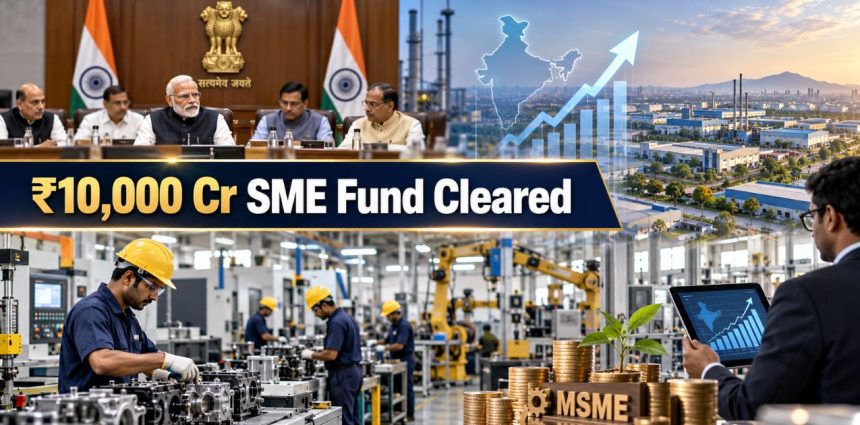
Cabinet approval sets up a direct-equity route for growth-focused SMEs, with most of the fund aimed at manufacturing businesses and industrial clusters in Tier-II and Tier-III cities.
The Union Cabinet has approved the government’s ₹10,000 crore commitment to the SME Growth Fund, moving the Budget 2026-27 proposal from announcement towards implementation.
But the bigger takeaway is where the money is expected to go.
The latest details show that a majority of the fund’s allocation will be directed towards small and medium manufacturing-focused enterprises, while SMEs operating in industrial clusters in Tier-II and Tier-III cities will also be considered. The fund is being structured for direct equity investments, giving growth-oriented businesses access to long-term capital rather than another conventional loan facility.
The FY27 Budget, however, carries an initial ₹500 crore provision for the SME Growth Fund against the much larger ₹10,000 crore government commitment.
That makes the next stage critical: the size of the eventual investments, the companies selected and the speed at which the larger commitment is deployed will matter more than the headline corpus.
Need to Know
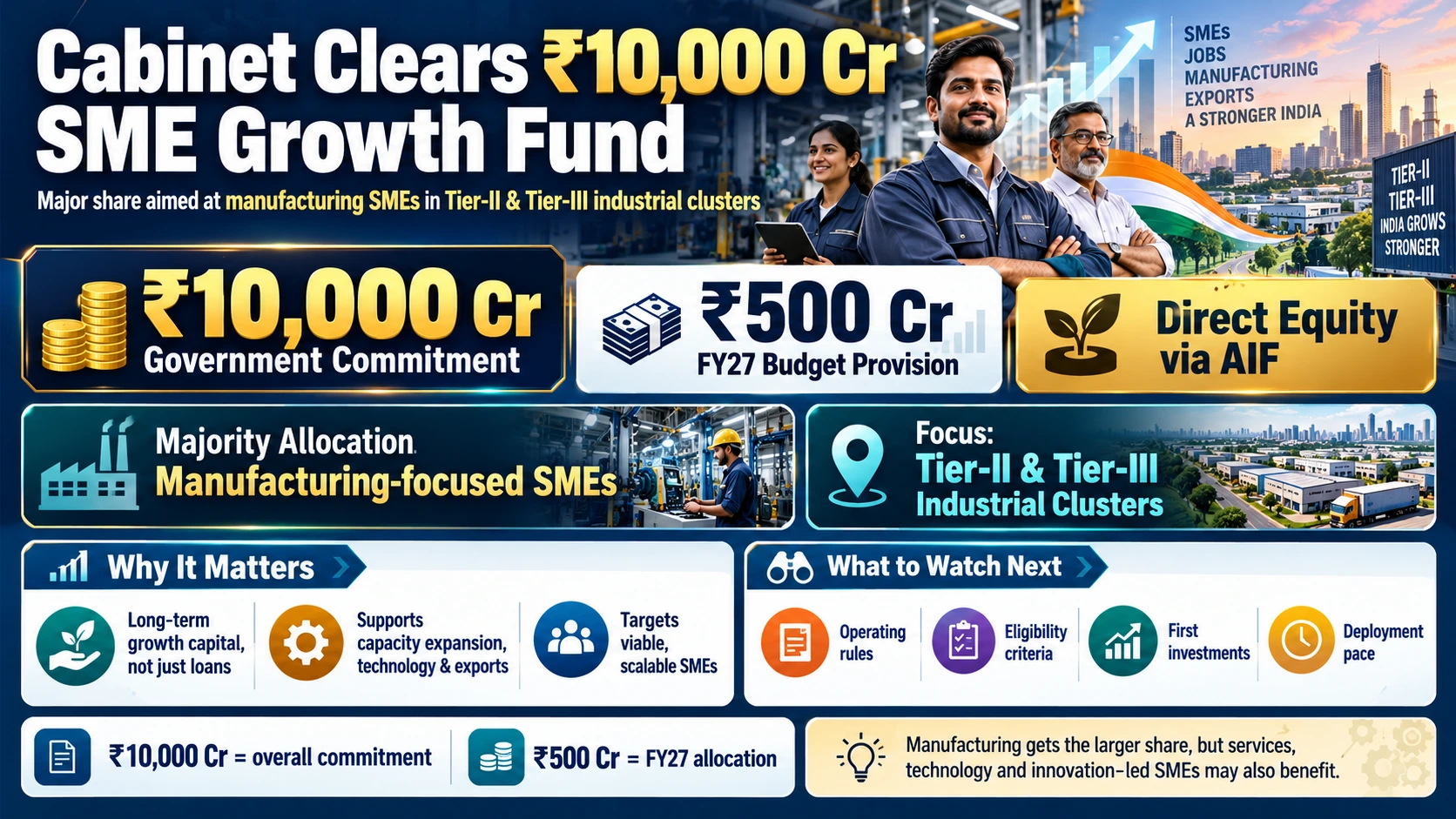
- ₹10,000 crore: Government commitment under the SME Growth Fund.
- ₹500 crore: FY27 Budget provision for the fund.
- Direct equity: The fund is being structured to invest directly in eligible SMEs through an AIF framework.
- Manufacturing priority: A majority of allocation is expected to go to small and medium manufacturing-focused enterprises.
- Tier-II and Tier-III focus: Industrial clusters in smaller cities are also being targeted.
- Next catalyst: Final operating rules, fund deployment and the first investments.
What the Cabinet Approved
Finance Minister Nirmala Sitharaman had announced the ₹10,000 crore SME Growth Fund in the February 1, 2026 Union Budget under the government’s plan to create future “Champion” SMEs.
The Budget placed the initiative under the equity-support pillar of a three-part MSME strategy covering equity, liquidity and professional assistance.
The Cabinet approval now gives the proposal a formal implementation framework.
According to the latest details, the Government of India will provide an aggregate ₹10,000 crore commitment to an Alternative Investment Fund established under the SME Growth Fund framework. The objective is to channel growth capital into businesses with demonstrated viability and scalability.
That is an important distinction from a typical government credit scheme.
The fund is not intended to distribute ₹10,000 crore equally across the country’s vast MSME base. Instead, it is designed to identify enterprises capable of scaling, investing in technology, expanding capacity, entering overseas markets and moving up the value chain.
Manufacturing Gets the Larger Share
The strongest new detail in the Cabinet-approved framework is the expected allocation pattern.
A majority of the SME Growth Fund is to be directed towards small and medium manufacturing-focused enterprises. SMEs operating in industrial clusters in Tier-II and Tier-III cities will also be considered.
This gives the scheme a more targeted character than a broad MSME support programme.
For manufacturers, long-term equity can potentially support investments in machinery, automation, technology, new production lines, product development and export capacity.
The government says the broader objective is to help Indian SMEs achieve greater scale, improve productivity, adopt advanced technology, integrate into global value chains and emerge as stronger companies in their respective sectors.
Why Equity Capital Matters
A key financing gap exists between ordinary bank credit and the capital required to scale an ambitious business.
A company may have a viable order book but still need significant upfront capital for expansion. Borrowing can provide funds, but it also increases repayment obligations.
The SME Growth Fund is designed to address the long-term risk-capital gap through equity.
That makes it different from programmes primarily aimed at working capital or invoice financing.
The new fund is therefore less about keeping a business’s cash cycle moving and more about helping selected enterprises become larger businesses.
₹10,000 Crore Commitment vs ₹500 Crore FY27 Provision
The second number investors should watch is the ₹500 crore FY27 Budget provision.
Official Budget documents show ₹500 crore under the SME Growth Fund for 2026-27, while the overall government commitment under the fund is ₹10,000 crore.
The two numbers represent different things and should not be treated as contradictory.
₹10,000 crore = overall Government commitment to the fund structure
₹500 crore = FY27 Budget provision
The gap creates an important implementation question.
A large announced commitment does not automatically translate into ₹10,000 crore of investments immediately. The eventual economic impact will depend on the structure of the AIF, capital deployment schedules, investment selection and the pace at which commitments are converted into actual equity investments.
That is the part MSMEs and investors now need to watch.
Why Tier-II and Tier-III Clusters Matter
The focus on industrial clusters outside India’s largest cities adds another layer to the policy.
Many manufacturing MSMEs are concentrated in established industrial clusters where suppliers, labour, logistics networks and specialist capabilities already exist.
Directing growth capital towards such clusters could potentially allow existing manufacturing ecosystems to expand rather than relying entirely on new industrial hubs.
The government also expects investments in these clusters to support local supply chains and employment while broadening regional industrial development.
This Is Not Just About Manufacturing
Manufacturing is expected to receive the majority allocation, but the fund is not formally limited to manufacturing alone.
The approved framework also envisages supporting growth-oriented SMEs across services, technology, innovation-driven industries and strategic value chains.
That is important because it prevents the story from becoming too narrow.
The broader objective is to identify Indian enterprises with the potential to become larger, more competitive companies.
Also Read: Govt’s New Mobile Manufacturing Scheme Offers Up to 6.5% Incentives, Eyes Indian Brands
How This Fits Into the Wider MSME Push
The SME Growth Fund is only one part of the government’s MSME financing strategy.
The Budget also proposed a ₹2,000 crore top-up to the Self-Reliant India Fund, which is intended to continue providing risk capital to micro enterprises. Government figures show the SRI Fund had supported 682 MSMEs with investments worth ₹15,442 crore as of November 30, 2025.
On the liquidity side, the government has been expanding the role of TReDS, which finances and discounts MSME trade receivables.
TReDS invoice discounting rose to ₹3.47 lakh crore in FY2025-26, up sharply from ₹40,000 crore in FY2021-22.
This highlights the distinction between the two channels:
TReDS = liquidity against receivables
SME Growth Fund = long-term equity capital
The two address different financing constraints.
Read More: Budget 2026 Market Implications: Special Trading Sessions, Policy Changes, and Sector Impact
The Real Test Starts Now
Cabinet approval removes the biggest policy hurdle, but it does not by itself guarantee that the intended businesses will receive capital quickly.
The next developments that matter are the operating framework, eligibility and selection criteria, fund management arrangements, ticket sizes, investment terms and the first set of investments.
This matters because the government has designed the fund for enterprises with business viability and scalability rather than for every MSME.
The expectation gap is therefore straightforward:
₹10,000 crore is the headline commitment; actual capital deployed into scalable businesses is the number that will ultimately determine the scheme’s impact.
What It Means for Investors
The announcement may support sentiment around the broader manufacturing and SME ecosystem, but it is too early to declare individual listed companies direct beneficiaries.
The final investment criteria have to be assessed before making stock-specific claims.
For investors, the more useful signals will be the sectors receiving capital, the size of the first investments, the manufacturing clusters selected and evidence that supported companies are expanding capacity or exports.
That is likely to provide a much clearer picture than the ₹10,000 crore headline alone.
Track Live: FII-DII activity and institutional flows
What to Watch Next
The next market-relevant developments are likely to be:
Fund structure: How the AIF will operate and who will manage it.
Eligibility: Which SMEs qualify and what scale, growth or performance criteria apply.
First investments: The identity and profile of the initial companies will reveal how selective the programme is.
Deployment pace: How quickly the ₹10,000 crore commitment translates into actual investments.
Bottom Line
The Cabinet approval gives India’s SME financing policy a new equity channel, but the most important detail is where the money is going.
A majority allocation is expected for small and medium manufacturing-focused enterprises, with industrial clusters in Tier-II and Tier-III cities also in the frame. The fund will operate through an AIF structure aimed at direct equity investments.
The ₹500 crore FY27 provision versus the ₹10,000 crore overall commitment adds another layer to the story, but it should be viewed as a budget-year allocation rather than the size of the entire programme.
The policy has now cleared the approval hurdle.
The bigger question is whether the ₹10,000 crore commitment can quickly become meaningful equity capital for the Indian SMEs capable of scaling into manufacturing and export champions.