
Zerodha’s Big SEBI Move Could Transform India’s IPO Market
India’s biggest discount broker is preparing for its next big leap—and it could reshape the country’s IPO landscape.
Zerodha merchant banker licence has become one of the biggest talking points in the financial sector after the company applied to the Securities and Exchange Board of India (SEBI) for a Category-I merchant banking licence. If approved, Zerodha will be able to manage IPOs, FPOs, rights issues and several other capital market transactions, expanding far beyond its traditional broking business.
The move comes at a time when India’s primary market is booming and competition among investment banks is intensifying.
Track Live : Stock Market Today
Zerodha merchant banker licence signals a major business expansion
The Zerodha merchant banker licence application was submitted by Zerodha Corporate Advisors on April 27. According to SEBI’s latest update as of May 31, the application remains under review.
Confirming the development, a Zerodha spokesperson said:
“We have filed an application for the merchant banking (Category 1) licence with SEBI. We’ll be able to share more about our business plans once we receive the licence.”
If SEBI grants approval, Zerodha can officially manage IPOs, FPOs, rights issues, underwriting assignments and other fundraising activities for listed and unlisted companies.
Read More : GST at 10: How AI Is Transforming India’s Tax System for Businesses
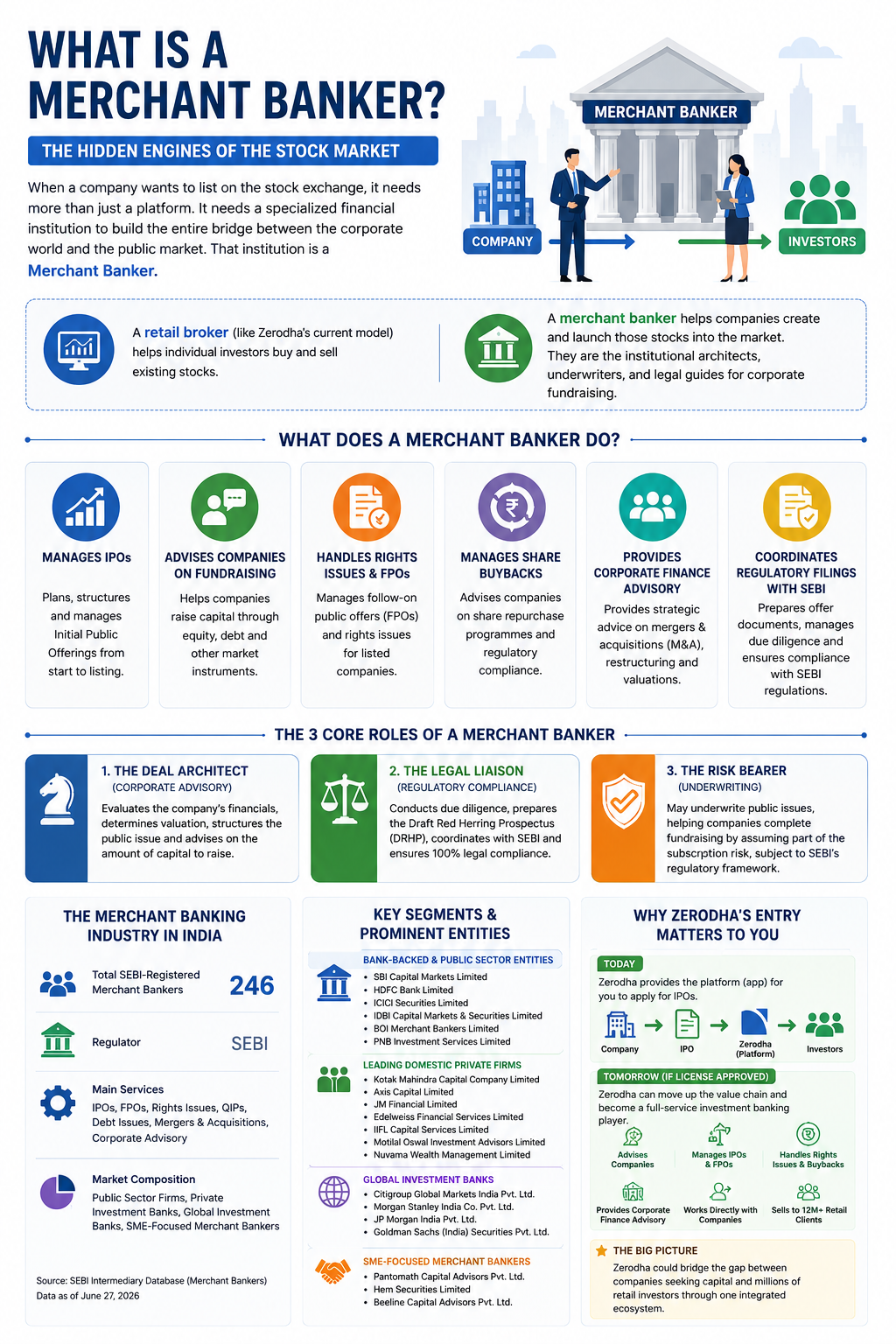
Why the Zerodha merchant banker licence matters now
The Zerodha merchant banker licence comes when India’s IPO market continues to witness strong investor participation.
Merchant bankers play a critical role in managing public issues, regulatory compliance, pricing, underwriting and fundraising. Entering this segment would allow Zerodha to become a full-service capital markets player instead of remaining only a brokerage platform.
The move also strengthens Zerodha’s long-term growth strategy as India’s equity markets continue to deepen.
More financial firms are chasing merchant banking opportunities
Zerodha is not alone.
SEBI data shows 12 other firms have also applied for merchant banking licences. Some notable applicants include Societe Generale Securities and InCred Capital.
India currently has 246 registered merchant bankers, while Capri Global became the latest company to receive approval on June 5.
The growing number of applications reflects rising confidence in India’s expanding capital markets and IPO ecosystem.
Overview of India’s 246 Registered Merchant Bankers
| Category | Leading Merchant Bankers | Primary Focus |
|---|---|---|
| Bank-Backed & Public Sector Entities | SBI Capital Markets Ltd., HDFC Bank Ltd., ICICI Securities Ltd., IDBI Capital Markets & Securities Ltd., BOI Merchant Bankers Ltd., PNB Investment Services Ltd. | IPOs, FPOs, Rights Issues, Debt Offerings, Corporate Advisory |
| Leading Domestic Private Firms | Kotak Mahindra Capital Co. Ltd., Axis Capital Ltd., JM Financial Ltd., Edelweiss Financial Services Ltd., IIFL Capital Services Ltd., Motilal Oswal Investment Advisors Ltd., Nuvama Wealth Management Ltd. | Equity Capital Markets, Investment Banking, M&A, Fund Raising |
| Global Investment Banks | Citigroup Global Markets India Pvt. Ltd., Morgan Stanley India Co. Pvt. Ltd., JP Morgan India Pvt. Ltd., Goldman Sachs (India) Securities Pvt. Ltd. | Large IPOs, Cross-Border Transactions, Institutional Capital Raising |
| SME-Focused Merchant Bankers | Pantomath Capital Advisors Pvt. Ltd., Hem Securities Ltd., Beeline Capital Advisors Pvt. Ltd. | SME IPOs, Corporate Advisory, Merchant Banking Services |
Snapshot of India’s Merchant Banking Industry
| Particulars | Details |
|---|---|
| Total SEBI-Registered Merchant Bankers | 246 |
| Regulator | Securities and Exchange Board of India (SEBI) |
| Main Services | IPOs, FPOs, Rights Issues, QIPs, Debt Issues, Mergers & Acquisitions, Corporate Advisory |
| Market Composition | Public Sector Firms, Private Investment Banks, Global Investment Banks, SME-Focused Merchant Bankers |
Source: Securities and Exchange Board of India (SEBI) Intermediary Database (Registered Merchant Bankers as of June 27, 2026). The database lists 246 registered merchant bankers operating in India.
SEBI has tightened merchant banking regulations
The Zerodha merchant banker licence application also comes after SEBI strengthened the regulatory framework for merchant bankers.
The regulator has introduced:
- Higher capital adequacy norms
- Revised net worth and liquid net worth requirements
- Stronger compliance standards
- Higher certification requirements
- Underwriting exposure capped at 20 times liquid net worth
Existing merchant bankers have until January 2, 2028, to comply with the revised framework.
The tighter rules are intended to improve governance, financial stability and investor protection.
What impact could the Zerodha merchant banker licence have on investors?
If approved, the Zerodha merchant banker licence could significantly strengthen the company’s presence across India’s capital markets.
For investors, this may translate into more competition in IPO management, improved execution standards and better access to capital market services.
For traders, the development has no immediate impact on trading activity. However, a stronger merchant banking ecosystem could lead to more IPO launches, creating fresh opportunities in the primary market.
Long-term investors should also watch whether Zerodha expands into advisory, institutional fundraising and corporate finance after receiving regulatory approval.
What Is a Merchant Banker?
Many retail investors know how to apply for an IPO through their broker, but few know who actually brings that IPO to the stock market. That job belongs to a merchant banker.
A merchant banker is a SEBI-registered financial intermediary that helps companies raise capital through public issues and other fundraising activities. Merchant bankers manage the entire issue process—from preparing offer documents and obtaining regulatory approvals to pricing the issue and coordinating with investors. They also provide corporate finance and advisory services.
What Does a Merchant Banker Do?
| Function | What It Means |
|---|---|
| Manages IPOs | Plans, structures and manages Initial Public Offerings (IPOs) from start to listing. |
| Advises on Fundraising | Helps companies raise capital through equity, debt and other market instruments. |
| Handles Rights Issues & FPOs | Manages follow-on public offers (FPOs) and rights issues for listed companies. |
| Manages Share Buybacks | Advises companies on share repurchase programmes and regulatory compliance. |
| Corporate Finance Advisory | Provides strategic advice on mergers & acquisitions (M&A), restructuring and valuations. |
| Coordinates SEBI Filings | Prepares offer documents, manages due diligence and ensures compliance with SEBI regulations. |
The Hidden Engines of the Stock Market
When a company wants to list on the stock exchange, it cannot simply upload its shares for trading. It must comply with detailed regulatory, legal and financial requirements before its shares can reach investors.
This entire process is managed by a merchant banker, often referred to as an investment banker.
While a retail broker such as Zerodha’s existing platform helps investors buy and sell listed shares, a merchant banker works with companies before those shares are listed. Merchant bankers act as the bridge between businesses seeking capital and investors looking for opportunities.
The Three Core Roles of a Merchant Banker
| Role | Responsibility |
|---|---|
| Deal Architect | Evaluates the company’s financials, determines valuation, structures the public issue and advises on the amount of capital to raise. |
| Regulatory Expert | Conducts due diligence, prepares the Draft Red Herring Prospectus (DRHP), coordinates with SEBI and ensures compliance with securities regulations. |
| Risk Manager | May underwrite public issues, helping companies complete fundraising by assuming part of the subscription risk, subject to SEBI’s regulatory framework. |
Why Zerodha’s Entry Matters
Today, Zerodha primarily acts as a distribution platform where investors can apply for IPOs.
If Zerodha receives a Category I Merchant Banking licence from SEBI, it could expand into investment banking by:
- Managing IPOs and FPOs
- Advising companies on capital raising
- Handling rights issues and buybacks
- Providing corporate finance advisory
- Working directly with companies before they list on the stock exchange
This would allow Zerodha to move beyond retail broking and participate in the corporate fundraising process, potentially creating a new long-term business vertical alongside its existing brokerage operations.