Key Takeaways
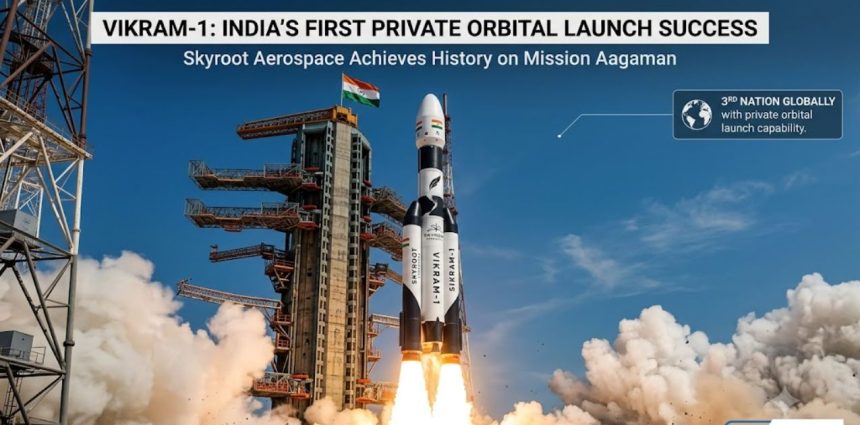
- Skyroot Aerospace’s Vikram-1 reached its planned 450-kilometer low Earth orbit 15 minutes after liftoff, becoming India’s first privately developed orbital-class rocket to fly successfully.
- Liftoff was originally scheduled for 11:30 am but was delayed by about 35 minutes after the countdown was briefly paused due to a navigation-related issue, with the rocket eventually lifting off at 12:05 pm IST.
- India has become the third country in the world after the US and China to have a private player capable of handling orbital launches.
- Vikram-1 is a multi-stage orbital launch vehicle built with an all-carbon composite structure, and designed to carry 350 kg of payload to Low Earth Orbit.
- Nagpur-listed Solar Industries India (NSE: SOLARINDS), a Skyroot investor with a board seat, is the stock traders will be watching when markets reopen Monday.
What Happened
Skyroot Aerospace’s Vikram-1 rocket lifted off from the Satish Dhawan Space Centre in Sriharikota on Saturday and reached its planned 450-kilometer low Earth orbit within 15 minutes, in a flight the company named Mission Aagaman. It is the first time a privately built Indian rocket has completed a full orbital mission.
The milestone puts India alongside the United States and China as the only countries where a private company has placed its own orbital-class rocket into space. For markets, the launch matters less as an immediate trading trigger and more as validation of India’s multi-year push to open rocket-building to private companies.
How Vikram-1 Reached Orbit
The launch was delayed by 35 minutes because of a technical issue found at the T-minus 5-minute point in the countdown. Once cleared, the three solid-fuel stages performed as expected, followed by the firing of the liquid-propellant Orbital Adjustment Module, which fired for about six minutes to place the payload into its final orbit.
| Parameter | Detail |
|---|---|
| Mission | Mission Aagaman (Test Flight-1) |
| Launch site | First Launch Pad, SDSC-SHAR, Sriharikota |
| Liftoff | 12:05 pm IST, July 18, 2026 |
| Configuration | Four-stage, carbon-composite |
| Orbit achieved | ~450 km Low Earth Orbit |
| Payload capacity | Up to 350 kg to LEO |
Source: Skyroot Aerospace, SpaceNews
Check Live: SOLAR INDUSTRIES INDIA Options Chart
Payloads Aboard the Mission
| Payload | Provider | Purpose |
|---|---|---|
| SCOPE | Skyroot Aerospace | In-house technology demonstration |
| SOLARAS S3 | Grahaa Space | Earth-observation nanosatellite |
| Technology demo | DCUBED | Component-level space demonstration |
| Embrace | Cosmoserve Space | Robotic arm designed to capture orbital debris |
| Gold micro-rocket | Cosmos Diamonds | Tiny sculptures, smaller than rice grains, of C.V. Raman, A.P.J. Abdul Kalam and Vikram Sarabhai |
Source: Skyroot Aerospace, Business Today
The rocket also carried a handwritten postcard from Prime Minister Narendra Modi, who described the mission as reflecting the talent and entrepreneurial spirit behind India’s space-sector reforms.
Why This Is a Milestone for Private Space
India’s private space sector looked very different a decade ago, in 2014, the country had just one space startup. Today, there are more than 400, according to government data, backed by reforms under the Indian Space Policy 2023 that opened the sector’s launch, satellite and applications businesses to non-government players.
Skyroot Aerospace was founded in 2018 by former ISRO scientists Pawan Kumar Chandana and Naga Bharath Daka, and first reached space with the suborbital Vikram-S flight in November 2022. Vikram-1 was its first attempt at a full orbital mission, and it succeeded on the first try.
Skyroot has raised a total funding of roughly $150 million over 12 rounds, with its latest Series C round of $50 million closing on May 7, 2026, taking its valuation to about ₹10,600 crore. Investors include GIC, Temasek Holdings, BlackRock and Solar Industries India.
NiftyTrader Desk View
| Stock | Key Technical Trigger | Trader View |
|---|---|---|
| Solar Industries India (SOLARINDS) | CEO Manish Nuwal holds a board director seat at Skyroot Aerospace; explosives and defence maker with rocket/missile propulsion exposure | Closed at ₹18,467, up 0.36% in the last session before Saturday’s launch (July 17); thematic space-sector name to track when trading resumes Monday |
Source: NSE India, as of July 17, 2026 close
Traders tracking the stock’s technical setup can pull live charts and support-resistance levels on NiftyTrader’s Stock Analysis tool: https://www.niftytrader.in/stocks-price
Bottom Line
Vikram-1’s success is a proof-of-concept moment for India’s private space sector rather than an immediate trading trigger, Skyroot itself remains unlisted. The stock with the clearest thematic link is Solar Industries India, given its board seat and propulsion-technology ties to Skyroot. Traders should watch for Skyroot’s next Vikram-1 flights planned later this year, progress on the larger Vikram-2 vehicle, and any management commentary from Solar Industries on its space-sector business at coming results.
Read Next: Axis Bank’s Q1 Brings a Profit Surprise and a Fresh Debate for Investors
This article is for informational purposes only and does not constitute investment advice. Readers should consult a SEBI-registered investment advisor before making investment decisions.