Key Takeaways
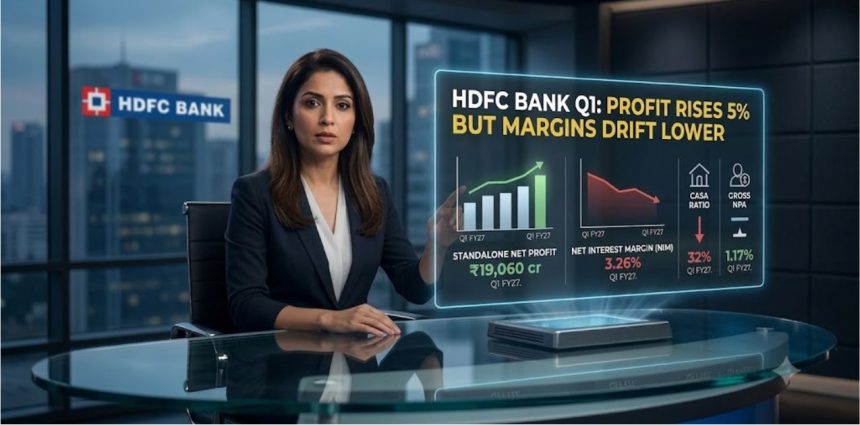
- Standalone net profit rose 5% YoY to Rs 19,060 crore; adjusted for last year’s one-off HDB Financial Services IPO gain, like-for-like growth was 9.8%
- RoA held steady at 1.85%; RoE eased to 13.8%; NIM compressed to 3.26%
- CASA ratio fell to 32% from 34% QoQ, extending a multi-year decline from 38% in Sept 2023
- Gross NPA ratio stable at 1.17%, but fresh slippages of Rs 8,000 crore pushed absolute GNPA higher QoQ
- Consolidated profit (with subsidiaries) grew a stronger 18.4% YoY to Rs 19,240 crore, led by HDB Financial Services’ 38% profit jump
- ICICI Bank also declared Q1 FY27 results the same day, posting 4.6% QoQ profit growth
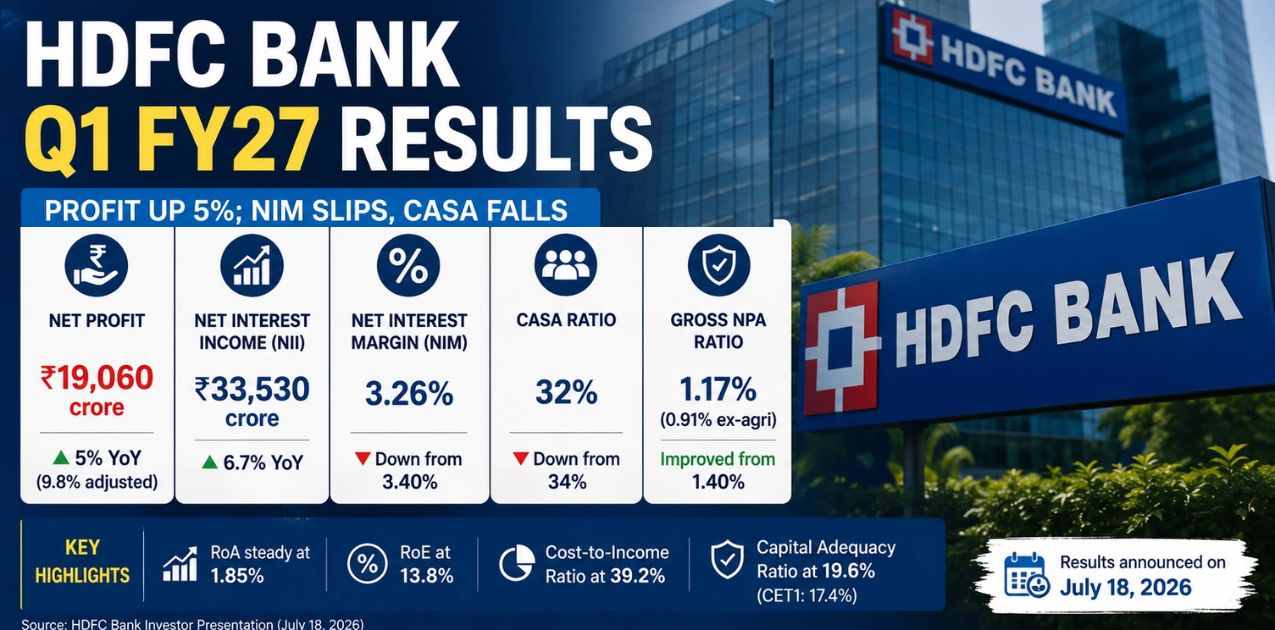
HDFC Bank’s Q1 FY27 numbers, declared straight from the bank’s own investor presentation on July 18, tell a more layered story than the headline “profit up 5%” suggests. Standalone net profit came in at Rs 19,060 crore (Rs 191 billion), up 5% year-on-year, with Return on Assets holding steady at 1.85% and Return on Equity at 13.8%. But net revenue actually fell 12.8% YoY to Rs 46,360 crore, and once you know why, the quarter looks considerably stronger than the topline suggests.HDFC Bank Q1
HDFC Bank Q1 Results: Why Revenue “Fell” 12.8% When Profit Rose
The revenue decline is a base-effect story, not a demand problem. Non-interest income crashed 41% YoY to Rs 12,820 crore from Rs 21,730 crore, because Q1 FY26 included a one-time Rs 6,949 crore transaction gain from the partial stake sale of subsidiary HDB Financial Services during its IPO.
Strip that out, and HDFC Bank’s own adjusted numbers show Q1 FY26 profit at Rs 17,370 crore, which makes this quarter’s Rs 19,060 crore print a 9.8% YoY rise, almost double the 5% headline growth.
Core lending income had no such distortion: net interest income rose a clean 6.7% YoY to Rs 33,530 crore, aided by 13.3% average deposit growth and 10.8% growth in advances under management. Provisions fell 78.8% YoY to Rs 3,060 crore, though they rose 17.2% sequentially from Q4 FY26’s unusually low base.
RoA Holds, But RoE and NIM Keep Drifting Lower
Return on Assets at 1.85% has stayed essentially flat all year, but Return on Equity has been on a multi-year slide, 18% in FY16 to 14.3% in FY26 to 13.8% this quarter, a structural effect of the 2023 HDFC Ltd merger diluting return ratios even as the capital base has strengthened over the decade (CET1 now at 17.4%, up from 13.2% in FY16).
Net interest margin eased to 3.26% on total assets, down from 3.4% both sequentially and a year ago, continuing a slow multi-quarter compression. Core cost-to-income ratio came in at 39.2%, largely stable. EPS for the quarter was Rs 12.4, marginally lower than Q4 FY26’s Rs 12.5.
CASA Ratio Slips to 32% as Wholesale Funding Mix Rises
The more watchable trend is on the liability side. CASA ratio fell to 32% from 34% in the previous quarter, continuing a steady decline from 38% back in September 2023, as average current account balances dipped even as time deposits grew a strong 6.3% QoQ.
Retail deposits’ share of the average mix slipped to 80% from 82%, with wholesale funding inching up to 20%. Cost of funds held flat sequentially at 4.4%, but yield on assets kept slipping, to 7.7% from 7.8% in Q4 FY26 and 8.1% a year ago, asset-side pricing pressure, not funding costs, is the direct driver of the NIM compression above.
Asset Quality Stable, But Fresh Slippages Tick Up
Gross NPA ratio held at 1.17% (0.91% ex-agri), with net NPA steady at 0.4%. In absolute terms, though, gross NPAs rose to Rs 35,800 crore from Rs 34,100 crore in Q4 FY26, as fresh slippages of Rs 8,000 crore outpaced Rs 4,000 crore in upgrades and recoveries plus Rs 2,300 crore in write-offs. Specific provision coverage ratio (ex-agri) held at 70%. Credit cost ticked up to 40 basis points from 35 bps in Q4 FY26, though still well down from 56 bps a year ago.
Subsidiaries: HDB Financial Shines, ERGO Lags
On a consolidated basis, which includes subsidiaries, profit was Rs 19,240 crore, up a stronger 18.4% YoY, underlining how much cleaner the group-level comparison looks once HDB Financial’s minority stake dilution is folded in.
Among subsidiaries: HDB Financial Services (74.12% stake) posted 38% profit growth to Rs 790 crore with RoA of 2.5%; HDFC Life Insurance (50.54%) grew profit 12% to Rs 610 crore; HDFC Securities (93.99%) rose 28% to Rs 300 crore; HDFC AMC (52.34%) grew 12% to Rs 840 crore; while HDFC ERGO General Insurance (50.24%) lagged with 6% growth to Rs 220 crore.
Governance Overhang Still Shadows the Stock
None of this appears in the results presentation itself, but it’s the context that explains why HDFC Bank shares remain down sharply for 2026: former part-time chairman Atanu Chakraborty resigned in March citing unspecified “practices… not in congruence with my personal values and ethics,” followed by a reported internal vigilance probe into roughly Rs 45 crore in payments linked to Maharashtra State Road Development Corporation.
HDFC Bank has denied wrongdoing, and the RBI has publicly said it found no material governance concerns. ICICI Bank also declared its Q1 FY27 results the same day, posting consolidated profit of Rs 15,440 crore, up 4.6% QoQ.
Key Financials — Standalone (Q1 FY27)
| Metric | Q1 FY27 | YoY Change / Comparison |
|---|---|---|
| Net Profit | ₹19,060 crore | ▲ 5.0% YoY (▲ 9.8% adjusted) |
| Net Interest Income (NII) | ₹33,530 crore | ▲ 6.7% YoY |
| Net Revenue | ₹46,360 crore | ▼ 12.8% YoY |
| Return on Assets (RoA) | 1.85% | Flat YoY |
| Return on Equity (RoE) | 13.8% | Down from 14.6% |
| Net Interest Margin (NIM) | 3.26% | Down from 3.40% |
| Cost-to-Income Ratio | 39.2% | Broadly stable |
| Gross NPA Ratio | 1.17% (0.91% ex-agri) | Improved from 1.40% |
| CASA Ratio | 32.0% | Down from 34.0% |
| Capital Adequacy Ratio (CAR) | 19.6% (CET1: 17.4%) | Down from 19.9% |
| Earnings Per Share (EPS) | ₹12.4 | Down from ₹12.5 |
Subsidiary Performance (Q1 FY27)
| Subsidiary | HDFC Bank Stake | Net Profit | YoY Growth |
|---|---|---|---|
| HDB Financial Services | 74.12% | ₹790 crore | ▲ 38% |
| HDFC AMC | 52.34% | ₹840 crore | ▲ 12% |
| HDFC Life Insurance | 50.54% | ₹610 crore | ▲ 12% |
| HDFC Securities | 93.99% | ₹300 crore | ▲ 28% |
| HDFC ERGO General Insurance | 50.24% | ₹220 crore | ▲ 6% |
NiftyTrader Desk View
| Stock | Trigger | Trader View |
|---|---|---|
| HDFC Bank | Q1 FY27 net profit rose 5.0% YoY (9.8% on an adjusted basis). RoA remained steady at 1.85%, CASA ratio declined to 32%, while asset quality stayed healthy despite a rise in fresh slippages. | NIM trajectory (currently 3.26%) and CASA recovery remain the key monitorables heading into Q2. The stock continues to trade under the shadow of the unresolved March–June 2026 governance probe, even as core operating performance remains resilient. |
Curious how FIIs and DIIs are positioning in HDFC Bank and other Nifty Bank heavyweights this week? Check live FII/DII cash-market flows on the NiftyTrader FII-DII Dashboard.
Read Next: Vikram-1 Enters Orbit: India Joins US, China in Private Space Launch
FAQs
Q: Why did HDFC Bank’s net revenue fall 12.8% even though profit rose?
Because Q1 FY26 included a one-off Rs 6,949 crore gain from the HDB Financial Services IPO stake sale. Adjusted for that one-time item, profit actually grew 9.8% YoY.
Q: What are HDFC Bank’s RoA and RoE for Q1 FY27?
RoA was 1.85% and RoE was 13.8%.
Q: What is HDFC Bank’s CASA ratio in Q1 FY27?
32%, down from 34% in Q4 FY27FY26 and 38% in September 2023.
Q: Did ICICI Bank also report Q1 FY27 results on July 18?
Yes, ICICI Bank posted consolidated profit of Rs 15,440 crore, up 4.6% quarter-on-quarter.
Q: What is the governance issue affecting HDFC Bank’s stock in 2026?
Former chairman Atanu Chakraborty resigned in March 2026 citing unspecified ethical concerns, followed by reports of an internal vigilance probe into Rs 45 crore in disputed payments. The bank has denied wrongdoing and the RBI has said it found no material governance concerns.
Disclaimer: This article is for informational purposes only and does not constitute investment advice. Stock market investments are subject to market risks. Please consult a SEBI-registered investment advisor before making any investment decisions.