
Why are India’s wealthiest investors moving away from equities? The answer lies in soaring real estate investments, booming private credit and changing market dynamics.
India’s ultra-high-net-worth individuals (UHNIs) significantly increased their AIF real estate investments in FY26, shifting capital away from volatile equity markets and toward income-generating property assets. The latest SEBI data shows that real estate emerged as the biggest investment theme for Alternative Investment Funds (AIFs), reflecting investors’ growing preference for stable returns amid global uncertainty.
The trend comes after equity markets witnessed heightened volatility due to geopolitical tensions, tariff concerns and global economic uncertainty.
AIF real estate investments surge 80% in FY26
The biggest highlight from SEBI’s latest data was the sharp rise in AIF real estate investments.
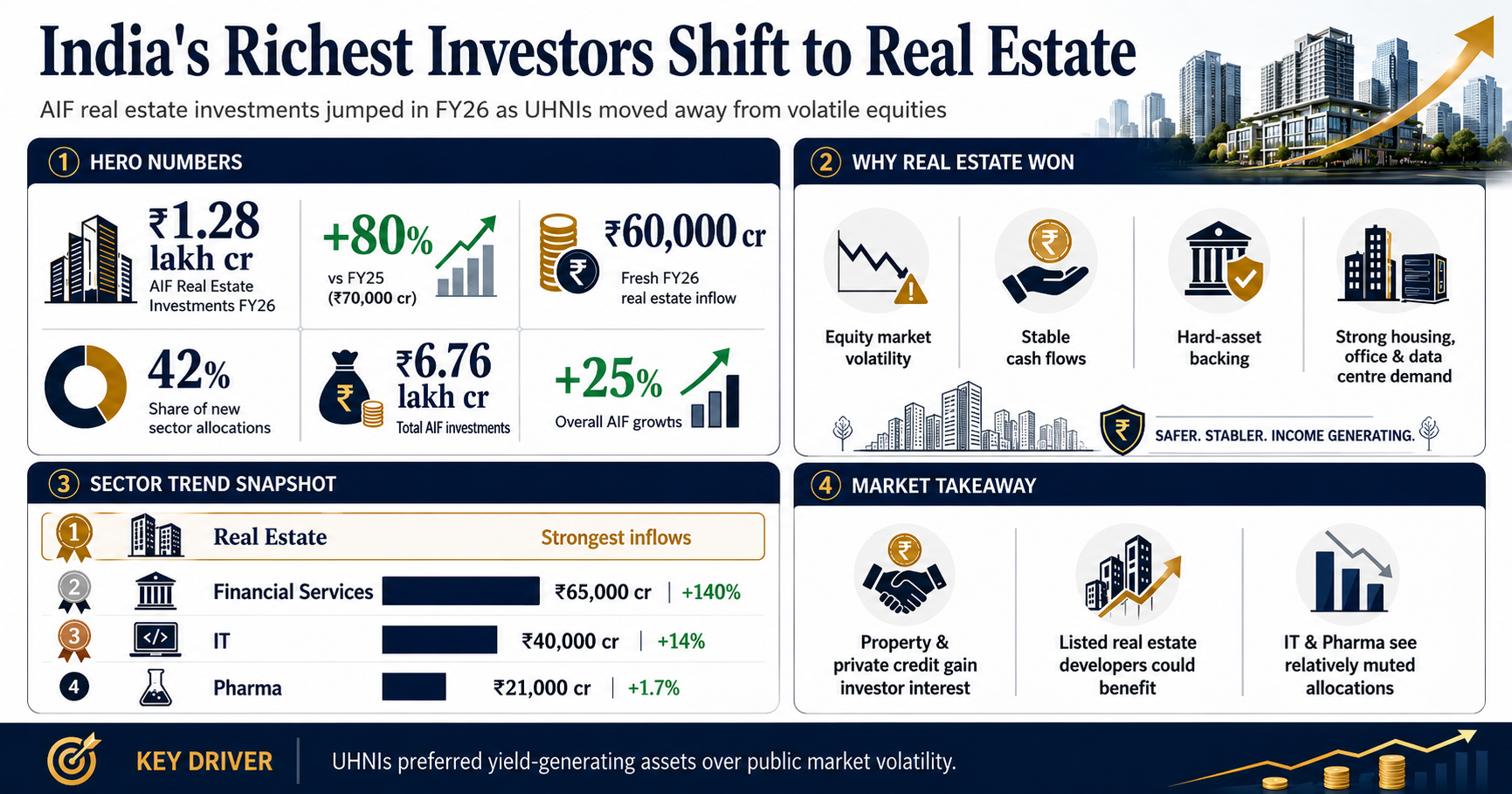
Cumulative investments in the real estate sector climbed to ₹1.28 lakh crore in FY26, compared with ₹70,000 crore in FY25, representing growth of more than 80%.
During FY26 alone, AIFs invested around ₹1.4 lakh crore across sectors, with nearly 42%, or about ₹60,000 crore, flowing into real estate.
Overall, total AIF investments increased 25%, rising from ₹5.38 lakh crore in FY25 to ₹6.76 lakh crore in FY26.
Read More : Rupee Sinks to 96.52, Weakest Since May, as Hormuz Fears Grip Markets
Why wealthy investors preferred real estate over equities
Market experts attribute the sharp rise in AIF real estate investments to the volatile performance of equity markets during FY26.
The benchmark Sensex declined 5.2% during the financial year as investors reacted to global uncertainties, including tariff-related concerns and the ongoing West Asia conflict.
Unlike equities, real estate offered investors relatively stable returns backed by physical assets.
Experts noted:
“Equity markets were turbulent through much of the year, and HNI and family office investors were actively seeking yield-bearing, hard-asset-backed opportunities rather than chasing public market volatility.”
Most AIFs typically invest in real estate through structured debt, allowing investors to earn relatively predictable cash flows while benefiting from improving fundamentals in the property market.
Strong residential demand across major cities, rising commercial office leasing and increasing demand for data centres further strengthened investor confidence.
Real estate becomes the largest investment destination for AIFs
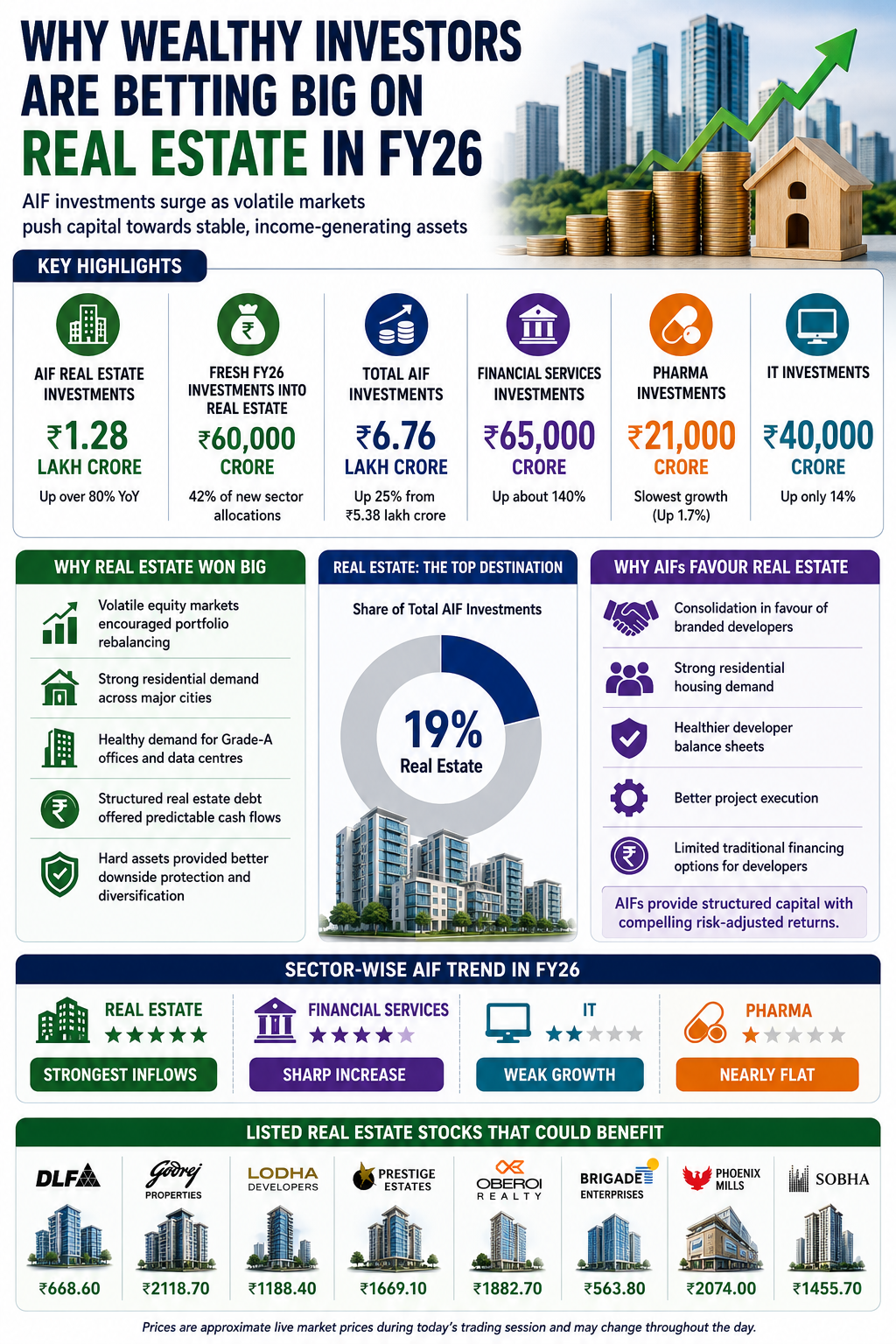
Real estate now accounts for nearly 19% of total AIF investments, making it the largest sector in the industry’s portfolio.
Industry experts believe the sector has become more attractive because of several structural improvements.
These include:
- Consolidation in favour of branded developers.
- Strong residential housing demand.
- Healthier developer balance sheets.
- Better project execution.
- Limited traditional financing options for developers.
Experts added:
“Traditional funding sources remain constrained, creating attractive opportunities for AIFs to provide structured capital with compelling risk-adjusted returns.”
This combination has strengthened the long-term investment case for private real estate funding.
Financial services emerge as another major winner
Apart from AIF real estate investments, the financial services sector also witnessed remarkable growth.
Investments in financial services jumped 140%, increasing from ₹27,000 crore to around ₹65,000 crore during FY26.
The sector includes NBFCs, fintech companies, stock broking firms and insurance businesses.
Experts believe the expansion of private credit opportunities and healthy lending demand encouraged AIF managers to increase exposure.
According to market participants:
“The sharp rise reflects the growing opportunity in structured credit as AIF managers benefit from the gap between traditional bank lending rates and private credit pricing.”
Pharma and IT attract comparatively lower investments
Not every sector benefited equally from AIF allocations.
The pharmaceutical sector recorded the slowest growth, with investments increasing only 1.7% to around ₹21,000 crore.
The information technology sector also witnessed relatively muted interest.
AIF investments in IT increased only 14% to ₹40,000 crore, as investors remained cautious over slowing technology spending and the impact of artificial intelligence on global IT services demand.
Why Wealthy Investors Shifted to Real Estate in FY26
India’s ultra-high-net-worth investors (UHNIs) significantly increased their allocation to real estate through Alternative Investment Funds (AIFs) in FY26 as volatile equity markets encouraged a shift toward stable, yield-generating assets. SEBI data showed AIF investments in real estate jumped over 80%, while overall AIF investments grew 25% during the year.
Key Highlights
- AIF real estate investments: ₹1.28 lakh crore (up over 80% YoY)
- Fresh FY26 AIF investments into real estate: ₹60,000 crore (42% of new sector allocations)
- Total AIF investments: ₹6.76 lakh crore (up 25% from ₹5.38 lakh crore)
- Financial services investments: ₹65,000 crore (up about 140%)
- Pharma: Slowest growth at ₹21,000 crore
- IT: Investments rose only 14% to ₹40,000 crore
Why Real Estate Became the Preferred Bet
- Volatile equity markets encouraged portfolio rebalancing.
- Strong residential demand across major cities.
- Healthy demand for Grade-A offices and data centres.
- Structured real estate debt offered predictable cash flows.
- Hard assets provided better downside protection and diversification.
Sector-Wise AIF Trend
| Sector | FY26 Trend |
|---|---|
| Real Estate | Strongest inflows |
| Financial Services | Sharp increase |
| IT | Weak growth |
| Pharma | Nearly flat |
Listed Real Estate Stocks That Could Benefit
| Company | Approx. Current Price* |
|---|---|
| DLF | ₹668.60 |
| Godrej Properties | ₹2118.70 |
| Lodha Developers | ₹1188.40 |
| Prestige Estates | ₹1669.10 |
| Oberoi Realty | ₹1882.70 |
| Brigade Enterprises | ₹563.80 |
| Phoenix Mills | ₹2074.00 |
| Sobha | ₹1455.70 |
Track Live : Nifty Change in Open Interest – Live Buildup
What impact could this have on investors and the market?
For investors, rising AIF real estate investments indicate growing confidence in India’s property market and private credit ecosystem. Listed real estate developers, commercial property companies and firms linked to housing demand could continue benefiting if institutional capital inflows remain strong.
The sharp increase in financial services investments also reflects improving opportunities in NBFCs and fintech businesses, particularly those involved in structured lending and private credit.
Meanwhile, slower investment growth in the pharmaceutical and IT sectors suggests that investors remain selective, focusing on industries with stronger earnings visibility and predictable cash flows.
If market volatility continues, analysts believe wealthy investors may continue allocating capital toward real estate and structured credit, making these sectors key areas to watch in the coming quarters.