Key Takeaways
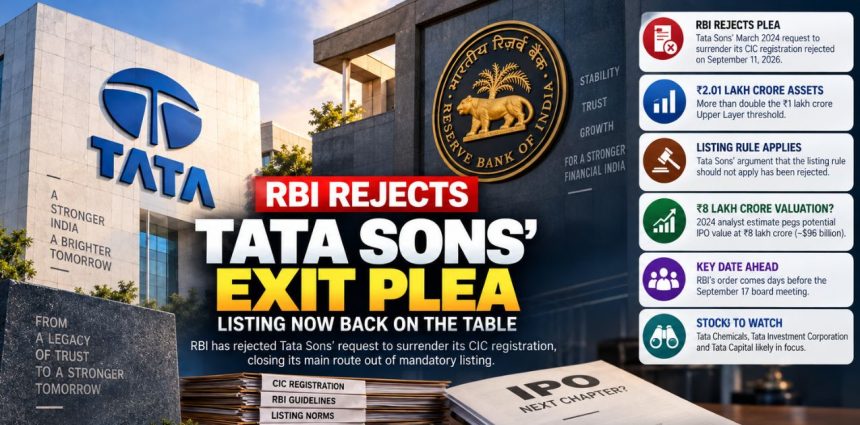
- RBI rejected Tata Sons’ March 2024 plea to surrender its CIC registration, in a letter dated September 11, 2026, closing its main route out of mandatory listing.
- Tata Sons’ reported ₹2.01 lakh crore asset base is more than double the ₹1 lakh crore Upper Layer threshold RBI set in a June 2026 rule change.
- Tata Sons’ own “if we’re not a CIC, the listing rule shouldn’t apply” argument, pending with RBI since 2024, has now been rejected outright.
- A 2024 analyst estimate pegged a Tata Sons IPO’s potential valuation as high as ₹8 lakh crore (~$96 billion), more than 25 times the size of LIC’s then-record ₹21,000 crore IPO.
- The order lands days ahead of a September 17 board meeting expected to take up chairman N Chandrasekaran’s exit and succession.
- Tata Chemicals, Tata Investment Corporation and Tata Capital are the listed proxies likely to be in focus when markets reopen Monday, September 14.
What the RBI’s September 11 Letter Says
For more than two years, Tata Sons tried to argue its way out of a stock market listing. On September 11, the RBI said no. In a letter dated that day, the central bank said it could not accede to Tata Sons’ request after considering its application dated March 28, 2024, and subsequent correspondence.
RBI advised Tata Sons to ensure full compliance with all guidelines applicable to upper-layer non-banking financial companies, meaning it stays inside the NBFC-UL framework that carries the listing obligation.
How Tata Sons Got Here: A Four-Year Regulatory Standoff
- September 2022: RBI first places Tata Sons in the “upper layer” NBFC category, one of 16 companies on that inaugural list, triggering a three-year listing clock.
- FY2024: Tata Sons repays roughly ₹21,813 crore of debt, aiming to qualify as a debt-free, unregistered CIC and exit the NBFC framework entirely.
- March 28, 2024: Tata Sons formally applies to RBI to surrender its CIC registration.
- September 2025: The original three-year listing deadline lapses — with no listing, and no decision yet on the pending exemption plea.
- June 24, 2026: RBI overhauls the Upper Layer criteria, swapping the old scoring model for a flat ₹1 lakh crore asset threshold.
- August 2026: RBI’s 2026-27 Upper Layer list again includes Tata Sons, “without prejudice” to its pending deregistration application.
- September 11, 2026: RBI formally rejects the application.
The Legal Argument Tata Sons Made — and Why It Didn’t Hold
Tata Sons’ case rested on a fairly clean piece of logic: once it stopped operating as a registered Core Investment Company, RBI would have no continuing regulatory hook to keep it inside the Upper Layer bracket, and therefore no basis to enforce a listing mandate that flowed from that classification in the first place.
For nearly two years, RBI neither accepted nor rejected that argument outright, leaving the question open even as it kept renewing Tata Sons’ place on the Upper Layer list each year.
That ambiguity is now resolved. RBI’s own framework closes the loophole Tata Sons was counting on: deregistration is only available to entities with no public funds, no customer interface, and total assets under ₹1,000 crore.
A diversified holding company with equity across steel, automobiles, financial services, aviation and semiconductors, and a balance sheet in the lakhs of crores, was never going to fit inside that box, regardless of how debt-free it became.
The Rs 1 Lakh Crore Rule That Sealed the Outcome
The timing traces to a mid-year rule change. On June 24, 2026, RBI replaced the earlier weighted scoring system (size, leverage, interconnectedness, complexity) with a single, objective test: any NBFC with audited assets of ₹1 lakh crore or more is automatically Upper Layer.
That threshold is reviewed every three years, and once classified, an entity stays inside the enhanced framework for a minimum of five years, even if it later falls below the bar.
Tata Sons’ total assets stood at ₹2.01 lakh crore as of March 31, 2026, more than double the new threshold. An RBI list published in August had put the figure closer to ₹1.75 lakh crore; the gap likely reflects FY26 accounts being finalised only in June. Either number clears the bar by a wide margin.
What Tata Sons’ Own Filings Show
Standalone and consolidated numbers are easy to conflate here, so they’re worth separating. Tata Sons’ FY25 net worth rose 20% to ₹1,49,680.13 crore, with net debt turning negative, cash exceeded borrowings, after it repaid all outstanding loans during the year.
Standalone revenue was ₹38,834.58 crore and profit after tax ₹26,231.74 crore. That’s Tata Sons alone. Its 323 subsidiaries collectively generated consolidated revenue of ₹15.34 lakh crore, and the group’s listed entities carried a combined market capitalisation of roughly ₹27.8 lakh crore, an entirely different, much larger number.
FY26 improved further: the board approved accounts on June 12 showing standalone profit rising to more than ₹31,000 crore from about ₹26,000 crore the year before, driven substantially by gains linked to Tata Capital’s listing. Tata Capital listed on October 13, 2025, with Tata Sons selling 23 crore shares to raise about ₹7,500 crore.
How Big Could a Tata Sons Listing Be?
This is the number that keeps analysts interested even when the regulatory story goes quiet for months. Back in March 2024, Mumbai-based Spark PWM estimated Tata Sons’ listed investments alone were worth about ₹16 lakh crore, with unlisted holdings, including its semiconductor and EV-battery bets, adding another ₹1-2 lakh crore.
After applying a typical 30-60% holding-company discount (similar to what the market applies to Bajaj Holdings or Godrej Industries), the firm arrived at a fair-value estimate of roughly ₹7.8 lakh crore, with a bull case as high as ₹8 lakh crore, or about $96 billion, putting even a 5% stake above the entire size of LIC’s ₹21,000 crore IPO, India’s largest at the time it listed in 2022. Spark also floated a possible issue size around ₹55,000 crore.
Two caveats matter. First, that estimate is now more than two years old, and the group’s combined listed market cap has since grown to roughly ₹27.8 lakh crore, so any updated number would likely be higher, not lower.
Second, none of this tells you when a listing happens or how it’s structured; RBI’s letter compels compliance with Upper Layer norms, not a specific IPO date or format.
Also Check: Tata Technologies Limited – IPO
A Divided Shareholder Register
Tata Sons’ shareholder base is far from unanimous on listing. Tata Trusts, the largest shareholder at about 66%, has opposed a public listing, wary of diluting control over the group’s governance structure.
Shapoorji Pallonji, the second-largest shareholder at over 18%, wants Tata Sons listed, partly to help monetise its own stake amid financial stress. RBI’s rejection removes one card the controlling Trusts had been holding to keep the company private.
Leadership Transition Adds to the Pressure
The regulatory setback lands amid unusual boardroom turbulence. Within the past month, chairman N Chandrasekaran informed the board he will not seek a third term, with his current tenure ending February 20, 2027; one board member is understood to oppose his reappointment, and the matter has been on hold for six months.
Sir Dorabji Tata Trust has already passed a resolution to set up a selection committee for his successor. The board is likely to meet on September 17, where the succession question may surface even though it isn’t on the formal agenda.
Which Stocks Investors Will Watch
Tata Sons itself isn’t listed, so any market reaction runs through its listed proxies:
- Tata Chemicals — holds roughly a 3% direct equity stake in Tata Sons, historically valued in the tens of thousands of crores; has rallied sharply in the past on comparable listing speculation.
- Tata Investment Corporation — a Tata Sons-linked investment holding company that has moved on prior Upper Layer headlines.
- Tata Capital — an NBFC-UL entity itself, and the first major Tata financial-services listing (October 2025), often cited as a template for how a Tata Sons listing could eventually be structured.
Since the RBI’s letter is dated a Friday, the first live market test comes when the NSE and BSE reopen Monday, September 14.
📊 Track how FIIs and DIIs are positioning across Tata Group counters ahead of Monday’s session on the NiftyTrader FII-DII Tracker → niftytrader.in/fii-dii-data
What Happens Next
RBI’s letter doesn’t set a fresh listing deadline, the original three-year window from the 2022 classification lapsed in September 2025 without resolution, and no new compliance date has surfaced yet.
Neither Tata Sons nor the RBI had issued a public statement as of Saturday. Attention now shifts to the September 17 board meeting, where both the succession question and, potentially, the regulator’s stance are likely to come up.
Bottom Line
RBI’s rejection doesn’t order an immediate listing, but it eliminates the one legal off-ramp Tata Sons had pursued since 2024, and closes off an argument it had kept alive for nearly two years.
With assets more than double the ₹1 lakh crore Upper Layer threshold, no realistic path to the sub-₹1,000-crore deregistration bar, and analyst estimates once putting its potential IPO value near $96 billion, Tata Sons remains squarely inside a framework built around eventual public listing, a question its board, and its two largest, differently-motivated shareholders, must now confront without the escape hatch they’d been counting on.
Read Next: BRICS Summit 2026: Modi-Xi-Putin Meet, What Changes for India?
This article is for informational purposes only, based on regulatory filings, public disclosures and media reports cited above. It does not constitute investment advice or a recommendation to buy, sell or hold any security.