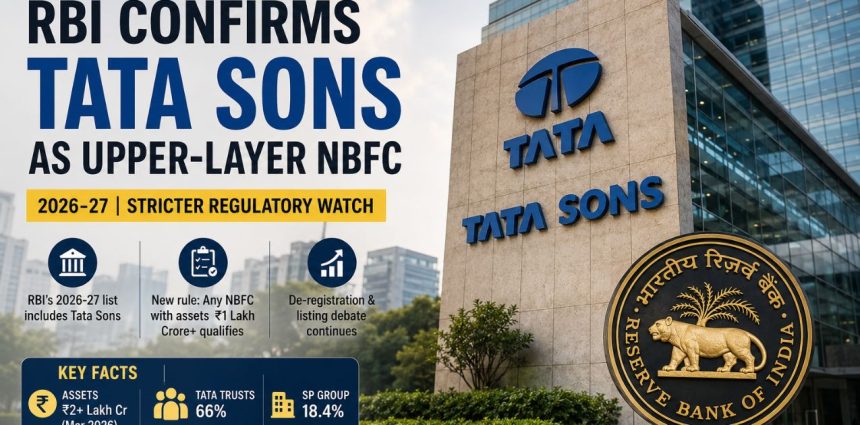
The Reserve Bank of India on Thursday confirmed Tata Sons Private Limited as an Upper-Layer Non-Banking Financial Company (NBFC-UL) for 2026-27, keeping India’s largest unlisted holding company under enhanced regulatory scrutiny and reopening the question of whether Tata Sons will finally have to go public.
The central bank’s 2026-27 list places Tata Sons among 17 systemically important NBFCs, following a revised asset-based framework that took effect in June this year. Under the new rules, which replaced the earlier scoring model based on size, leverage and interconnectedness, any NBFC with assets of Rs 1 lakh crore and above qualifies automatically for the upper layer.
Tata Sons’ standalone assets exceeded Rs 2 lakh crore as of March 2026 by some accounts, while RBI’s Wednesday press briefing pegged the figure at over Rs 1.75 lakh crore, according to Business Standard and Business Today; either way, Tata Sons Private Limited clears the threshold comfortably.
Why It Matters Today
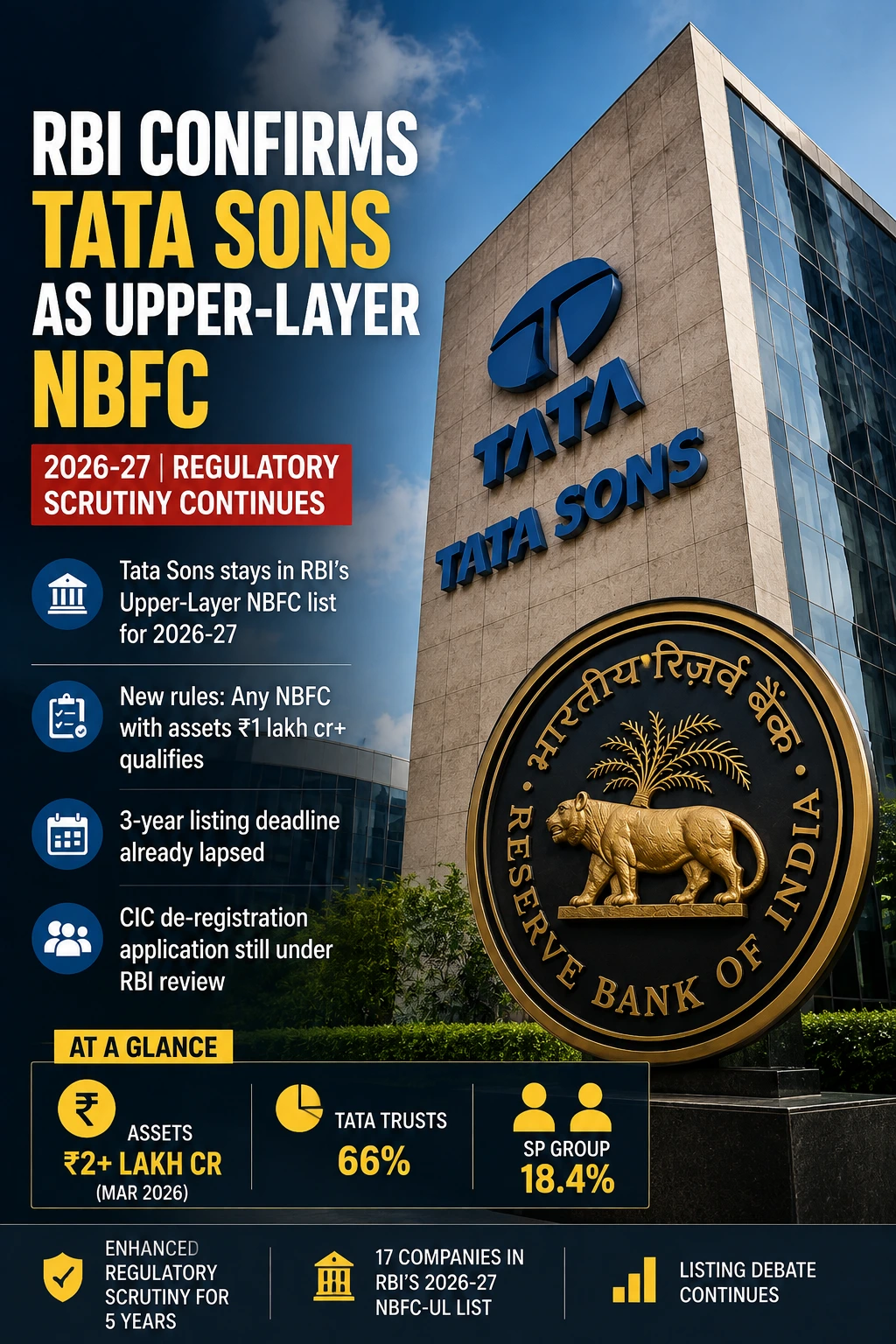
- Tata Sons has now spent four straight years in RBI’s Upper-Layer NBFC bracket since its first classification in September 2022.
- Enhanced regulatory requirements apply for a minimum of five years from classification, RBI’s release notes, regardless of whether a company meets the criteria in later years.
- The classification technically carries a three-year listing deadline, one that already lapsed on September 30, 2025, without resolution.
- RBI explicitly said the tag does not prejudge its pending decision on Tata Sons’ request to exit the NBFC framework altogether.
How the Upper-Layer Rules Changed
RBI’s original 2021 scale-based regulation framework identified upper-layer NBFCs using a parametric scoring model weighted 70% on quantitative factors and 30% on qualitative ones. That approach was scrapped this year: the central bank issued draft amendment directions on April 10, 2026, finalised them on June 24, 2026, and made them effective from July 1, 2026, replacing the scoring model with a flat asset threshold of Rs 1 lakh crore. RBI had skipped publishing a 2025-26 upper-layer list altogether while this review was underway, which is why Thursday’s announcement effectively covers two missed annual updates at once.
Check Live to explore: NiftyTrader: Live Options Analytics & F&O Trading Tools
Why the Classification Was Never in Doubt
RBI Governor Sanjay Malhotra addressed the question directly at Wednesday’s post-Monetary Policy Committee press conference, telling reporters the new framework “is principle-based; anyone who meets the criteria will continue.” Deputy Governor Shirish Chandra Murmu added that the updated list would be released “very soon” — a promise the central bank kept a day later. Malhotra’s comments effectively pre-confirmed Tata Sons’ status before RBI’s formal press release followed on Thursday.
The CIC De-Registration Question Stays Open
Tata Sons is registered as a Core Investment Company (CIC), an NBFC sub-category whose principal business is holding stakes in group firms; RBI rules require CICs to keep at least 90% of net assets in the equity, preference shares, bonds, debentures or loans of group companies.
Tata Sons applied in 2024 to surrender this CIC registration after becoming debt-free, a move that, if approved, could let it stay private and skip the listing obligation tied to its Upper-Layer NBFC status entirely. RBI’s language on Thursday was unambiguous: inclusion of Tata Sons in the NBFC-UL list is “without prejudice to the outcome of its application for de-registration, which is under examination.” Whether the exemption comes through before the listing requirement is enforced remains, per multiple reports, an open call.
Ownership Split Keeps the Listing Debate Alive
The push to list Tata Sons isn’t only regulatory. Tata Trusts, chaired by Noel Tata, holds roughly 66% of Tata Sons and has historically resisted a public listing, wary of diluting control over the wider Tata group.
The Shapoorji Pallonji Group, the second-largest shareholder with an 18.4% stake, has pushed the opposite way, with group chairman Shapoorji Pallonji Mistry arguing publicly that a timely listing “is not merely a regulatory compliance but a necessary evolution.” SP Group’s stance isn’t just philosophical: the debt-laden conglomerate has used its Tata Sons shares as collateral, including for a $1.7-billion loan taken in 2021, and has reportedly been exploring monetising close to 7% of its holding through a share-swap arrangement with listed Tata companies.
Inside Tata Trusts itself, trustees Venu Srinivasan and Vijay Singh have reportedly favoured a listing, putting them at odds with Noel Tata’s preference to keep Tata Sons private. Tata Sons sits atop 31 group entities, including TCS, Tata Motors Passenger Vehicles and Tata Steel, and posted a 22% year-on-year rise in annual profit for the year ended March 2026.
Other Names on the 2026-27 Upper-Layer List
| Company | Category / Notes |
|---|---|
| Tata Sons Private Ltd | Core Investment Company; CIC de-registration pending |
| Bajaj Finance Ltd | Deposit-taking NBFC-ICC |
| Shriram Finance Ltd | Deposit-taking NBFC-ICC |
| Tata Capital Ltd | Non-deposit-taking NBFC-ICC |
| REC Ltd | Government-owned infrastructure financier |
| Power Finance Corporation Ltd | Government-owned infrastructure financier |
| Indian Railway Finance Corporation | Government-owned infrastructure financier |
| PNB Housing Finance Ltd | Retained despite not meeting current asset criteria |
| Sammaan Capital Ltd | Retained despite not meeting current asset criteria |
Sources: RBI’s 2026-27 NBFC-UL list, as reported by Business Today and Asianet Newsable.
What Happens Next for Tata Sons
For now, nothing changes overnight: Tata Sons continues operating as an unlisted, privately held company while RBI works through its CIC de-registration application. But the Upper-Layer NBFC classification keeps the regulatory clock running, and with Tata Trusts internally divided and SP Group publicly lobbying for a market debut, pressure on RBI to resolve the exemption question is unlikely to ease anytime soon.
Read Next: LIC Q1 FY27 Results: Margin Story Steals the Show as Profit Climbs 23% and VNB Soars 61%
FAQs
Q1. What is an Upper-Layer NBFC (NBFC-UL)?
It’s RBI’s designation for the largest, most systemically important non-banking financial companies, which face bank-like regulatory scrutiny. Under the framework effective June 2026, any NBFC with assets of Rs 1 lakh crore or more qualifies.
Q2. Does this mean Tata Sons must list immediately?
Not immediately. NBFC-UL status technically requires listing within three years of classification, but Tata Sons’ original three-year window from 2022 already lapsed on September 30, 2025, and its pending CIC de-registration application could still exempt it.
Q3. Why is Tata Sons trying to de-register as a CIC?
It applied in 2024, after clearing its debt, to surrender its Core Investment Company registration, a status that, if approved, would let it exit the NBFC framework and avoid the listing requirement tied to the Upper-Layer tag.
Q4. Who are Tata Sons’ key shareholders in the listing debate?
Tata Trusts holds about 66% and has resisted listing; the Shapoorji Pallonji Group holds roughly 18.4% and has publicly pushed for a listing to unlock the value of its stake.
Q5. How many companies are in RBI’s 2026-27 Upper-Layer NBFC list?
Seventeen, including Tata Sons, Bajaj Finance, Shriram Finance, Tata Capital, REC, Power Finance Corporation and Indian Railway Finance Corporation.