
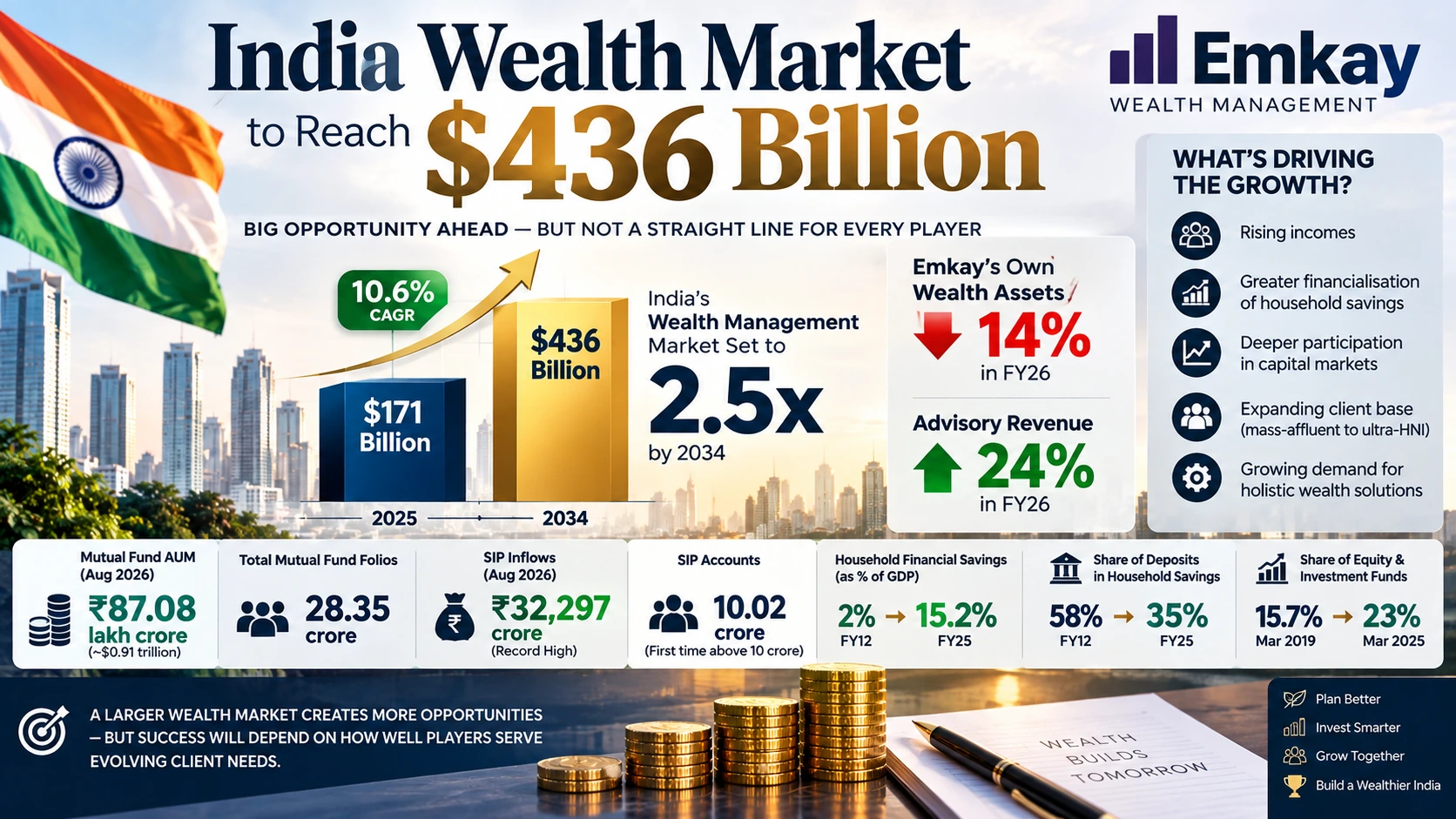
India’s wealth-management market could become about 2.5 times larger by 2034, according to Emkay Wealth Management. But there is a catch beneath that bullish long-term projection: Emkay’s own wealth assets fell 14% in FY26 even as advisory revenue rose 24%, showing that a larger industry does not necessarily mean a smooth rise in AUM for every wealth manager.
The other number worth watching is the bond market. The benchmark 6.94% 2036 government bond closed at 7.0686% on September 18, only about 3 basis points below the 7.10% yield level Emkay said could be reached.
The combination points to a broader shift: India is accumulating more financial wealth, but clients are also demanding more sophisticated ways to allocate, preserve and transfer it.
Emkay’s forecast: $171 billion to $436 billion
Emkay Wealth estimates India’s wealth-management market at around $171 billion in 2025, rising to approximately $436 billion by 2034. The firm reports a CAGR of around 10.6%.
Emkay says the expansion is being driven by rising incomes, financialisation of household savings, deeper participation in capital markets and a widening client base.
The opportunity is no longer restricted to traditional HNIs.
The firm expects demand to increasingly come from mass-affluent, affluent, HNI, ultra-HNI, family-office and institutional clients. CEO Parag Morey said investors are increasingly looking beyond individual products and towards integrated approaches covering wealth accumulation, preservation and transmission.
That is an important distinction.
The next phase of the wealth-management industry may be less about simply gathering assets from existing millionaires and more about serving investors earlier in their wealth-building journey, while offering increasingly specialised services at the higher end.
The first reality check: $436 billion is not total Indian wealth
The $436 billion forecast should not be confused with India’s total household wealth, total HNI wealth, mutual-fund AUM or the assets managed by a particular wealth manager.
AMFI reported mutual-fund AUM of ₹87.08 lakh crore as of August 31, 2026. At the September 18 exchange rate of roughly ₹95.88 per dollar, that is approximately $0.91 trillion — more than five times the $171 billion wealth-management market estimate.
Capgemini, meanwhile, estimated Indian HNWI wealth at $1.645 trillion in 2025, another entirely different measure.
The public coverage of Emkay’s forecast does not provide a full reconciliation showing exactly how the $171 billion market-size figure is defined against these broader AUM and wealth measures.
That means the figures should be used as different indicators of different parts of India’s financial ecosystem, rather than added together.
The 2034 forecast itself translates to roughly ₹41.8 lakh crore at ₹95.89 per dollar, assuming the exchange rate were unchanged. That is a simple conversion, not a forecast for the rupee.
The 10.6% CAGR needs one small caveat
Emkay reports a CAGR of about 10.6%.
However, using the rounded headline numbers of $171 billion in 2025 and $436 billion in 2034 produces a CAGR closer to 11% over nine years.
That does not by itself show an error. The underlying figures may be more precise than the rounded numbers reported publicly.
For that reason, 10.6% should remain explicitly attributed to Emkay, rather than being presented as a NiftyTrader calculation.
India’s household savings are already moving towards financial assets
The structural argument behind Emkay’s forecast is supported by broader government data.
The Economic Survey 2025-26 said household financial savings rose from roughly 2% of GDP in FY12 to more than 15.2% in FY25.
At the same time, the share of deposits in household financial savings declined from above 58% to around 35%. The Survey also showed the share of equity and investment funds in household financial assets rising from 15.7% in March 2019 to 23% in March 2025.
The important nuance is that this is not simply a story of Indians abandoning deposits.
The Economic Survey describes the change more as portfolio diversification, with households adding more financial-market exposure alongside conventional savings.
For wealth managers, that change is significant because a larger pool of financial assets creates more demand for allocation, risk management, tax planning and long-term advice.
Mutual funds show how broad the investor base has become
The latest AMFI numbers reinforce that structural shift.
As of August 31, 2026:
- Mutual-fund AUM stood at ₹87.08 lakh crore.
- Total folios reached 28.35 crore.
- Equity, hybrid and solution-oriented schemes accounted for about 21.62 crore folios.
August also brought a new SIP milestone.
Monthly SIP contributions reached a record ₹32,297 crore, while the number of contributing SIP accounts crossed 10 crore for the first time, reaching around 10.02 crore.
Equity mutual funds attracted about ₹29,329 crore in August, extending their positive-flow streak to 66 consecutive months. Small-cap funds drew ₹7,973 crore, while mid-cap funds received ₹6,989 crore.
That creates a particularly interesting contrast with Emkay’s caution on smaller companies: investor flows are already leaning towards the very segments where valuation and liquidity risks can be higher.
Also Read: August SIP Data: Accounts Cross 10 Crore Mark as Inflows Reach ₹32,297 Crore
Read the PMS headline carefully
Portfolio-management data require even more caution because the headline number contains a large provident-fund component.
SEBI reported total PMS assets of ₹44.11 lakh crore as of July 31, 2026.
But about ₹31.87 lakh crore of that was contributed by EPFO/PF funds. The non-EPFO/PF pool in discretionary and non-discretionary PMS was about ₹9.03 lakh crore. Advisory assets were separately reported at roughly ₹3.15 lakh crore.
That means the ₹44.11 lakh crore headline should not be described as a pool of HNI or affluent investor money.
SEBI’s table itself does not break the non-EPFO/PF pool down by investor category.
The distinction matters because wealth-management estimates are often discussed alongside PMS statistics even though the underlying populations and definitions can differ significantly.
AIF commitments are rising — but commitments are not deployed capital
Alternative investment funds provide another indicator of the deepening financial ecosystem.
SEBI’s data as of June 30, 2026 showed cumulative AIF commitments of ₹17.53 lakh crore, funds raised of ₹7.59 lakh crore and investments made of ₹7.11 lakh crore.
The commitments figure was ₹14.18 lakh crore a year earlier, indicating substantial growth in the pool of capital committed to AIFs.
But the three numbers tell different stories.
Commitments are promises of capital.
Funds raised represent capital actually called/raised.
Investments made represent deployed capital.
For a wealth-management story, that distinction is important because a larger AIF commitment pool does not automatically mean the same amount is already invested or generating returns.
SIFs add another layer between mutual funds and PMS
Specialized Investment Funds are also gaining scale.
August data showed SIF assets at approximately ₹31,175 crore, up about 34.5% from July, with monthly inflows of roughly ₹7,699 crore.
Hybrid strategies accounted for most of the category, while equity-oriented strategies were also attracting meaningful inflows.
The category is still tiny compared with mutual funds or PMS, but its rapid early growth is relevant to the broader wealth-management theme because it provides investors with a more sophisticated product set without requiring them to move entirely into traditional PMS structures.
The HNI pool is expanding — but not as fast as Emkay’s market forecast
Capgemini’s World Wealth Report 2026 estimated India’s HNWI population at 390,100 in 2025, up 3%, while total HNWI wealth rose 4.6% to $1.645 trillion. Equity represented 25% of HNWI portfolios as of January 2026, up three percentage points from the previous year.
Knight Frank separately estimated that India’s UHNWI population was 19,877 and forecast it to reach 25,217 by 2031.
Emkay’s reported 10.6% market CAGR is therefore well above the 4.6% dollar growth in Indian HNWI wealth reported by Capgemini. The two metrics are not directly comparable, but the difference is directionally consistent with Emkay’s broader argument that the industry has to expand beyond the existing HNI pool.
That is where mass-affluent investors become important.
The yield Emkay flagged is already close
The investment backdrop also matters.
Emkay said it remained cautious on the longer end of the domestic yield curve and that the 10-year benchmark could move towards 7.10%, preferring accrual-oriented and performing-credit strategies over taking large duration exposure.
On September 18, the benchmark 6.94% 2036 bond yield closed at 7.0686%, compared with 7.0463% on Thursday, taking its weekly rise to about 4.5 basis points. Reuters reported that Indian government bonds had recorded a fifth consecutive weekly decline amid global rate pressure and RBI liquidity measures.
That does not mean Emkay’s 7.10% level is a forecast that must be reached.
It does show, however, that one of the risks cited in its portfolio framework is already close to the market.
For investors using bonds as part of wealth allocation, the next issue is therefore not just the direction of rates but whether elevated yields create attractive accrual opportunities without taking excessive duration risk.
The rupee adds another layer to global diversification
The rupee ended Friday at ₹95.875 per dollar, down about 0.3% for the week, according to Reuters. Traders were watching the ₹96 level as a key area while higher global rates and geopolitical risks kept pressure on emerging-market currencies.
A weaker rupee can increase the rupee value of overseas assets held by Indian investors, but it also raises the currency risk associated with international investments.
That makes overseas diversification more complicated than simply buying global equities.
Emkay expects global diversification to become increasingly relevant for Indian HNIs and family offices as portfolios become less India-centric. GIFT IFSC is also expected to play a larger role in providing access to global investment opportunities.
IFSCA said in April 2026 that it had registered the first foreign Family Investment Fund under its framework, marking another development in the private-wealth ecosystem at GIFT IFSC.
Small-cap flows highlight another expectation gap
Emkay’s CIO Ashish Ranawade has argued that future growth opportunities may increasingly come from small-caps, micro-caps and SMEs rather than only the largest 250 companies. The firm has also flagged elevated valuations in smaller companies.
The flow data show why that view matters.
Small-cap mutual funds received ₹7,973 crore in August, their highest monthly inflow on record according to reporting based on AMFI data, while mid-cap funds received ₹6,989 crore.
The tension is straightforward:
Capital is moving towards smaller companies at the same time as valuations and liquidity deserve closer scrutiny.
That does not make the segment inherently attractive or unattractive. It makes portfolio construction more important.
Emkay’s own financials show why industry growth will not be automatic
The most useful reality check comes from Emkay itself.
For FY26, Emkay Global Financial Services reported:
| Wealth metric | FY26 | YoY change |
|---|---|---|
| Wealth assets | ₹15,458 crore | -14% |
| PMS & AIF AUM | ₹1,595 crore | +30% |
| Wealth advisory revenue | ₹22.5 crore | +24% |
| Wealth transactional revenue | ₹50.5 crore | -34% |
These figures come from the company’s exchange-filed FY26 investor presentation.
The divergence is more informative than any single number.
AUM fell 14%. Advisory revenue rose 24%. Transactional revenue fell 34%.
That suggests wealth-management economics can behave differently from asset-gathering itself.
A firm may experience weaker assets or transaction volumes while still increasing revenue from recurring or advisory relationships.
For the industry as a whole, that could mean the future competition is not simply about who gathers the most AUM.
It may be about who can turn a larger investor base into durable advisory relationships.
Emkay’s Q1 FY27 numbers show a stronger start — but the mix still matters
Emkay’s Q1 FY27 performance suggests the wealth business began the new financial year on a firmer footing.
Company-related disclosures show wealth AUM at about ₹20,544 crore as of June 30, 2026, while PMS and AIF AUM had risen to around ₹2,370 crore.
The wealth-management segment’s reported revenue was around ₹19.7 crore, up about 2% year on year according to company-related reporting.
The numbers reinforce the same message seen in FY26: asset growth and revenue growth do not necessarily move at the same pace.
That is likely to remain an important issue as competition increases.
Banks, independent managers and wealth-tech are chasing the same wallet
Emkay expects the market to become increasingly competitive.
Banks can use existing customer relationships, deposits, transaction data and distribution networks.
Independent wealth managers and RIAs can compete through customised advice, open product architecture and fee transparency.
Digital wealth-tech platforms can target mass-affluent investors through lower-cost products, automated portfolios and analytics.
That creates a new expectation gap.
Investors may increasingly want the personalisation of private wealth management, the transparency of an adviser and the convenience of a digital platform.
Delivering those characteristics together at scale is likely to be more difficult than simply increasing the number of products available.
What could challenge the $436 billion thesis?
The long-term direction is supported by several structural trends, but the path remains uncertain.
Market corrections can reduce AUM even when client numbers continue to rise.
Higher bond yields can change the relative attractiveness of fixed income and equities.
Currency volatility can alter the rupee value and risk profile of overseas assets.
Competition and fee pressure could make it harder for wealth managers to convert industry growth into proportional revenue growth.
Product complexity could increase the need for high-quality advice while simultaneously raising suitability and compliance demands.
And there is a forward-looking question around the mass-affluent segment: will investors who begin with SIPs and low-cost digital products eventually shift toward higher-value advisory relationships, or will technology keep compressing the fees wealth managers can charge?
That answer could determine how much of the industry’s projected expansion translates into recurring revenue.
What to watch next
The most useful indicators are no longer just the headline $436 billion target.
Watch September mutual-fund and SIP data to see whether August’s ₹32,297-crore SIP pace remains durable.
Watch PMS and AIF growth to see whether sophisticated products continue gaining share, while remembering that large PMS figures include substantial EPFO/PF assets.
Watch Emkay’s wealth AUM, net flows and advisory revenue in Q2 FY27 to see whether the FY26 AUM-revenue divergence persists.
Watch the 10-year government-bond yield against the 7.10% level cited by Emkay.
Watch the rupee around the ₹96-per-dollar zone, especially as Indian investors increase overseas exposure.
And watch whether financialisation continues beyond the HNI segment into India’s much larger mass-affluent population.
The bigger story is not the $436 billion number
Emkay’s forecast puts a large number on India’s wealth-management opportunity.
But the more important story is underneath it.
Households are directing more savings toward financial assets. SIP participation has crossed a major threshold. Mutual-fund AUM has reached ₹87.08 lakh crore. Equity participation has broadened. AIFs and SIFs are expanding. India’s HNI and UHNI populations are growing.
At the same time, Emkay’s own results show that industry growth does not mean straight-line AUM growth, and asset growth does not automatically translate into similar revenue growth.
That is the key tension investors and wealth-industry executives will need to follow.
The $436 billion forecast could prove to be a marker for the size of the opportunity.
The harder question is how much of that opportunity will be captured by banks, independent wealth managers, RIAs and wealth-tech platforms, and how much will ultimately be converted into recurring advisory relationships rather than simply larger asset pools.
Read Next: Anthropic’s $65 Billion Momentum Meets OpenAI’s New AI Threat Ahead of IPO
Disclaimer: This article is for informational and educational purposes only. Market forecasts, asset-allocation views and growth estimates cited in the story belong to the named institutions or research sources and are not guarantees of future outcomes. Market-size estimates should not be confused with total household wealth, mutual-fund AUM or the assets of individual wealth managers. Investors should independently assess product risks, suitability, liquidity, tax implications and applicable disclosures before making investment decisions.