
JioBlackRock’s new Balanced Advantage Fund combines a roughly 250-stock universe, six-factor stock selection, dynamic equity allocation and BlackRock’s Aladdin optimisation platform. But the model is not an automated trading system—and its biggest test begins only after the NFO closes.
JioBlackRock’s new Balanced Advantage Fund may look like a quant-heavy mutual fund, but its investment architecture is more layered than an “AI picks stocks” pitch suggests.
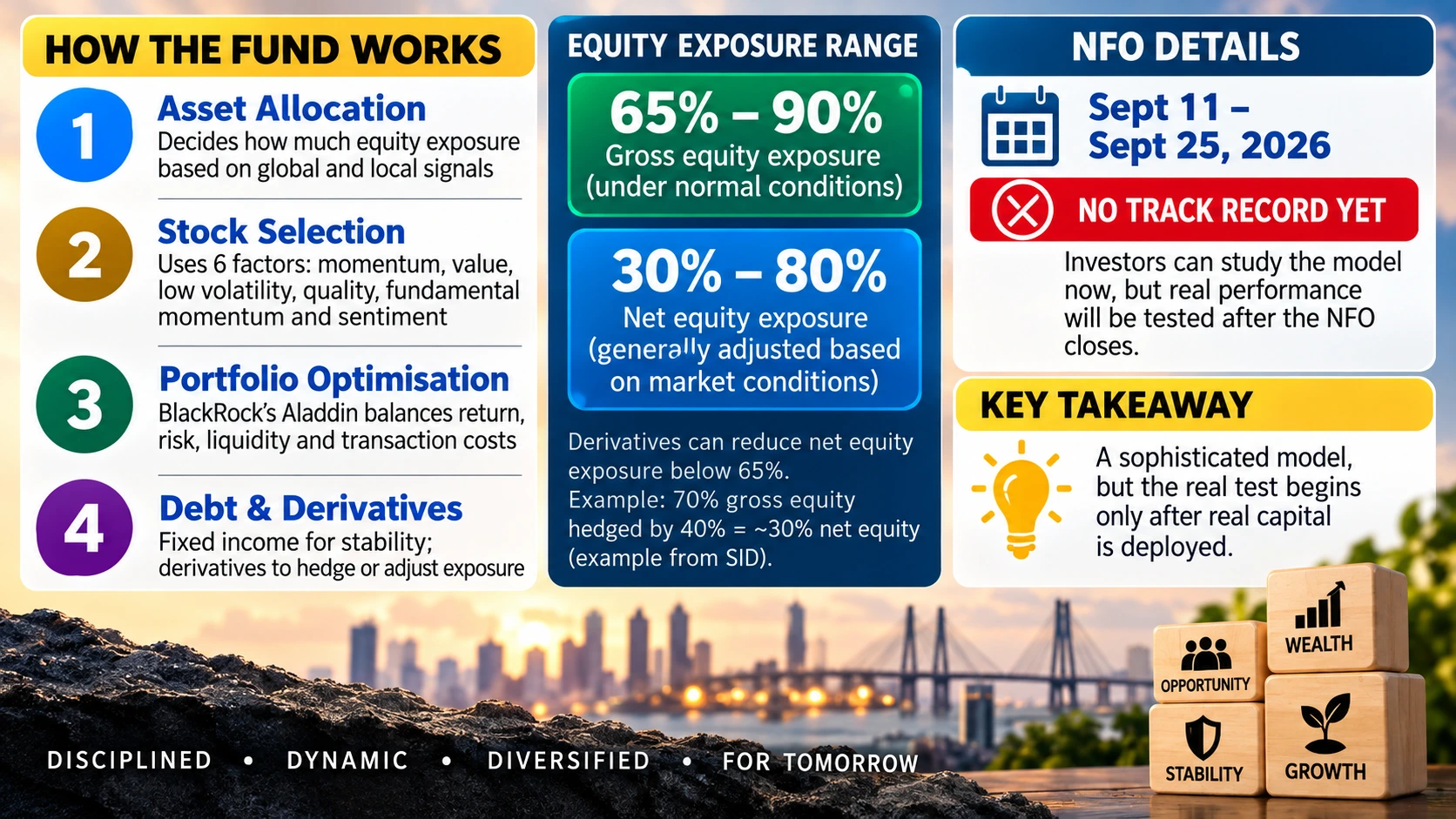
The process is designed to first determine how much equity exposure the portfolio should carry, then identify stocks within a roughly 250-company universe, and finally use BlackRock’s Aladdin platform to balance expected return, risk, liquidity and transaction costs. Fund managers retain the final authority over investment decisions.
That distinction matters because the scheme is still new. Its NFO runs from September 11 to September 25, 2026, and the SID says the fund has no performance track record.
Investors can therefore examine the machinery before launch, but not yet whether it can deliver consistently across different market regimes. That expectation gap could become the fund’s biggest test once real capital is deployed.

The portfolio machine has several layers
The August 25, 2026 SID lays out a framework covering asset allocation, security selection, portfolio optimisation, fixed income and derivatives.
How JioBlackRock’s portfolio architecture works
| Layer | What it does | What is disclosed |
|---|---|---|
| Top-down allocation | Determines the equity risk budget | Global risk sentiment, local risk sentiment, macroeconomics, technicals and valuations |
| Stock selection | Identifies equity candidates | Six factors described by management: momentum, value, low volatility, quality, fundamental momentum and sentiment |
| Portfolio optimisation | Converts signals into portfolio weights | Aladdin considers alpha, risk, liquidity, transaction costs and constraints |
| Debt portfolio | Builds the fixed-income allocation | Credit risk, interest-rate risk, liquidity and term/credit spreads |
| Derivatives | Changes or hedges market exposure | Hedging, rebalancing and other permitted derivative strategies |
The important point is that these layers interact.
A strong stock score does not automatically translate into a large portfolio weight. Likewise, a favourable stock signal does not by itself determine the fund’s overall equity exposure.
First question: How much equity risk should the fund take?
Under normal circumstances, the scheme can allocate 65% to 90% of total assets to equity and equity-related instruments, with 10% to 35% in debt and money-market instruments.
But gross equity exposure is not the same as net equity exposure.
The SID says gross equity can remain between 65% and 90% while derivatives reduce net equity exposure below 65%. Its illustration shows a portfolio with 70% gross equity exposure hedged by 40%, resulting in roughly 30% net equity exposure. The document presents this as an example of the mechanism, not a forecast.
JioBlackRock separately states that net equity is generally adjusted between 30% and 80%, depending on market conditions and valuation.
That distinction could become important once the scheme begins operating. Two Balanced Advantage Funds may report similar gross equity holdings while carrying materially different net market exposure because of their hedging positions.
For investors following the strategy, net equity exposure may therefore provide a clearer indication of actual market-risk positioning than gross equity allocation alone.
Five signal groups steer the asset-allocation process
The top-down model does not begin with individual stocks.
JioBlackRock’s framework combines global risk sentiment with four domestic signal groups: local risk sentiment, macroeconomic indicators, technical indicators and valuations.
Management has said the global component can incorporate factors such as geopolitics, crude prices and bond yields, while domestic inputs include growth, inflation, interest rates, price behaviour and valuation measures.
The model then uses a composite score to determine the appropriate equity allocation.
A change in global risk sentiment or valuations does not automatically trigger a particular stock trade. Instead, those signals influence the portfolio’s broader risk budget before stock selection takes place.
Then comes the 250-stock universe
Once the equity allocation is established, the next stage is stock selection.
CIO Rishi Kohli told ET that the model evaluates about 250 companies across the large-cap and large-and-midcap segment. The six factors are momentum, value, low volatility, quality, fundamental momentum and sentiment.
The factors are intended to capture different characteristics of a company and its market behaviour:
Momentum looks at persistence in price trends.
Value focuses on relative attractiveness of valuation.
Low volatility identifies stocks with comparatively lower price fluctuations.
Quality considers business and financial strength.
Fundamental momentum captures improving earnings, sales and other fundamentals.
Sentiment incorporates market, news and analyst perception.
There is an important disclosure nuance: the six-factor list comes from management’s explanation, while the SID discusses several of these characteristics in detail and says the groupings are indicative and may evolve.
The portfolio, therefore, should not be viewed as permanently tied to one fixed factor recipe.
A high factor score does not automatically mean a high weight
This is where Aladdin becomes important.
The SID says BlackRock’s Aladdin technology platform, licensed to JioBlackRock AMC, supports portfolio construction. The optimisation process uses the composite research score alongside risk constraints, transaction costs, market liquidity and sector or stock constraints.
In practice, a stock with an attractive expected-return signal may still receive a smaller allocation if implementing the trade would create excessive liquidity or market-impact costs.
The architecture is therefore closer to:
signals → composite score → optimisation → portfolio weights
rather than:
highest score → biggest position
That distinction becomes particularly relevant when markets become less liquid or factor signals change rapidly.
Aladdin is not the final decision-maker
The “AI fund” description also needs qualification.
The SID explicitly says the systematic models and data analytics are an analytical framework, not an automated decision-making system. Fund managers retain full and final authority over investment decisions.
The practical structure is therefore:
data → signals → model → optimisation → fund-manager decision
That human layer means the eventual outcome will depend not only on the signals generated by the system, but also on how the investment team applies and adjusts the framework.
The equity portfolio is expected to hold 50–75 stocks
The fund is not expected to own all 250 stocks in its universe.
Kohli told ET that the resulting portfolio is expected to contain 50 to 75 stocks, with a typical range of about 60 to 70.
That makes the eventual portfolio materially narrower than the stock-selection universe.
The more revealing disclosures will therefore come after launch: top holdings, sector weights, factor tilts and portfolio turnover should show how the optimisation process is translating the wider universe into actual risk concentrations.
The tax structure adds another layer
The scheme’s design also addresses the tax treatment associated with equity-oriented funds.
The Income-tax Act defines an equity-oriented fund using a minimum 65% investment in equity shares of domestic companies, based on the prescribed calculation methodology.
That creates a structural challenge for a Balanced Advantage Fund. The portfolio may seek to reduce its economic equity exposure when market conditions deteriorate while still seeking the tax treatment associated with an equity-oriented fund.
JioBlackRock says its structure addresses this through an arbitrage and hedging sleeve when net equity allocation falls below 65%.
Kohli also explained to ET that cash-futures arbitrage can bridge the difference between the desired economic equity allocation and the classification requirement.
The important distinction is that gross classification exposure and economic market exposure are not necessarily the same thing.
The model also faces a trading-cost test
The SID does not provide a target portfolio-turnover number.
Instead, it says turnover is difficult to estimate because subscriptions, redemptions and portfolio decisions can affect trading activity. It also warns that frequent trading can increase transaction costs such as brokerage.
That creates a practical market tension.
A systematic model can react to changing signals quickly, but acting on every signal can raise implementation costs. The portfolio therefore has to balance the expected benefit of changing positions against the cost of executing those trades.
Aladdin’s explicit use of transaction-cost and liquidity inputs becomes important in that context.
Even so, no optimisation process can guarantee that a forecasted alpha signal will survive brokerage, spreads, market impact, taxes, slippage and changing market conditions.
Derivatives add another layer of risk
Derivatives give the fund a mechanism to change net market exposure without necessarily rebuilding the underlying equity portfolio.
But the SID also identifies risks including basis risk, liquidity risk, valuation and model risk, and imperfect correlation between the hedge and the underlying exposure. It notes that a breakdown in the required hedge relationship can trigger rebalancing requirements.
That creates a forward-looking test for the strategy.
It is not enough for the model to identify the right market direction. The hedge also has to be implemented efficiently during stressed conditions.
The paper model is not the same as a live track record
Kohli told ET that the model’s paper portfolio had been operating in roughly a 40%–60% equity range during the preceding six months, depending on market conditions.
That provides some visibility into the framework’s testing phase.
But it is not a live return history.
The SID explicitly states that the scheme is new and does not have a performance track record.
That distinction is critical because investors have yet to see how the strategy behaves during a sharp market sell-off, prolonged momentum rally, factor reversal, liquidity shock or rapid change in bond yields.
The model can be examined before launch. Its real-world performance cannot.
JioBlackRock is entering a much larger existing BAF market
The competitive context puts the launch in perspective.
HDFC Balanced Advantage Fund had ₹1,07,295.79 crore in AUM as of August 31, 2026, according to HDFC Mutual Fund.
JioBlackRock AMC, by comparison, said its overall AMC AUM had crossed ₹22,000 crore as of September 8, 2026, while management was targeting ₹25,000 crore for FY2026-27.
That provides a useful scale marker: JioBlackRock’s Balanced Advantage Fund is entering a category where at least one established competitor already manages more than ₹1 lakh crore.
The eventual assessment of the new scheme will therefore depend on more than its technology stack. Live portfolio construction, risk control, implementation costs and performance relative to the benchmark will matter.
Management has outlined an alpha ambition — not an achieved result
Kohli has said JioBlackRock is aiming for 3%–4% alpha over the benchmark.
That is a management objective, not a realised result.
The scheme’s benchmark is the Nifty 50 Hybrid Composite Debt 50:50 Index (TRI). The SID also states that there is no assurance that the investment objective will be achieved.
The more meaningful test will come after implementation costs, hedging effects and actual market conditions are reflected in live returns.
What investors should watch after launch
Once the portfolio becomes live, these disclosures should provide a clearer picture of whether the architecture is translating into actual positioning.
| Metric | Why it matters |
|---|---|
| Net equity exposure | Shows the fund’s actual market-risk positioning |
| Gross equity exposure | Shows the underlying equity book |
| Derivative hedge size | Indicates how aggressively net exposure is being adjusted |
| Top 10 holdings | Reveals concentration |
| Sector weights | Identifies hidden sector bets |
| Factor tilts | Shows which signals are driving selection |
| Portfolio turnover | Provides evidence of implementation intensity and trading costs |
| Performance vs benchmark | Tests the strategy against its stated reference index |
| Drawdown in stressed markets | Shows how the dynamic-allocation mechanism behaves under pressure |
The SID says portfolio disclosures will be provided on the AMC’s website after the scheme begins operating.
Need to Know
| Detail | JioBlackRock Balanced Advantage Fund |
|---|---|
| NFO period | September 11–25, 2026 |
| Category | Hybrid – Balanced Advantage Fund |
| Minimum application | ₹500 |
| Benchmark | Nifty 50 Hybrid Composite Debt 50:50 Index (TRI) |
| Gross equity range | 65%–90% |
| Debt/money-market range | 10%–35% |
| Net equity | Can fall below 65% through derivative hedging |
| Riskometer | Very High Risk |
| Exit load | Nil |
| Plans | Regular and Direct |
| Option | Growth |
| Live performance history | None yet |
The NFO dates, minimum investment, benchmark, asset-allocation range, exit load and plan structure are stated in the SID. The official JioBlackRock fund page confirms the Very High Risk riskometer.
Read Next: Apple Pay India Launch With Axis Bank: Why NPCI’s Tap-to-Pay Move Matters
Track the market signals
Once the fund is live, investors can compare its positioning with broader market signals such as institutional flows and derivatives activity.
FII-DII Tracker: NiftyTrader FII-DII Data
Option Chain: NiftyTrader NSE Option Chain
Options Simulator: NiftyTrader Options Simulator
Disclaimer: Mutual fund investments are subject to market risks. This article is for informational purposes only and should not be considered investment advice. Investors should review the latest scheme documents and assess their own financial circumstances before investing.