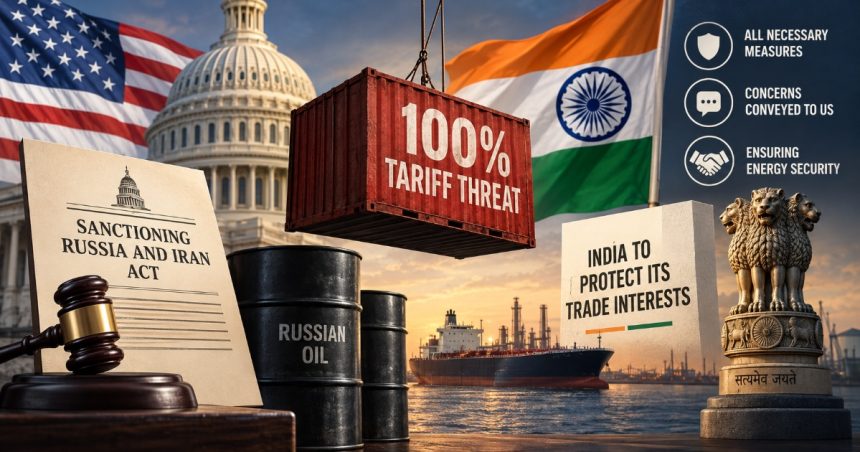
US Threatens 100% Tariffs Over India’s Russian Oil Buys as Congress Passes Bill
India has signalled that it is prepared to protect its trade and economic interests after the US Congress passed legislation that could allow tariffs of up to 100% on countries continuing to buy Russian oil and gas. The development has put India’s energy sourcing and US trade relations back in focus.
For investors, the key question is what happens next. The legislation does not itself impose a 100% tariff on Indian exports. Instead, it gives the US administration additional powers to impose tariffs on countries involved in certain Russian energy transactions.
Track Live : GIFT Nifty Live – Today Price, Chart, Timings and Nifty Opening Signal
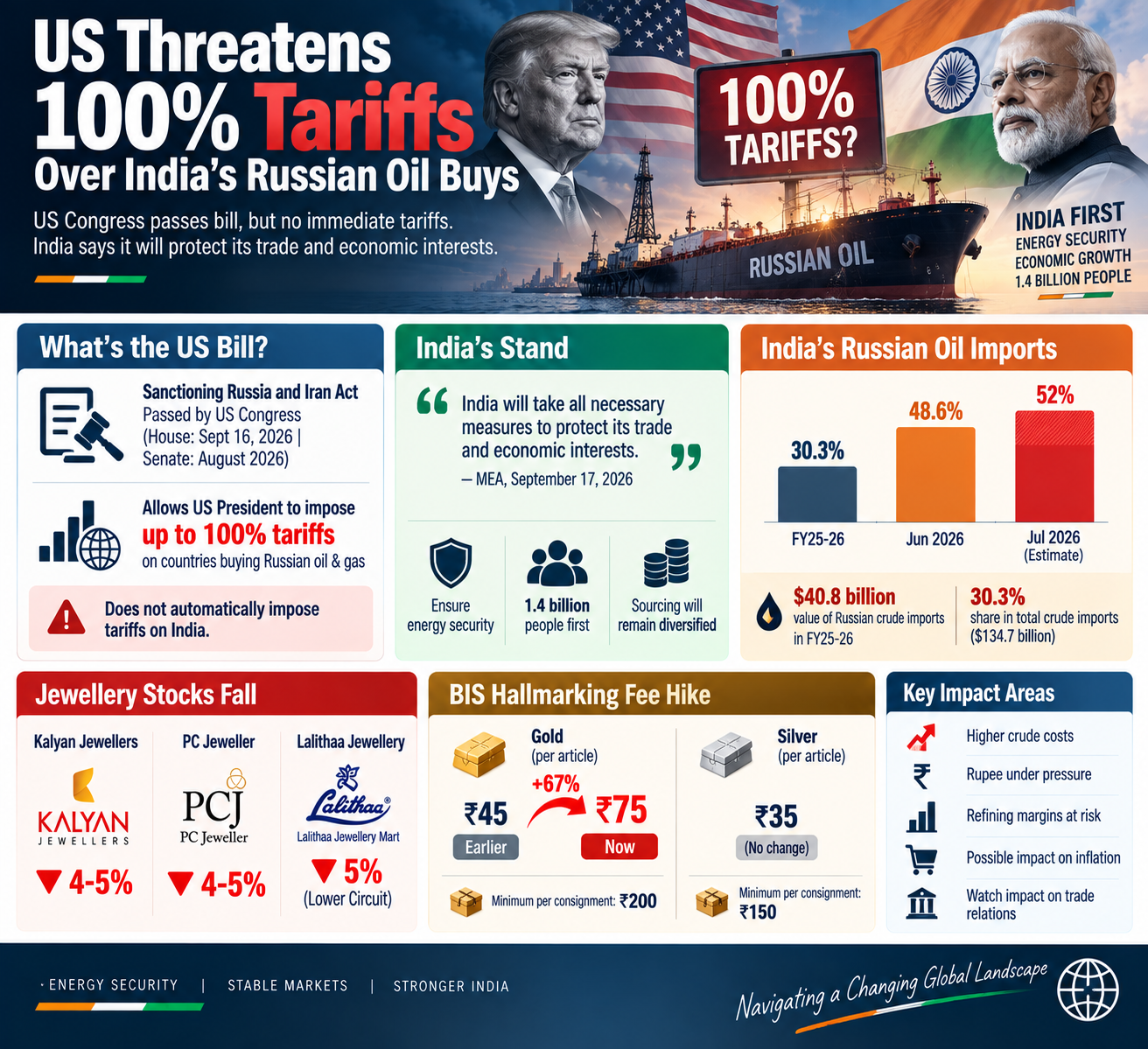
US Threatens 100% Tariffs India says it will protect trade and economic interests
The Ministry of External Affairs (MEA) said on September 17 that India is closely monitoring the situation and will work with trade and industry bodies to assess the implications.
“The Indian side has also made clear its determination to take all necessary measures to protect its trade and economic interests,” the MEA said.
The ministry added that the government would work closely with Indian trade and industry bodies as the situation develops.
The US House of Representatives passed the Sanctioning Russia and Iran Act on September 16 after the Senate approved the legislation in August. The bill now requires further action before becoming law.
India’s Stand and Economic Stakes
- Prioritising “1.4 Billion People First”: The Ministry of External Affairs (MEA) reiterated that its energy policy is dictated by domestic economic needs, ensuring secure, affordable, and reliable energy for its population.
- High Dependence on Russian Crude: In August 2026, crude oil imports from Russia surged by 62.4% year-on-year, accounting for over 50% of India’s total oil import mix.
- Substantial Economic Savings: Economic think tanks estimate that India has saved approximately $12.6 billion since its post-2022 shift to Russian crude, providing a critical buffer given tight global supplies.
- Refinery Pressure: Domestic Indian refiners are urging New Delhi to negotiate quotas or gradual relaxations with Washington rather than an outright tariff wall, noting that cutting Russian supplies would heavily impact refinery profit margins.
Key Provisions of the US Sanctions Bill
- Discretionary 100% Tariffs: Authorises the US President to impose duties up to 100% on goods from major energy buyers of Russian oil, explicitly threatening India, China, Slovakia, Hungary, and Azerbaijan.
- Disrupting Revenue: Aims to choke Moscow’s export funding to force an end to the war in Ukraine.
- Secondary Targets: Imposes targeted sanctions on vessels, logistical entities, and maritime operators transporting discounted Russian oil below established market caps.
Key Facts of the US Legislation
- The Bill: The US House of Representatives passed the Sanctioning Russia and Iran Act on September 16, 2026, following Senate approval in August. It now awaits further action by the US administration.
- The Threat: The legislation expands sanctions and authorises the US administration to impose tariffs of up to 100% on countries that continue to purchase Russian oil and gas.
- Current Status: The act gives the US President the power to leverage these tariffs, but it does not automatically or immediately impose a specific tariff on Indian exports.
Russian oil remains important for India’s energy strategy
The issue is significant because Russian crude has become an important part of India’s oil sourcing following the shift in global energy trade after Russia’s invasion of Ukraine.
Indian refiners have purchased Russian crude partly because of its competitive pricing. Any measures that make these supplies more expensive or difficult to access could therefore have implications beyond foreign policy, particularly for India’s oil-import bill, refining margins and domestic fuel economics.
India has repeatedly maintained that its energy sourcing decisions are driven by energy security and market conditions.
“As stated on several earlier occasions, India remains firmly committed to ensuring energy security for its 1.4 billion people,” the MEA said, adding that sourcing would remain diversified and based on evolving market dynamics.
Track Live : Opening Price Clues – What Pre-Market Data Says Today
Russian crude dependency: the key numbers
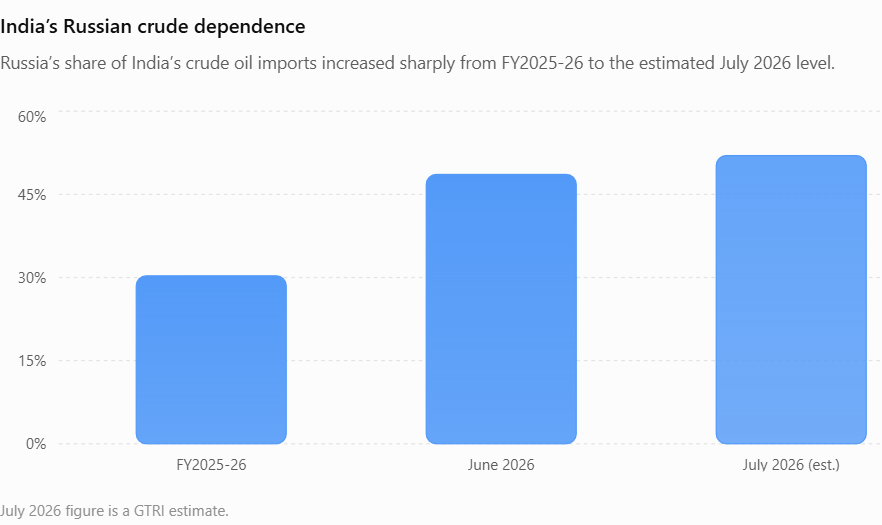
According to GTRI analysis cited by Economic Times, Russia supplied 30.3% of India’s crude oil imports in FY2025-26, worth about $40.8 billion out of India’s total crude imports of $134.7 billion.
The dependence increased sharply in 2026. GTRI estimated Russia’s share at 48.6% in June 2026 and around 52% in July 2026. The July figure is an estimate, because detailed country- and product-wise crude data was not yet available; GTRI derived it from available government trade data.
If Russian crude purchases fall, what could change?
- Higher-cost crude: India may need more Middle Eastern and other replacement barrels, potentially raising procurement costs.
- Refining margins: A costlier crude mix could squeeze refinery profitability, particularly if product prices do not rise proportionately.
- Inflation: Higher crude and fuel costs can feed into transportation and other prices.
- Current account: A larger oil import bill could widen India’s trade/current-account pressures.
- Rupee: More expensive oil imports increase dollar demand, potentially adding pressure on the rupee.
- Equities: Investors could reassess earnings for refiners, oil marketers, transport and other crude-sensitive sectors if higher input costs persist.
Here’s what happened today and why traders reacted
The immediate market focus is likely to remain on whether the US administration ultimately uses the tariff powers provided by the legislation and how India responds.
The MEA said India had already conveyed its concerns to US officials regarding the possible impact on bilateral relations and global energy markets.
“This issue has been discussed at high levels in recent months with various US interlocutors,” the ministry said, adding that the implications for the India-US relationship and international energy markets had been clearly communicated.
This uncertainty could keep oil prices, the rupee, Indian refiners and energy-sensitive stocks on investors’ radar.
Read More : UPI MDR Sparks Bullish Brokerage Calls on Paytm, Pine Labs; Up to 35% Upside Seen
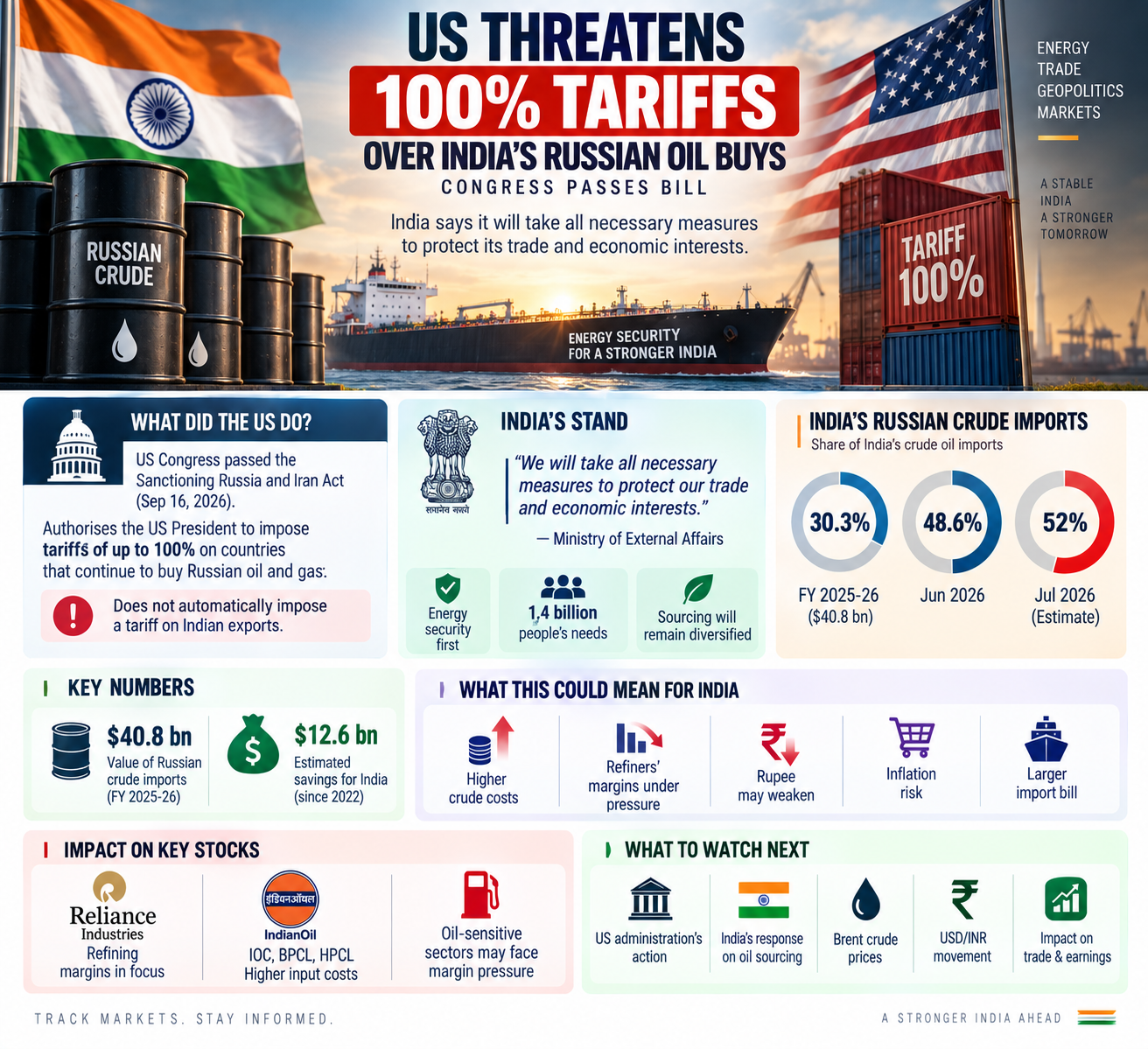
What could the US tariff threat mean for Indian stocks investors?
For Indian investors, the biggest variables are crude prices, refining economics, currency movements and the potential effect on India-US trade.
Oil marketing and refining companies could see changing margin expectations if the cost or availability of Russian crude shifts. At the broader market level, a sustained rise in crude prices could increase pressure on India’s import bill and potentially affect the rupee.
Export-focused companies also need to monitor the wider India-US trade relationship because the legislation comes while both countries are engaged in discussions on bilateral trade.
For now, investors will be watching for the next steps from Washington and New Delhi rather than assuming that a 100% tariff has already been imposed.
- Reliance Industries: Refining margins could come under focus.
- IOC, BPCL, HPCL: Higher crude costs could pressure marketing margins and working capital if fuel prices do not fully adjust.
- Refining margins: Replacement crude could increase input costs.
- Earnings: Sustained higher crude prices could affect profit estimates.
What investors should watch next
- US administration’s action on the legislation
- India’s response on Russian crude purchases
- Brent crude and global oil prices
- USD/INR movement
- Refining margins and oil-sector stocks
- Progress in India-US trade discussions
The situation remains fluid, and the eventual market impact will depend heavily on how the tariff powers are implemented and whether India changes its Russian oil sourcing strategy.