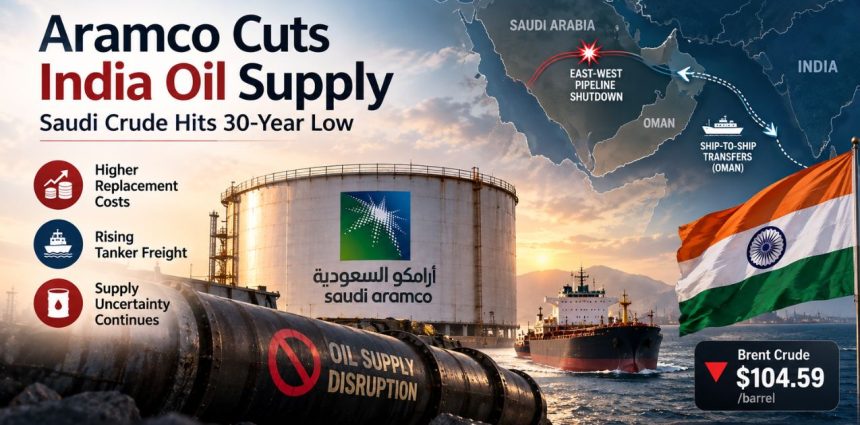
Saudi Arabia is rerouting crude through Oman and trying to restore its damaged pipeline, but Indian refiners face a tougher replacement problem as freight, crude differentials and supply uncertainty rise.
Saudi Aramco has stopped supplying contracted crude to Indian refiners until further notice after attacks forced the shutdown of Saudi Arabia’s critical East-West pipeline, according to people familiar with the matter cited by The Economic Times.
For India, the immediate issue is not a lack of replacement crude. Refiners can source barrels from other producers. The pressure is emerging elsewhere: replacement crude is more expensive, tanker costs are elevated and the safest routes are becoming harder to secure.
The disruption is also larger than a single Saudi pipeline outage. The International Energy Agency said Saudi oil production had fallen sharply amid the wider Middle East supply shock, while Reuters reported that August production had dropped to 6.2 million barrels per day, the lowest level in more than three decades. The East-West pipeline itself had been moving roughly 4 million barrels per day, equivalent to about 4% of global oil supply.
That puts Indian refiners in a market where oil can still be found, but getting the right barrels delivered economically is becoming the bigger challenge.
Also Read: Saudi Pipeline Shut, Houthis Advance: Why Nifty Faces Fresh Oil Risk
Need to Know
| Development | Latest information |
|---|---|
| Saudi-East West Pipeline | Shut after September 10 attacks |
| Pipeline capacity | About 7 million barrels per day |
| Recent throughput before shutdown | About 4–5 million barrels per day |
| Saudi August production | 6.2 million barrels per day, according to Reuters citing IEA data |
| India’s Saudi crude share | 13.58% of crude imports in FY2024-25 |
| Saudi workaround | Ship-to-ship crude transfers near Sohar, Oman |
| Brent on Sept. 17 | About $104.59/barrel in Reuters’ latest report |
| Pipeline repair outlook | Partial restart targeted within days; full restoration could take weeks |
Sources: Reuters, IEA, Government of India, Saudi Press Agency.
Saudi Oil Crisis Is Bigger Than India
The East-West pipeline is strategically important because it normally allows Saudi crude to move from the kingdom’s eastern fields to Yanbu on the Red Sea, providing a route that bypasses the Strait of Hormuz.
That alternative has become particularly important because shipping through Hormuz has been severely disrupted during the wider Middle East conflict.
Saudi Arabia now has to manage crude exports with fewer reliable paths.
Reuters reported that Saudi oil loadings at Ras Tanura and Juaymah had risen to about 4 million barrels per day, while Yanbu loadings had halted. Saudi Arabia is also offering Arab Light, Arab Medium and Arab Heavy crude to Asian buyers using ship-to-ship transfers off Sohar, Oman.
Oil prices have responded to that change in logistics rather than to a simple production shutdown.
Brent fell to about $104.59 a barrel on September 17, after declining roughly $3 the previous day, as the additional Saudi flows through Oman eased fears of an immediate physical shortage.
That price decline does not mean the supply problem has disappeared.
It means the market has found a possible workaround.
What Happened to India’s Saudi Contracts?
ET reported that Indian refiners are currently not receiving their contracted Saudi term supplies.
Saudi Aramco typically sells crude to Indian customers through annual term contracts linked to its official selling prices. The current disruption is forcing refiners to turn towards alternative supplies and spot-market purchases.
Some Saudi spot cargoes have still been sold to traders who may ultimately deliver smaller volumes to Indian buyers.
Those shipments can involve buying Iraqi crude at discounts, moving cargoes through Hormuz and then transferring them ship-to-ship in the Gulf of Oman before onward delivery.
That is important because it demonstrates that physical barrels can still reach India — but the logistics are becoming more complicated and potentially more expensive.
India Has a Cushion — But It Is Not Free
Saudi Arabia supplied 33.14 million tonnes of crude to India in FY2024-25, representing 13.58% of India’s total crude imports, according to the Government of India.
That means India is not dependent on Saudi Arabia for all of its oil.
Indian refiners have historically been able to shift toward other suppliers when Middle Eastern flows are disrupted. Reuters previously reported that companies including HPCL, IOC and MRPL were already increasing spot purchases and looking toward suppliers outside the most disrupted shipping routes.
The problem is timing.
When several refiners simultaneously chase replacement crude, the cheapest available barrels can quickly become more expensive.
This creates a key expectation gap:
Replacement supply may be available, but replacement supply at the same landed cost is not guaranteed.
The Real Pressure Point: Freight
The price of the crude itself is only one part of India’s import bill.
Freight and insurance can rise sharply when ships have to avoid high-risk routes or compete for a limited number of available tankers.
The IEA said tanker costs increased sharply in August as security risks intensified, while global observed oil inventories fell by another 95 million barrels during the month. Cumulative inventory withdrawals since February reached 507 million barrels.
That matters for Indian refiners because a replacement cargo can become expensive even if Brent does not move proportionately.
A simplified refinery cost chain looks like this:
Crude benchmark + grade differential + freight + insurance + financing = landed crude cost
So a Brent pullback does not automatically mean Indian refiners have escaped cost pressure.
Saudi Arabia Is Already Trying to Fix the Problem
Saudi Arabia is not standing still.
Reuters reported that Saudi Aramco has increased Gulf-side loadings and is offering additional cargoes through Oman. Four VLCCs capable of carrying about 2 million barrels each were also reported loading at Ras Tanura based on satellite data cited by Reuters.
There is also a repair effort.
Reuters reported that U.S. Energy Secretary Chris Wright said the pipeline could be operational again within days, while other estimates have put a full restoration timeline at roughly five to six weeks. A separate Bloomberg report said Aramco was targeting restoration of about half the pipeline’s throughput within days, with full repair targeted in around six weeks.
These are not the same as a confirmed Saudi repair schedule.
The uncertainty over duration is therefore still a key market variable.
The repair clock matters
Fast partial restart:
More Saudi barrels return to the system and pressure on physical premiums could ease.
Partial restart but prolonged reduced capacity:
Saudi Arabia may keep using Gulf terminals and Oman transfers while refiners continue paying elevated logistics costs.
Long disruption:
Global buyers could compete more aggressively for Atlantic Basin, Russian, African and Latin American crude, potentially keeping physical premiums and freight elevated.
Europe Is Already Searching for Replacement Barrels
The disruption has moved beyond Asia.
Reuters reported that Saudi Arabia had cut some shipments to European customers after the pipeline attack. Poland’s Orlen, which has historically relied heavily on Saudi crude, responded by buying additional cargoes from Norway, Britain, Algeria, Kazakhstan and the Americas.
Market sources cited by Argus also reported that several European cargoes had been cancelled or delayed and estimated that Yanbu’s remaining inventories were limited. That inventory estimate could not be independently confirmed and should therefore be treated as a market-source warning rather than an official Saudi stock figure.
The European scramble matters for India because refiners in multiple regions can end up competing for the same replacement barrels.
That can change regional crude premiums even when the headline Brent price is relatively stable.
What This Means for Indian Refiners
The key Indian listed names investors are likely to monitor are Indian Oil Corporation, Bharat Petroleum Corporation, Hindustan Petroleum Corporation and Reliance Industries, because crude costs and refined-product margins are important variables for their earnings.
The direction of the impact is not identical across companies.
For state-run oil marketing companies, higher crude costs can increase pressure on marketing margins and working capital when retail fuel prices do not adjust immediately. Recent market analysis has highlighted this sensitivity as Indian crude costs remained above historical norms.
At the same time, refiners can sometimes benefit from stronger product cracks when fuel markets tighten.
The IEA reported that refining margins in the Atlantic Basin reached record levels in August, driven by sharply higher diesel cracks, although rising freight costs also weighed on refining economics in Asia.
So the market outcome is not simply:
Higher crude = bad for every oil company.
The more useful equation is:
crude cost + freight + product cracks + inventory gains/losses + retail pricing
That is what investors need to watch.
CHECK LIVE: INDIAN OIL CORPORATION Options Chart | Nifty Trader
BHARAT PETROLEUM CORPORATION Option Chain (NSE)
HINDUSTAN PETROLEUM CORPORATION Ltd Futures
India’s Broader Oil-Import Risk
The Saudi disruption arrives after months of supply-chain stress.
The IEA’s September Oil Market Report said global oil production fell 1.6 million barrels per day month-on-month to 100.1 million bpd in August, while more than 10 million bpd of Gulf output remained shut in because of security risks. The agency projected 2026 global supply at 100.7 million bpd, down 5.7 million bpd for the year.
The same report said global observed inventories had fallen 507 million barrels since February.
For India, that means the current Saudi disruption is occurring against a market that is already carrying less spare inventory and higher transport costs.
This increases the importance of duration.
A short Saudi outage can be absorbed through alternative barrels and logistics.
A prolonged outage combined with continuing Hormuz and Red Sea disruption would make that substitution progressively more expensive.
Crude Prices Are Sending a Mixed Signal
The latest price action illustrates the market tension.
Brent fell to $104.59 a barrel on September 17 as Saudi Arabia’s Oman workaround eased immediate supply fears.
But the IEA continues to describe an unusually tight physical market, with depleted inventories, elevated freight and severe disruptions to Middle Eastern production and exports.
That creates a potentially important divergence:
Futures prices can fall because investors see a repair or rerouting solution, while physical crude buyers may still be paying elevated premiums for prompt cargoes.
ET’s report specifically notes that spot-market prices can rise faster than futures prices during supply disruptions.
For Indian refiners, that physical-market distinction may matter more than the next headline move in Brent.
What Investors Should Watch Now
The next signals are straightforward.
Saudi pipeline restart: The speed of partial and full restoration will show whether the disruption is temporary or prolonged.
Yanbu exports: A sustained return of loadings would indicate that Saudi’s Red Sea route is recovering.
Sohar transfers: Higher volumes would show whether the Oman workaround can meaningfully offset lost pipeline capacity.
Tanker rates: A sustained spike could keep Indian landed crude costs high even if Brent retreats.
Indian crude premiums: The spread paid for alternative grades may reveal more about refinery economics than the headline benchmark.
Russian crude discounts: Any renewed narrowing or widening will affect how much Indian refiners can offset the loss of Saudi term barrels.
Domestic fuel pricing: Petrol and diesel prices remained unchanged in major Indian cities on September 17 despite the crude volatility, according to current market reporting.
For daily positioning, track the [FII-DII Tracker] alongside crude, rupee and institutional flows to see whether the oil shock is translating into broader Indian market pressure.
Key Takeaways
- Saudi Aramco has stopped supplying contracted crude to Indian refiners until further notice, according to people cited by ET.
- India is expected to find alternative barrels, but higher crude differentials, freight and insurance are raising the replacement cost.
- Saudi Arabia is increasing Gulf loadings and offering crude through ship-to-ship transfers near Sohar, Oman, helping reduce the immediate global shortage risk.
- Saudi August production was reported by Reuters at 6.2 million bpd, the lowest in more than three decades.
- India’s diversified crude basket offers a cushion, but a prolonged disruption could raise its landed oil cost and pressure refinery and fuel-marketing economics.
Bottom Line
Saudi Arabia’s oil problem is increasingly becoming a routing and replacement-cost problem rather than a simple question of whether India can find crude.
Aramco is already using alternative Gulf logistics and trying to restore the East-West pipeline, which explains why Brent has eased from its recent highs. But the broader oil market remains unusually tight, inventories are depleted and tanker costs are elevated.
For India, the key risk is therefore not an immediate physical shortage of crude.
It is the possibility that Saudi term barrels are replaced by more expensive spot cargoes, longer shipping routes and higher freight, squeezing refinery and marketing economics for longer than the current futures curve suggests.
The next few days of pipeline repair progress and Saudi export rerouting could therefore matter more for Indian oil companies than the next single move in Brent.
Read Next: Stocks To Watch Today, Sept. 17: Mazagon Dock, Tahmar, Fortis
Market Risk Note: Oil prices, freight rates, crude differentials and refinery margins can change rapidly during geopolitical disruptions. Estimates from traders, brokers and market sources are subject to revision and should not be treated as official data unless independently confirmed.
SEBI Disclaimer: This article is for informational and educational purposes only and is not investment advice, a recommendation, or a solicitation to buy or sell any security. Investors should conduct their own research and consult a SEBI-registered investment adviser before making investment decisions.