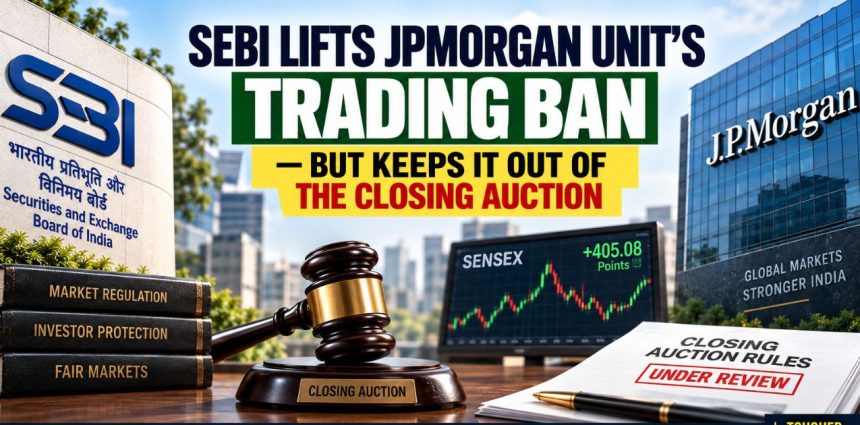
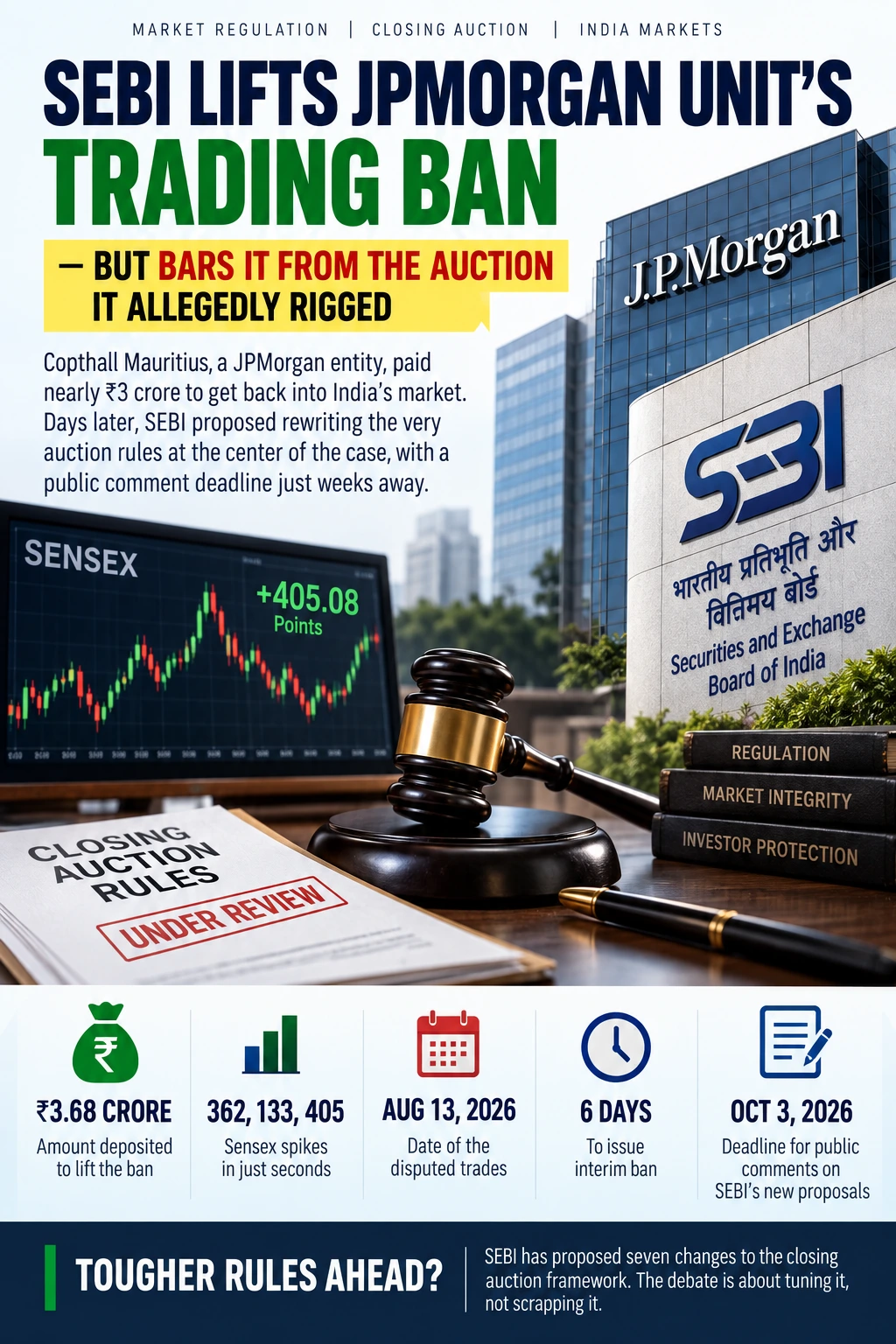
Copthall Mauritius, a JPMorgan Chase entity, paid nearly ₹3 crore to get back into India’s market. Days later, SEBI proposed rewriting the very auction rules at the center of the case, with a public comment deadline just weeks away.
India’s markets regulator has let a JPMorgan Chase unit back into the country’s stock market, five weeks after banning it over allegations its trades distorted the closing price of the Sensex. But the relief comes with a catch: most coverage of the story missed the firm is still shut out of the exact trading window where the alleged manipulation happened, and the Securities and Exchange Board of India (SEBI) has now proposed rewriting the rules of that window entirely.
The Numbers at a Glance
- ₹3.68 crore (~$387,000) — combined amount Copthall Mauritius and Mansi Share and Stock Broking deposited to get their ban lifted
- 362, 133 and 405 points — the three Sensex spikes SEBI flagged, each packed into 2 to 28 seconds
- August 13 — date of the disputed trades, a weekly Sensex derivatives expiry day
- 6 days — how fast SEBI moved from the alleged trades to an interim ban
- October 3, 2026 — deadline for public feedback on SEBI’s proposed closing-auction overhaul
Check Live: NiftyTrader: Live Options Analytics & F&O Trading Tools
What Actually Changed on September 9
Copthall Mauritius Investment Ltd., a Mauritius-based JPMorgan entity, and Mumbai brokerage Mansi Share and Stock Broking deposited a combined ₹3.68 crore to comply with SEBI’s interim order, restoring their general ability to trade in Indian markets, Reuters reported, citing people familiar with the matter. Bloomberg reported that Copthall’s share of that payment, roughly ₹2.96 crore, matches SEBI’s estimate of the firm’s own alleged gains, with Mansi accounting for the remaining roughly ₹72 lakh.
The relief isn’t unconditional. Copthall remains barred specifically from participating in the BSE’s closing auction session while SEBI’s investigation continues, meaning the firm can trade everywhere in the market except the one mechanism this entire case is about.
| What changed | What stays in place |
|---|---|
| General trading ban lifted for both firms | Copthall still barred from the Closing Auction Session |
| ₹3.68 crore deposited | SEBI’s investigation continues |
| Entities can trade normally elsewhere | No confirmatory order or final finding yet |
Inside the August 13 Trades SEBI Flagged
The closing auction session (CAS) launched on August 3 as a 20-minute window starting at 3:15 p.m. IST, built to set official end-of-day prices for Sensex-linked stocks and settle futures and options contracts more transparently, bringing India’s price-discovery process closer to global norms.
Ten days after launch, on a day weekly Sensex derivatives contracts expired, SEBI’s 46-page interim order, issued by whole-time member Kamlesh Chandra Varshney, alleges Copthall placed buy orders for 3.17 million shares across all 30 Sensex constituents, priced roughly 3% above reference levels, and then cancelled about a third of them. Mansi placed sell orders for 1.28 million shares and cancelled nearly all of them within seconds.
SEBI’s surveillance flagged three unusually sharp, short-lived spikes in the Sensex’s indicative equilibrium price during the auction window: a 362.02-point jump in two seconds, a 132.67-point move in 12 seconds, and a 405.08-point rise in 28 seconds. Copthall accounted for 99.91%, 96.09% and 85.21% of the buy-order value behind those three spikes, respectively; its first burst of orders alone totalled ₹66.64 crore, of which it later cancelled roughly ₹98.12 crore worth across the episodes. SEBI said the pattern benefited both firms’ existing options positions tied to the index.
The regulator moved unusually fast: its interim order landed just six days after the trades, one of the quickest turnarounds of any Indian market-manipulation case in recent memory.
Also Read: SEBI Rethinks CAS After Sharp Expiry-Day Swings
JPMorgan’s Next Move
Copthall operates as a foreign portfolio investor for JPMorgan’s global clients and is a separate legal entity from J.P. Morgan India Pvt Ltd, the bank’s locally registered broking and merchant-banking arm, so the case doesn’t directly touch JPMorgan’s onshore Indian business. The Mauritius unit is expected to seek further clarification from SEBI and argue the trading pattern reflected a technical or operational issue rather than deliberate manipulation, though it may hold off on a formal appeal for now.
SEBI has signalled a confirmatory order will follow once both firms have had a hearing, the step that decides whether the interim findings hold and whether further penalties follow.
Worth stressing: SEBI’s order is an interim finding, not a final determination of wrongdoing. Copthall and Mansi still have a formal hearing ahead before any confirmatory order is issued.
Part of a Bigger Wall Street Reckoning in India
This case isn’t happening in isolation. Over the past year, SEBI has turned sharply more aggressive towards global financial firms operating in India’s $5 trillion stock market, The Economic Times reported. Jane Street was banned in mid-2025 after SEBI’s interim order accused it of manipulating index levels and sought roughly ₹4,843 crore in alleged unlawful gains; the firm has since deposited more than $500 million in escrow while appealing the order in court. Bank of America received a show-cause notice in January over alleged information leaks tied to a 2024 block trade, and Capital Group has also drawn regulatory scrutiny this year.
A New Delhi law firm partner, Pradyun Chakravarty, put SEBI’s shift bluntly to The Economic Times: for the regulator, “scale, reputation and global standing offer no shelter” from India’s market-conduct rules. DSK Legal’s Ajay Shaw made a similar point, arguing regulators need real enforcement teeth to keep large investors in line.
The timing matters. Global banks and trading firms have piled into India’s options market, the world’s largest by contracts traded, chasing arbitrage and market-making profits, even as tighter scrutiny now threatens to curb some of that activity and is pushing firms to upgrade local compliance.
The Real Fix SEBI Is Proposing
The Copthall case appears to have accelerated a broader rethink already underway. On September 3, SEBI said it would review how settlement prices for equity derivatives are calculated after feedback that CAS’s first month had triggered unusually sharp price swings, promising a consultation paper within a week, Bloomberg reported.
SEBI delivered on September 12, proposing seven changes to the closing-auction framework, Business Standard reported. Among them: shortening the transition window between continuous trading and the closing auction from five minutes to as little as one minute, so outstanding trading interest is fully captured in the auction’s order book rather than left on the sidelines. Public comments on all seven proposals are open until October 3, 2026.
Despite the criticism, SEBI chairman Tuhin Kanta Pandey has maintained that the closing-auction mechanism itself isn’t going away, the debate now is about tuning it, not scrapping it.
What to Watch Next
Two dates matter most from here. First, the outcome of Copthall and Mansi’s formal hearings, which will shape SEBI’s confirmatory order and decide whether Copthall’s closing-auction restriction is lifted, extended, or hardened into a formal penalty. Second, October 3, the deadline for market feedback on SEBI’s seven CAS proposals, changes that could reshape how block trades and options hedges are executed around expiry days for hundreds of Sensex- and Nifty-linked stocks heading into 2027.
The stakes reach beyond one enforcement case. A more manipulation-resistant closing auction could meaningfully cut the tracking error that has dogged index funds and ETFs since CAS launched, the same funds millions of retail investors hold through mutual funds and NPS accounts. SEBI now has five weeks of live trading data and one high-profile enforcement case behind it as it decides how to rewrite the rules.
Read Next: Gulf Pipe Boom: Why Jindal Saw and Man Industries Are Moving in Opposite Directions