On September 10, Man Industries disclosed a fresh Rs 600-crore order, taking its unexecuted order book to roughly Rs 4,100 crore. The stock surged as much as 19.2% intraday to a 52-week high of Rs 944 before closing 10.59% higher at Rs 876.45. Weeks earlier, Jindal Saw, the larger, more established name in the same business, had told the market something very different for the same quarter: consolidated net profit down 78% year-on-year, even as revenue grew 9%. Same pipe boom, same Middle East capex cycle, two Indian manufacturers moving in opposite directions.
The contrast doesn’t stop at earnings. Man Industries is also carrying what looks, from a distance, like a live two-year SEBI market-access ban, except a tribunal stayed the entire order nearly a year ago, a detail the original wave of coverage couldn’t have captured, and follow-ups on it have been thin since. Making sense of what’s actually happening at each company starts with the numbers and what’s changed since they were first reported.
The Bigger Pipe Story Is About Orders, Not Market Size
Global demand for Submerged Arc Welded (SAW) pipes is projected to grow from $12.8 billion in 2025 to $21.4 billion by 2034, per market researcher Dataintelo, roughly Rs 2 lakh crore at current exchange rates, though other research firms scope the market differently, so treat that figure as directional. The more useful signal for Indian manufacturers is the flow of actual orders: a Rs 600-crore order win, a Rs 1,000-crore Saudi acquisition, and a Rs 24,000-crore bid pipeline. Those are traceable to specific company disclosures; a global market-size estimate isn’t.
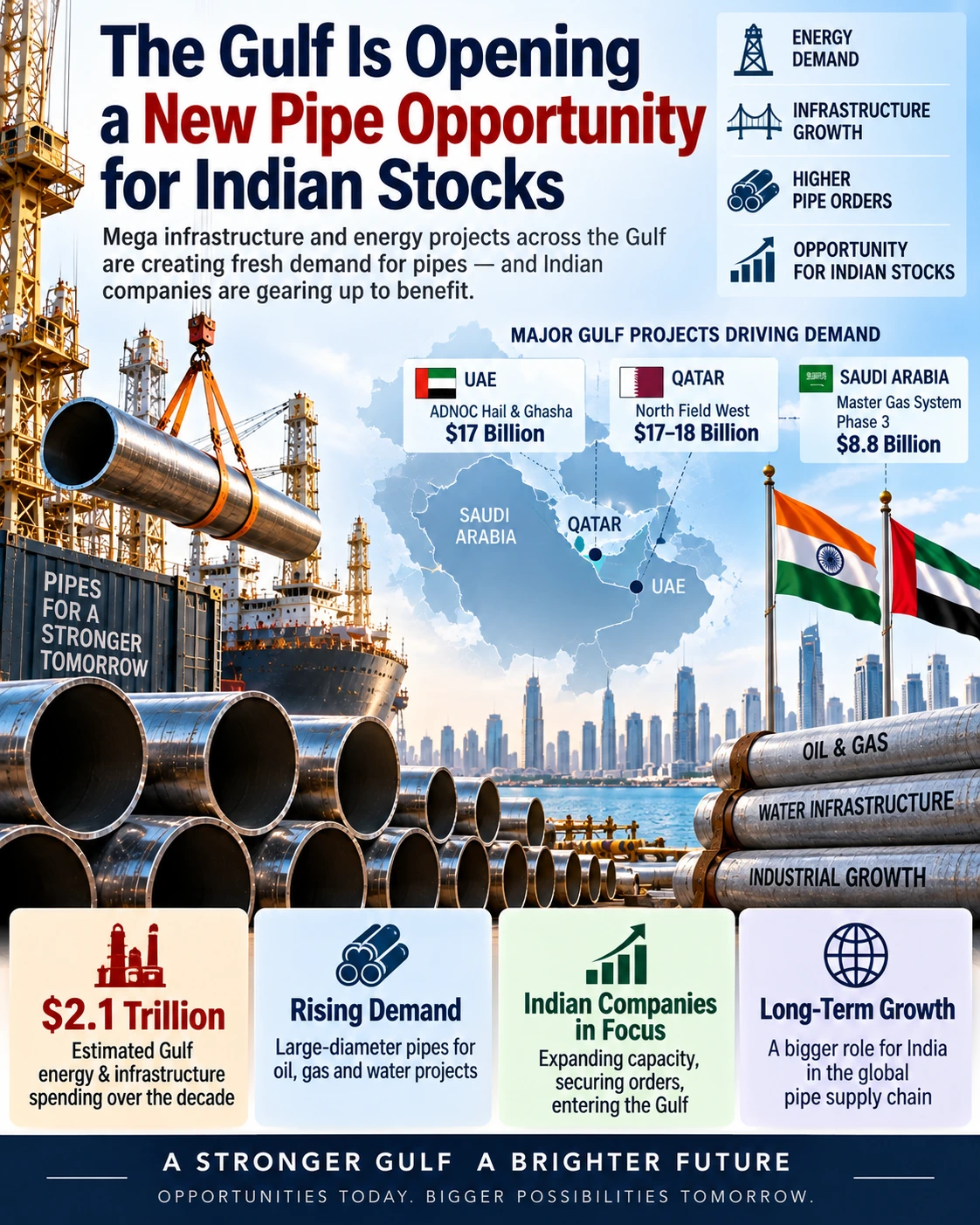
The regional backdrop is real, even if it’s not brand new: ADNOC’s roughly $17-billion Hail & Ghasha gas development, Qatar’s $17-18 billion North Field West expansion, and Saudi Arabia’s $8.8-billion Master Gas System Phase 3 together provide the broader capex cycle that large-diameter pipe suppliers are bidding into, with Saudi Arabia alone accounting for an estimated 39% of 2025 Middle East demand, per Mordor Intelligence.
At home, the Union Cabinet approved the extension and restructuring of the Jal Jeevan Mission to December 2028 in March 2026, raising its total outlay to Rs 8.69 lakh crore, including Rs 3.59 lakh crore of central assistance, up Rs 1.51 lakh crore from the 2019-20 allocation. That sustains long-run demand for water pipes, though the pace and timing of project awards and fund releases can still influence near-term order flow for suppliers.
Jindal Saw: Scale Leader, Margins Under Pressure
Jindal Saw is the world’s third-largest ductile iron pipe producer, with an installed DI capacity of 11.38 lakh tonnes a year, 8.38 lakh tonnes in India and 3 lakh tonnes in Abu Dhabi. Its Gulf expansion is often summarized as one big move; it’s actually three smaller ones. In June 2025, the board approved $118 million of combined investment: a wholly owned subsidiary, Jindal Seamless Pipe Manufacturing, is building a 300,000-tonne-a-year seamless pipe plant in Abu Dhabi’s KEZAD zone for about $105 million, aimed at the MENA oil and gas sector; separately, two Saudi Arabia joint ventures, a helically-spiral-welded pipe plant with Buhur for Investment Company (Jindal holding 51%, investing up to $10 million) and a ductile iron pipe project with RAX United Industrial Company (also 51%, up to $3 million) , were targeted for completion within roughly one to two years of approval. As of the company’s most recent public comments, the Abu Dhabi plant’s land has been secured, but financial closure with banks was still in progress.
That expansion is running into a rough patch on the existing business. Q1 FY27 consolidated revenue from operations rose 9% year-on-year to Rs 4,452 crore (total income: about Rs 4,476 crore, a separate, larger line item, not a correction to the revenue figure), but EBITDA fell 39% to Rs 421 crore from Rs 688 crore as margin nearly halved to 9.4% from 16.8%, pre-tax profit dropped 60% to Rs 148 crore, and net profit fell 78% to roughly Rs 91 crore from Rs 415 crore a year earlier. Revenue had also softened 3.9% sequentially from Rs 4,633 crore in the March 2026 quarter, pointing to a multi-quarter margin squeeze rather than a one-off. Management has attributed the pressure to Middle East shipping-route disruption and a domestic water-segment slowdown, guided for flat FY27 pipe-sales volumes, and pointed to a second-half recovery tied to logistics normalisation. On the balance sheet, standalone net debt eased to Rs 2,345 crore from Rs 2,453 crore at March-end, and the company’s API export licence, needed for seamless-pipe exports, was reinstated on June 24, 2026, valid through June 2029.
Man Industries: Smaller, Faster-Growing, Carrying More Risk
The Saudi Arabia Playbook
In May 2026, Man Industries completed a $102-million (about Rs 1,000-crore) buyout of Saudi Arabia’s National Pipe Company (NPC) through its subsidiary MISIC, funded with $70 million of debt and $32 million of equity. The deal added 430,000 tonnes a year of API-certified HSAW/LSAW capacity at NPC’s Dhahran plant, lifting group capacity to about 1.6 million tonnes, and handed Man Industries a two-decade-old Saudi Aramco-approved vendor relationship instead of a multi-year greenfield build. Per the company’s own statement, NPC serves major regional customers, including Saudi Aramco, the Saudi Water Authority, Kuwait Oil Company, and QatarEnergy (formerly Qatar Petroleum). In August 2026, Man Industries was separately added to QatarEnergy’s Preferred Manufacturers List for LSAW pipes, coating and bends, confirmed via an August 14 exchange filing, making it an eligible bidder for pipe packages tied to Qatar’s LNG expansion.
Q1 FY27 consolidated revenue rose 41.9% year-on-year to Rs 1,053 crore (total income: Rs 1,065 crore, up 37.6%), EBITDA nearly doubled, up 92.6%, to a record Rs 155 crore (margin: 14.6%, versus 10.4% a year ago), and net profit more than doubled to about Rs 61 crore from roughly Rs 28 crore. Its unexecuted order book stood at about Rs 3,600 crore at that point, with a separate ~Rs 24,000-crore bid pipeline, bids and tenders still being pursued, not confirmed revenue. NPC contributed only about 40 days to the quarter following its May 21 closing, with fuller earnings impact guided for Q2 FY27 onward. The September 10 order took the confirmed, unexecuted book from ~Rs 3,600 crore to ~Rs 4,100 crore; the Rs 24,000-crore figure is a separate, much larger opportunity that has not yet converted into booked orders.
The Governance Overhang, And Where It Actually Stands
SEBI’s order of September 29, 2025, found that Man Industries had failed to consolidate subsidiary Merino Shelters Pvt Ltd into its financials between FY15 and FY21, misrepresented related-party transactions, and round-tripped funds, including a flagged Rs 99.90-crore loan to a group entity, following a forensic audit initiated in November 2021. On those findings, SEBI barred the company and three senior executives, chairman Ramesh Mansukhani, managing director Nikhil Mansukhani and former CFO Ashok Gupta, from accessing the securities market for two years, with a Rs 25-lakh penalty on each of the four parties. The stock fell as much as 16% intraday on the news.
The Securities Appellate Tribunal subsequently stayed the entire order on October 10, 2025, pending the company’s appeal, conditional on Man Industries depositing 50% of the combined penalty in an escrow-linked fixed deposit. Crisil Ratings reaffirmed the company’s credit ratings shortly after, at Crisil A/Stable and Crisil A1, citing limited expected business impact given the company’s liquidity. The appeal remains under adjudication, and Man Industries has called the underlying findings “legacy matters,” noting it has consolidated Merino Shelters’ financials since FY23. The matter is stayed, not resolved, a genuine overhang, but a materially different one than a live market ban.
India’s Pipe Opportunity, By The Numbers
| Metric | Figure |
|---|---|
| Global SAW pipe market, 2025 | $12.8 billion |
| Global SAW pipe market, 2034E | $21.4 billion (~Rs 2 lakh crore) |
| Middle East oil & gas line-pipe market, 2026 | $6.54 billion |
| Saudi Arabia’s share of Middle East demand, 2025 | ~39% |
| ADNOC Hail & Ghasha gas development (EPC contract value) | ~$17 billion |
| Qatar North Field West expansion | $17-18 billion |
| Saudi Master Gas System Phase 3 | $8.8 billion |
| Jal Jeevan Mission 2.0 outlay (extended to Dec 2028) | Rs 8.69 lakh crore |
Sources: Dataintelo; Mordor Intelligence; Union Cabinet/PIB; ADNOC and industry reporting. Project values reflect different measures (contract award vs. total investment) and aren’t directly comparable to one another; treat the global market figure as directional.
Jindal Saw vs Man Industries: Q1 FY27 Snapshot
| Metric | Jindal Saw | Man Industries (Consolidated) |
|---|---|---|
| Total income | ~Rs 4,476 cr (+9% YoY) | Rs 1,065 cr (+37.6% YoY) |
| EBITDA | Rs 421 cr (-39% YoY) | Rs 155 cr (+92.6% YoY) |
| EBITDA margin | 9.4% (vs 16.8% YoY) | 14.6% (vs 10.4% YoY) |
| Net profit (PAT) | ~Rs 91 cr | ~Rs 61 cr |
| PAT YoY | -78% | +122% |
| Unexecuted order book | Not separately disclosed | ~Rs 4,100 cr (as of Sep 10, 2026) |
| Bid pipeline | Not disclosed | ~Rs 24,000 cr |
| Ductile iron pipe capacity | 11.38 lakh MTPA | ~16 lakh MTPA (group, post-NPC)* |
| Key Gulf move | UAE + Saudi greenfield/JV expansion | NPC Saudi acquisition |
*Man Industries’ group capacity spans HSAW/LSAW/ERW pipe, not ductile iron specifically, the two companies’ capacity figures reflect different product mixes and aren’t directly comparable tonne-for-tonne. Sources: Company Q1 FY27 exchange filings and earnings-call disclosures; Man Industries’ September 10, 2026 order-win filing.
What Happens Next
The bigger question isn’t whether India’s pipe opportunity is real, the order books, the Saudi acquisitions, and the megaproject pipeline all say it is. It’s which company converts that opportunity into profit that sticks. Man Industries has shown it can grow its order book and its margins at the same time, but Q1 FY27 captured barely six weeks of its Saudi acquisition, and its most consequential legal matter is paused, not settled. Jindal Saw has the scale and a second-half recovery penciled in, if MENA shipping normalises and the domestic water-segment slowdown doesn’t run into a second year. Both bets are now playing out at once, in the same region. The next two quarters should start to show which one is paying off.
Read Next: Copper Pulls Back From Record High: Why the Fed Is Changing the Trade
Disclaimer: This article is for informational and educational purposes only and does not constitute investment advice or a recommendation to buy or sell any security. Data on listed companies, including order books and financial results, can change quickly; readers should verify current figures via NSE/BSE filings before making investment decisions. Please consult a SEBI-registered investment advisor before investing.