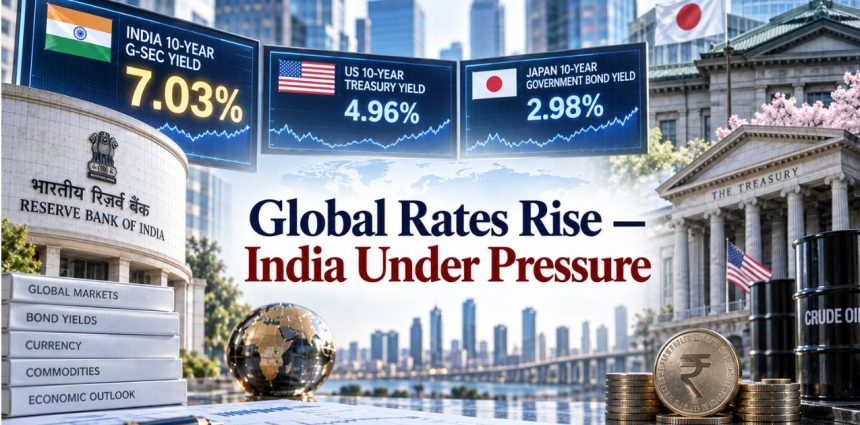
Global bond yields are climbing again, but India’s policy rate has not followed yet. With US and Japanese yields elevated and the Indian 10-year yield above 7%, investors are facing a very different rate environment from earlier this year.
A fresh global rate shock may already be reaching India, but not necessarily through an immediate Reserve Bank of India (RBI) rate hike.
The European Central Bank (ECB) has already raised rates, the US Federal Reserve is due to announce its decision on September 16, and the Bank of Japan (BoJ) is expected to consider another increase at its September 17–18 meeting. At the same time, India’s 10-year government bond yield has moved above 7% as oil prices and elevated global yields put pressure on domestic financial conditions.
The unusual part is that India’s policy repo rate is still 5.25%. The RBI kept the rate unchanged at its August review and retained a neutral stance while raising its FY27 growth forecast to 6.7% and lowering its inflation forecast to 5%.
That creates the key question for Indian investors: can India absorb higher global rates through bond yields, the rupee and liquidity conditions without forcing the RBI to reopen the rate-hike debate?
Also Read: RBI’s ₹1 Lakh Crore Liquidity Drain: Bonds, Banks, and Rates in Focus
Global Rates Have Become a New Pressure Point
The US remains the most important benchmark for global borrowing costs.
The Federal Reserve kept its federal-funds target range at 3.50%-3.75% at its July meeting. Its next policy meeting is scheduled for September 15–16.
The latest US inflation data has kept the market focused on the possibility of another hike. Consumer prices rose 0.4% in August, leaving annual inflation at 3.4%, while core CPI increased 0.3% month-on-month.
Markets have moved increasingly toward a September hike. Reuters reported on September 14 that Goldman Sachs now expects a 25-basis-point increase, while another Reuters market report put the probability of a September move at about 86% according to CME FedWatch. But economists are not unanimous: a Reuters poll on September 9 still showed a majority expecting the Fed to hold through year-end.
That uncertainty itself matters. The Fed decision is no longer a simple question of “cut or hold”; markets are now weighing whether inflation and energy pressures could force policy tighter again.
Japan adds another layer.
The BoJ’s next meeting is scheduled for September 17–18, and Reuters reported that economists widely expect the central bank to lift its policy rate by 25 basis points to 1.25%.
Higher Japanese rates can matter for global capital flows because they reduce the relative attractiveness of funding investments elsewhere with very cheap yen borrowing.
Europe has already moved. On September 10, the ECB (European Central Bank) raised all three key rates by 25 basis points, taking the deposit facility rate to 2.50%. The ECB said the Middle East conflict was generating inflation pressures and projected headline inflation at 3.0% for 2026.
The global rate story is therefore changing from “higher for longer” to the possibility of “higher again.”
India’s Bond Market Is Already Sending a Warning
India has not followed global central banks one-for-one on the policy-rate front.
The RBI’s repo rate remains 5.25%, but the bond market has become less comfortable.
India’s benchmark 10-year government bond yield moved above 7% on September 11, reaching about 7.035% during the session. Reuters reported that rising global yields and expectations around RBI liquidity operations were adding pressure to the market.
This is where the expectation gap becomes important.
The RBI has not raised the repo rate. But the market yield on long-term government borrowing has already moved higher.
That does not automatically mean an RBI hike is next.
Long-term yields price several factors at once: inflation expectations, government borrowing supply, crude oil, currency risk, global benchmark yields and expectations for future monetary policy.
So India can experience tighter financial conditions before the RBI changes its headline policy rate.
Why RBI May Not Follow the Fed Immediately
A rise in US or Japanese rates does not mechanically force the RBI to raise its repo rate.
At its August review, the RBI kept the repo rate at 5.25%, retained the neutral stance, raised its FY27 GDP growth forecast to 6.7%, and lowered its FY27 inflation forecast to 5%.
That leaves policymakers with a difficult trade-off.
Higher crude prices can increase imported inflation, while a weaker rupee can make those pressures more persistent. At the same time, tighter financial conditions and higher borrowing costs can weigh on domestic demand.
That means the RBI does not simply have to choose between “hike” and “do nothing.”
It can wait for more evidence, manage liquidity and monitor whether inflation pressures broaden beyond energy.
And that is the market tension: global rates can rise first, Indian bond yields can react next, while the RBI still keeps its policy rate unchanged.
RBI Is Tightening Liquidity Without Hiking the Repo Rate
One of the most important developments came on September 11.
The RBI announced ₹1 lakh crore of open-market sales of government securities, to be conducted in three tranches beginning September 17. The operation is designed to absorb excess liquidity from the banking system after a large foreign-currency mobilisation created a substantial rupee surplus.
That distinction matters.
The RBI can make financial conditions tighter without changing the 5.25% repo rate.
Liquidity operations influence money-market conditions, while government-bond sales can affect the supply-demand balance in the securities market. If demand is not strong enough, the additional supply can put further pressure on yields.
In other words, the policy headline can stay unchanged while the transmission mechanism becomes tighter.
That is one of the most important signals for bond-market investors to watch.
What Does This Mean for Home Loans and EMIs?
A rise in the 10-year government bond yield does not automatically mean an immediate increase in home-loan EMIs.
For a repo-linked floating-rate loan, the RBI policy rate and the lender’s benchmark-reset mechanism matter more directly than the daily movement in the 10-year G-Sec.
So a 7% government bond yield does not itself trigger an instant EMI reset.
The bigger risk comes if higher crude prices, global yields, or domestic inflation eventually lead the RBI to raise its policy rate.
For borrowers, the practical variables remain the loan benchmark, reset schedule, and the RBI’s actual policy decision.
What Does It Mean for Stocks?
Higher bond yields can put pressure on equities because fixed-income returns become relatively more attractive. All else equal, higher yields can also raise the discount rate applied to future corporate earnings, which matters particularly for richly valued growth stocks.
But the relationship is not automatic.
Strong earnings growth can offset some of the pressure from higher yields. The more important question is therefore whether the rise in yields is temporary or persistent.
For Indian equities, the risk becomes more significant if US yields, crude oil and the rupee all move against the market at the same time.
FPI Flows Add Another Warning Signal
Foreign portfolio investors have also turned cautious again.
FPIs withdrew ₹13,138 crore from Indian equities in September so far, reversing the net buying seen in July and August, when they invested ₹20,200 crore and ₹29,630 crore, respectively. The latest figures are based on CDSL data.
The selling should not be attributed entirely to global rates. Crude oil, the rupee, valuations, and India-specific factors can all affect foreign flows.
But the combination is worth watching.
A sustained rise in global yields can reduce the relative appeal of emerging-market equities, particularly when the rupee is also under pressure.
The Three Signals India Cannot Ignore
| Market signal | Why it matters |
|---|---|
| US yields | Higher global benchmark yields can tighten financial conditions and affect equity valuations |
| Crude oil | Higher energy costs can raise inflation and pressure the rupee |
| India 10-year yield | Higher domestic yields can increase borrowing costs across the financial system |
The risk becomes more serious when all three rise together.
Recent trading already showed how the combination can hit Indian markets. On September 11, Brent crude moved above $108 a barrel, the rupee fell to around ₹95.55 per dollar, and the 10-year government bond yield moved above 7%. Indian equities also declined sharply that day.
That does not prove a lasting global rate shock is coming.
But it shows the transmission channel is already visible.
What Investors Will Watch Next
The next few days are unusually important.
September 15–16: US Federal Reserve policy meeting.
September 17–18: Bank of Japan policy meeting.
September 17 onward: RBI’s ₹1 lakh crore OMO sales begin.
Investors will also be watching the US 10-year yield, crude oil, the rupee, India’s 10-year bond yield, and foreign flows.
The biggest question is no longer simply whether global rates are rising.
It is how much of that rise India can absorb before the RBI has to reconsider its own policy path.
For now, that answer is still uncertain. If US yields remain elevated, crude stays above $100 and the rupee remains under pressure, the RBI could face a much harder inflation-versus-growth trade-off even without wanting to raise the repo rate immediately.
That is the risk investors will be watching in the weeks ahead.
Read Next: SEBI Rethinks CAS After Sharp Expiry-Day Swings: What Could Change?
Disclaimer: This article is for informational purposes only and does not constitute investment advice. Market conditions can change rapidly.