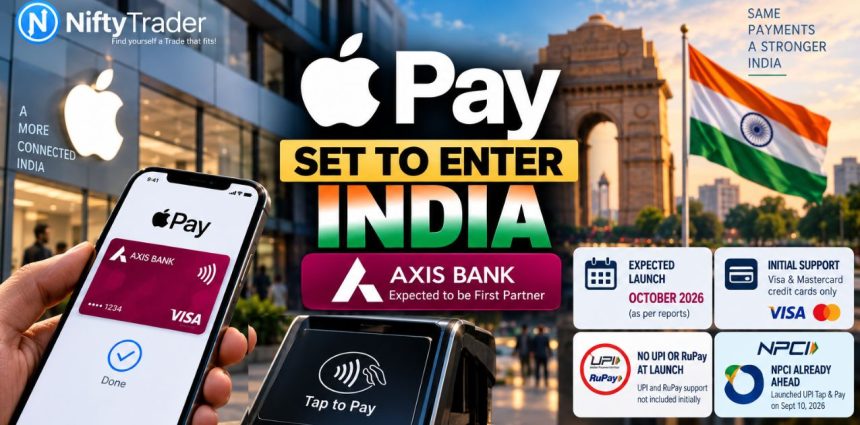
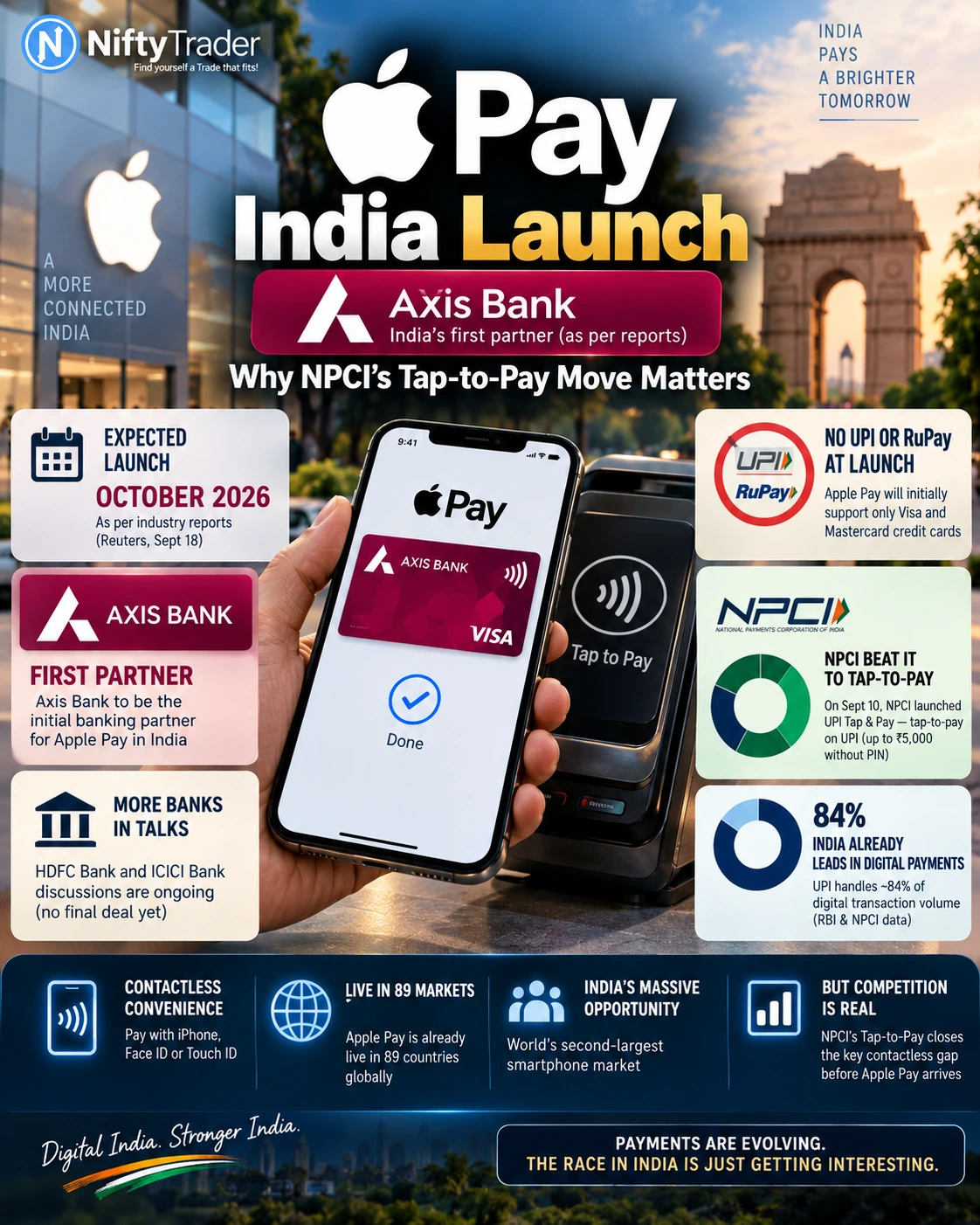
Apple’s plan to launch Apple Pay in India next month with Axis Bank credit cards will not include support for UPI or RuPay at launch, according to industry reports that go beyond Friday’s Reuters report on the Apple Pay deal, and the NPCI had already moved to blunt Apple Pay’s core selling point eight days earlier, rolling out its own NFC tap-to-pay feature on UPI first.
That timing gap matters in a market where the domestic real-time payments rail already handles roughly 84% of digital transaction volume, RBI and NPCI data show.
Reuters reported on September 18, citing three sources familiar with the matter, that Apple is preparing to launch Apple Pay in India in October with Axis Bank as its first banking partner, while talks with HDFC Bank and ICICI Bank continue without finalized commercial terms.
Apple, HDFC Bank, ICICI Bank and Axis Bank all either declined to comment or did not respond when Reuters sought comment for that report.
What Reuters did not detail is the single biggest constraint on the Apple Pay rollout: its initial India launch is expected to work only with Visa and Mastercard credit cards, according to earlier reporting by Business Standard and Economic Times through August and September.
UPI and RuPay, which together anchor the bulk of India’s retail digital payments, will be absent when Apple Pay launches. Adding UPI support would require a separate nod from the National Payments Corporation of India (NPCI) and a tie-up with a sponsor bank to route transactions, neither of which Apple has secured yet.
Also Read: NPCI’s New UPI Push Ahead of Apple Pay Launch Is Creating Buzz Across India’s Fintech Market
The Interchange Fee Fight Behind the Apple Pay Delay
Part of why Apple Pay’s India entry has slipped past its original mid-2026 target traces back to money. Business Standard reported on August 9 that Apple has been negotiating for a 15-20 basis point share of the interchange fee on every credit card transaction routed through Apple Pay, while large Indian card issuers have been countering with an offer closer to 10 basis points.
One basis point equals 0.01%, and the fee would be paid by banks out of their existing interchange earnings rather than charged to cardholders or merchants directly.
Apple’s fee ask for Apple Pay in India is not unprecedented. A U.S. Department of Justice antitrust complaint against Apple disclosed that the company already charges American issuing banks a flat 15 basis points on every Apple Pay credit transaction, a fee the DOJ said generates roughly $1 billion a year for Apple globally. The numbers, side by side:
Where Apple’s India Fee Ask Stands
| Interchange Share | |
|---|---|
| Apple’s ask in India | 15–20 basis points |
| Indian banks’ counter-offer | ~10 basis points |
| Apple’s existing flat US rate | 15 basis points |
Source: Business Standard (August 9, 2026); U.S. Department of Justice antitrust complaint against Apple
Judged against that benchmark, Apple Pay’s India pricing request sits close to Apple’s existing global rate card rather than representing an India-specific premium, even though the comparison point for Indian banks is a UPI network that runs on RBI’s zero-MDR mandate for most person-to-merchant transactions, charging neither consumers nor, in most cases, banks.
NPCI’s Pre-Emptive Countermove Before Apple Pay Arrives
Eight days before Reuters’ Axis Bank report, the NPCI unveiled UPI Tap & Pay, a near-field-communication feature that lets users complete a UPI payment by tapping their phone at a point-of-sale terminal without opening the UPI app, RBI Governor Sanjay Malhotra announced at the Global Fintech Fest in Mumbai on September 10.
The feature waives the UPI PIN for transactions up to ₹5,000 and works without an active mobile data connection since it rides on the terminal’s own connectivity, according to NPCI.
Alongside it, NPCI also launched MyUPI, an AI-powered support and transaction-management layer built on the organisation’s in-house FiMI language model.
The timing reads as a defensive move. Apple said in a January 2026 services recap that Apple Pay was live in 89 markets and had generated more than $100 billion in incremental merchant sales for retailers globally, a footprint from which India, the world’s second-most-populous country, has so far been absent.
NPCI’s Tap & Pay launch closes the specific contactless-payment gap that has been Apple Pay’s core selling point in those 89 markets, before Apple Pay even arrives in India. NPCI also disclosed that biometric-authenticated UPI transactions crossed 6.29 billion by August 31, showing the domestic network is already leaning on the same Face ID/Touch ID-style authentication that Apple Pay relies on elsewhere.
That capability follows the Reserve Bank of India’s Authentication Mechanisms for Digital Payment Transactions Directions, 2025, issued on September 25, 2025, which mandated two-factor authentication, including biometrics, for digital payments, with compliance required from April 1, 2026, rather than “last year” as some accounts have framed it.
UPI’s Scale Is the Backdrop Apple Pay Is Entering
UPI processed a record 24.51 billion transactions worth ₹29.82 lakh crore in August 2026, its highest-ever monthly volume, NPCI data released on September 1 showed.
That was up 3.6% from July’s 23.66 billion transactions and 22% higher than August 2025, even as the number of live member banks on the network rose to 752 from 741 the prior month.
For context, UPI ranks as the world’s largest retail fast-payment system by transaction volume, according to a 2025 IMF report cited by Reuters.
Against that base, Apple Pay’s card-only, UPI-less India debut looks less like a disruption of the payments market and more like a bet on India’s smaller but faster-growing credit card segment.
Inside India’s Credit Card Market, Where Apple Pay Will Actually Compete
India’s total credit card base stood at 12.29 crore (122.9 million) cards in July 2026, up 9.9% year-on-year, according to RBI data analysed by 1Lattice and reported by BW Businessworld. Here is how the top four issuers stack up:
Credit Card Issuer Market Share (India, July 2026)
| Issuer | Cards Outstanding | Market Share | YoY Growth |
|---|---|---|---|
| HDFC Bank | 26.97 million | 22% | +9% |
| SBI Card | 22.76 million | 19% | +7% |
| ICICI Bank | 19.69 million | 16% | +9% |
| Axis Bank | 16.26 million | 13% | +7% |
Source: RBI data analysed by 1Lattice, reported by BW Businessworld (July 2026)
Axis Bank, the bank Reuters named as Apple Pay’s likely launch partner, added 70,091 cards in July to reach that 16.26 million total.
But the more consequential number for Apple Pay’s growth trajectory is what happens if HDFC Bank and ICICI Bank sign on: combined with Axis, the three private banks Apple is reportedly negotiating with control roughly 62.9 million cards, about 51% of India’s entire card base.
An Axis-only launch gives Apple Pay a real foothold; a three-bank rollout would nearly quadruple its addressable card universe overnight.
Axis Bank’s own Q1 FY27 investor presentation, filed with stock exchanges on July 18, puts its credit-cards-in-force share slightly higher at approximately 13.4% as of May 2026, alongside a roughly 38% share of UPI payer PSP volumes for the same quarter, a reminder that Axis Bank’s digital-payments footprint extends well beyond the card book Apple Pay would tap first.
Axis Bank’s broader Q1 FY27 numbers, also from that July 18 filing, show net profit rising 23% year-on-year to ₹7,114 crore and net interest income up 8% to ₹14,646 crore, even as net interest margin compressed to 3.46%, what management called the cycle bottom.
The bank serves 54 million customers through more than 6,295 branches, with a market capitalisation of roughly ₹4.07 trillion as of its July filing.
Card issuers overall are growing at different speeds. HDFC Bank and ICICI Bank each posted 9% year-on-year growth in active credit cards in July, while Axis Bank and SBI Card grew 7% each, per the 1Lattice analysis.
Total credit card spending has topped ₹2 trillion a month for three consecutive months through July 2026, Business Standard reported, citing RBI data, a spending base Apple Pay’s backers argue a contactless iPhone wallet could accelerate further.
Track Live: Axis Bank Option Chain (AXISBANK) — Live OI, IV & PCR
How the Market Reacted to the Apple Pay Report
Shares of Apple (NASDAQ: AAPL) rose 1.38% and Axis Bank (NSE: AXISBANK) gained 0.25% after Reuters’ Apple Pay report, while HDFC Bank (NSE: HDFCBANK) climbed 1.95% and ICICI Bank (NSE: ICICIBANK) slipped 0.27%, according to intraday moves tracked by Investing.com on September 18.
The muted reaction across the three lenders suggests investors are not yet pricing in a material earnings impact from Apple Pay, consistent with the fact that only one bank partnership has been confirmed and India remains, in Apple’s own global context, a small contributor to Apple Pay’s overall transaction base.
The Apple Pay push follows a related move in July 2026, when Apple resumed accepting Visa and Mastercard credit and debit cards for Apple Account purchases in India, including iCloud+, Apple Music and App Store payments, ending a four-year suspension of card-based billing in the country.
Payments industry voices see the two moves as connected groundwork. Pine Labs CEO Amrish Rau told the company’s June-quarter earnings call, as reported by Business Standard, that credit card usage in India was already growing 10-15% and that Apple Pay’s entry was likely to expand card volumes further rather than cannibalise UPI, since the two rails serve different transaction types and cardholder segments.
Key Takeaways
- Apple Pay is expected to launch in India in October 2026 with Axis Bank as the first confirmed card-issuing partner, per Reuters; HDFC Bank and ICICI Bank talks remain unfinalized.
- UPI and RuPay support will be absent at launch — Apple Pay will initially work only with Visa and Mastercard credit cards, pending separate NPCI approval and a sponsor-bank tie-up.
- Apple is seeking 15-20 basis points of interchange per Apple Pay transaction; Indian banks are countering at roughly 10 basis points — a gap that has already delayed the launch from its original mid-2026 target.
- NPCI’s own UPI Tap & Pay and MyUPI launches on September 10 signal the domestic network is moving to match Apple Pay’s contactless convenience before it even arrives.
- Three private banks Apple is reportedly courting — HDFC, ICICI and Axis — control ~51% of India’s credit card base combined; an Axis-only launch reaches roughly a quarter of that.
Stocks to Watch
- Axis Bank (NSE: AXISBANK) — first-mover advantage as Apple Pay’s reported launch partner; Q1 FY27 PAT up 23% YoY to ₹7,114 crore.
- HDFC Bank (NSE: HDFCBANK) — India’s largest card issuer by a wide margin (22% share); in talks over Apple Pay but not yet finalized.
- ICICI Bank (NSE: ICICIBANK) — third-largest issuer (16% share); commercial terms for Apple Pay still under discussion.
- Apple Inc. (NASDAQ: AAPL) — India would be a new addition to Apple Pay’s 89-market global footprint; launch coincides with Apple’s India smartphone shipment share climbing towards 9%, per Counterpoint Research.
Read Next: BEL Wins Rs 648 Cr Orders, So Why Is the Stock Still Under Pressure?
Frequently Asked Questions
Will Apple Pay support UPI in India at launch?
No. Reports indicate Apple Pay’s initial India rollout will work only with Visa and Mastercard credit cards. UPI support for Apple Pay would require separate approval from the NPCI and a sponsor-bank partnership that has not yet been finalized.
Which bank is Apple’s first Apple Pay partner in India?
Axis Bank, according to Reuters, which cited three sources familiar with the matter. Apple has also held discussions about Apple Pay with HDFC Bank and ICICI Bank, though commercial terms with those lenders remain unresolved.
Why has Apple Pay’s India launch been delayed?
Talks have run into a fee dispute: Apple is seeking 15-20 basis points of interchange per Apple Pay transaction, while major Indian issuers have offered closer to 10 basis points. The service was originally targeted for a mid-2026 launch before slipping to October.
How does Apple Pay’s fee request compare globally?
A U.S. Department of Justice antitrust complaint disclosed that Apple already charges American issuing banks a flat 15 basis points per Apple Pay credit transaction, suggesting Apple Pay’s proposed India fee is close to Apple’s existing global standard rather than an unusual markup.
How large is Axis Bank’s credit card business?
Axis Bank had 16.26 million active credit cards and roughly 13% of India’s cards-in-force market as of July 2026, RBI data shows, making it the fourth-largest issuer behind HDFC Bank, SBI Card and ICICI Bank, and Apple Pay’s reported first partner in the country.
Disclaimer: This article is for informational purposes only and does not constitute investment advice. Stock market investments are subject to market risks. Readers are advised to consult a SEBI-registered financial advisor before making any investment decisions. NiftyTrader Desk does not take responsibility for any losses arising from decisions based on this content.