
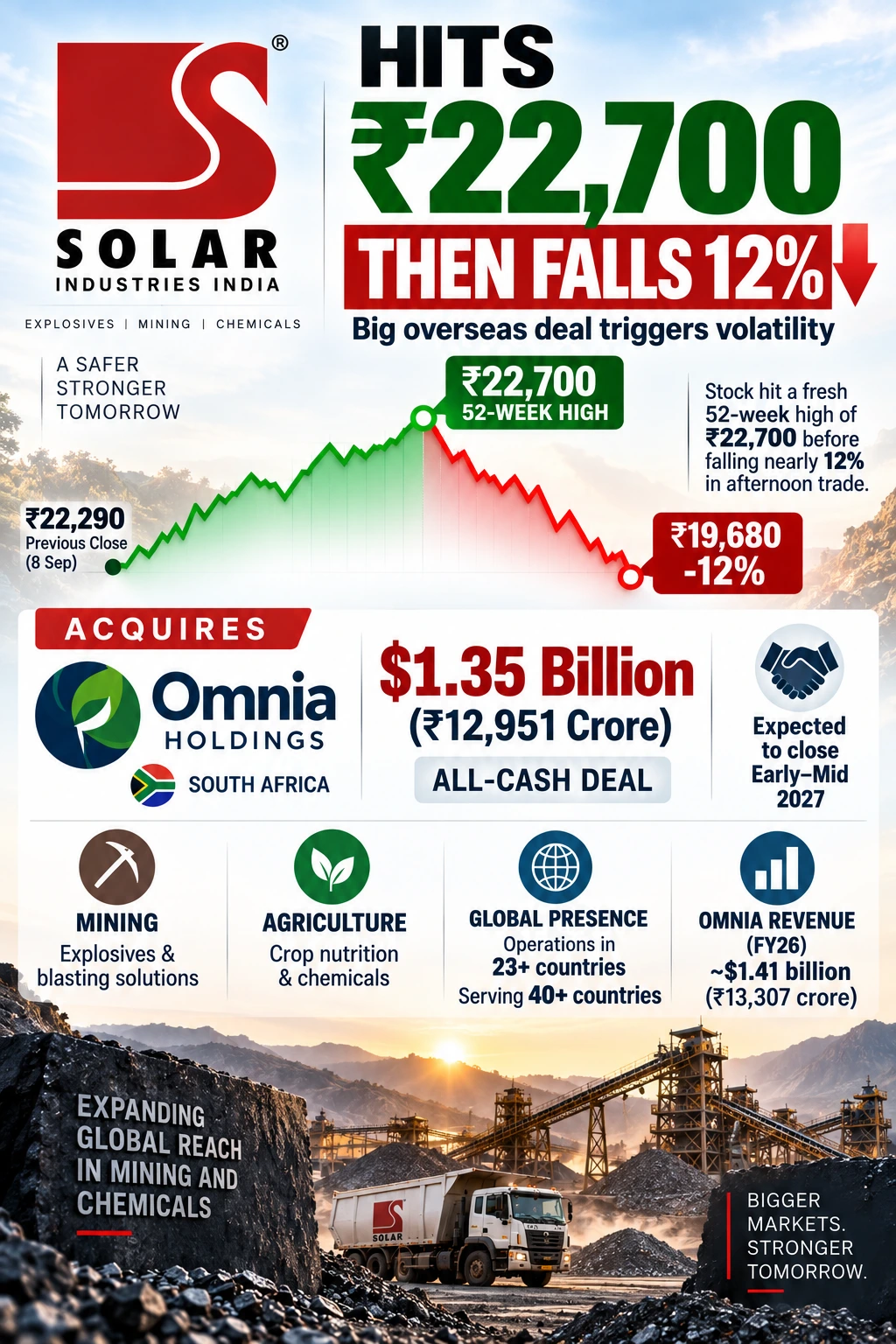
Solar Industries shares touched a fresh 52-week high of ₹22,700 on Tuesday before reversing sharply and falling nearly 12% in afternoon trade. The trigger was a ₹12,951 crore all-cash acquisition of South Africa’s Omnia Holdings, a deal analysts see as strategically powerful, but one that now puts capital allocation, execution and future earnings under the spotlight.
Solar Industries stock began Tuesday looking like the market had welcomed its biggest overseas expansion yet.
It didn’t end that way.
The shares jumped to a fresh 52-week high of ₹22,700 against Monday’s close of ₹22,290 before reversing sharply. The stock later slipped to around ₹19,680, taking the decline to nearly 12% during the session.
The surprise was the trigger.
There was no fresh earnings warning behind the move. Instead, investors were digesting Solar Industries’ agreement to acquire South Africa’s Omnia Holdings for approximately $1.355 billion, or ₹12,951 crore, in cash.
So the obvious question is:
Why did Solar Industries rise first — and then fall so sharply?
The answer sits inside the size of the deal itself.
Solar isn’t buying a small overseas operation. Its step-down subsidiary, Solar SA Investments, has agreed to acquire all of Omnia’s issued ordinary shares other than treasury shares at R134.50 per share.
The offer values Omnia’s issued share capital at about R21.8 billion and represents a 14.30% premium to Omnia’s September 11 closing price. It is also a 35.73% premium to Omnia’s 30-day VWAP.
That immediately creates a second question:
What exactly is Solar getting for ₹12,951 crore?
A lot more than a South African footprint.
Omnia is a diversified chemicals group whose operations span Mining and Agriculture. It has a physical presence in more than 23 countries and serves customers in more than 40 countries.
For Solar, the strategic prize is its mining business, particularly BME.
BME supplies commercial explosives, electronic initiation systems and blasting solutions to mining customers. That fits directly alongside Solar’s own industrial explosives and initiating-systems operations.
The combination could therefore give Solar something that is difficult to build organically:
an established international customer base + manufacturing capacity + mining technology + geographic access.
That is why the transaction is being viewed as a much bigger move than a simple South African acquisition. Market reports describe it as a significant expansion of Solar’s global mining and explosives platform.
Check Live: SOLAR INDUSTRIES INDIA Options Chart
Is Omnia big enough to change Solar’s growth story?
Its financial scale suggests yes.
Omnia reported revenue of roughly $1.41 billion in FY26, equivalent to around ₹13,307 crore in the figures cited in transaction coverage.
The comparison with Solar’s ₹12,951 crore purchase consideration is striking, although it should not be interpreted as a valuation multiple because revenue and acquisition price measure completely different things.
What it does show is the scale of the transaction.
Solar is effectively taking a business of substantial operating size onto its global platform.
And that brings us to the part investors are now focused on.
Why did investors sell if the strategic logic looks strong?
Because strategic logic and near-term stock valuation are not the same thing.
Solar has committed to an all-cash transaction that is expected to close only in early to mid-2027, subject to regulatory, competition and shareholder approvals. Omnia would then be delisted from the Johannesburg Stock Exchange and A2X Markets.
That means the market has to price several things before the benefits fully arrive:
How much capital will be committed?
How smoothly will the businesses be integrated?
How quickly will synergies appear?
How much incremental profit will Omnia contribute?
Those questions do not necessarily mean investors believe the acquisition is bad.
They mean the burden of proof has moved from strategy to execution.
Why the market reaction looks even stranger: brokerages stayed bullish
This is where the Solar story gets more interesting.
Goldman Sachs retained a Buy rating and raised its target price to ₹26,550. The brokerage estimates the Omnia transaction could potentially add 11%–25% to Solar’s FY28 EPS, although the acquisition has not been incorporated into its base estimates because completion remains uncertain.
Morgan Stanley retained Overweight with a ₹22,753 target, while Antique Stock Broking retained Buy and raised its target to ₹24,418, according to current market coverage.
| Brokerage | View | Target price |
|---|---|---|
| Goldman Sachs | Buy | ₹26,550 |
| Antique Stock Broking | Buy | ₹24,418 |
| Morgan Stanley | Overweight | ₹22,753 |
That creates an unusual expectation gap:
The stock fell sharply, but the major brokerage reactions remained constructive.
So the market may not be rejecting Omnia itself.
It may be questioning what Solar has to deliver between today’s announcement and the eventual earnings benefits.
What makes BME so important to Solar?
BME potentially changes the geographic and technological reach of Solar’s explosives business.
Solar already sells industrial explosives and related products in more than 90 countries, with manufacturing facilities spread across multiple countries, according to the Omnia transaction announcement.
Omnia adds another established mining platform.
That can potentially strengthen Solar across the mining value chain, from raw materials and manufacturing to explosives, initiation systems and blasting services.
Goldman Sachs has also highlighted potential opportunities in markets including Canada and Brazil, alongside expansion in existing regions such as Australia and Indonesia.
That is the long-term bull case.
But there is another part of Omnia that makes the acquisition more complicated.
Solar is also buying agriculture exposure
Omnia isn’t purely a mining company.
Its Agriculture business provides crop nutrition and related chemical products. That gives Solar a diversification opportunity, but it also takes the company into businesses outside its traditional explosives and defence focus.
For investors, that creates another execution question:
Can Solar expand its global footprint without spreading management attention too thin?
The answer will only become clearer after the transaction closes and integration begins.
Solar already has another giant investment programme
The Omnia acquisition is also arriving alongside Solar’s aggressive defence expansion.
Goldman Sachs expects the company to invest around ₹12,700 crore in expanding its defence business, making capital allocation an important part of the broader investment story.
That gives shareholders two very large growth ambitions to monitor:
| Growth engine | Strategic opportunity | Investor question |
|---|---|---|
| Omnia | Global mining & explosives | How quickly will synergies show? |
| Defence expansion | Higher-value defence products | How efficiently will capex translate into earnings? |
This is why Tuesday’s selloff matters.
The market is no longer looking only at Solar’s growth potential.
It is looking at how much capital is required to achieve that growth — and how quickly investors get paid back through higher earnings and cash generation.
Also Check: SOLAR INDUSTRIES INDIA Ltd Futures — Live Price, Open Interest & Basis Analysis
Why this may not be a rejection of the Omnia deal
Tuesday’s move should not automatically be interpreted as investors deciding that Omnia is a poor acquisition.
Omnia itself reported a strong FY26, with revenue of around R24.2 billion and operating profit of about R2.2 billion, according to its financial disclosures. Its established mining business gives Solar an operating platform that would be difficult to replicate quickly through organic expansion.
The uncertainty is elsewhere.
The deal still has to close.
The synergies still have to be realised.
And the market still has to see what the acquisition does to Solar’s earnings and capital structure.
That distinction is crucial.
The bull case vs the bear case
The bull case
Solar acquires a global mining platform with established customers, manufacturing assets and blasting technology.
BME fits directly with Solar’s existing explosives business. The deal could accelerate international expansion, create operational efficiencies and potentially improve earnings from FY28 onward.
Goldman’s estimated 11%–25% FY28 EPS accretion shows why the acquisition has attracted a positive brokerage response.
The bear case
The acquisition is large, entirely cash-based and will not close until 2027, assuming all required approvals are obtained.
Investors therefore face uncertainty over capital allocation, integration and the pace at which synergies translate into earnings.
Solar’s strong share-price performance before the announcement also means some investors may simply have chosen to lock in gains when the deal introduced a new layer of uncertainty.
That is why the same announcement can look strategically bullish and tactically bearish at the same time.
What happens to Solar Industries shares next?
The next major moves may come from information rather than headlines.
Investors will watch for:
Deal approvals: Omnia shareholder and regulatory processes still have to be completed.
Funding and capital allocation: The financial consequences of an all-cash acquisition of this size will remain important.
Integration: Investors will want evidence that the businesses can be combined without disrupting operations.
Earnings: The strategic thesis ultimately has to appear in revenue, margins, profit and cash flow.
Synergies: The market will eventually judge whether the expected benefits were worth paying a premium for Omnia.
The deal is therefore entering a different phase.
The first question was:
Why buy Omnia?
Solar has answered that.
The next question is harder:
Can Solar turn a $1.35 billion acquisition into enough incremental earnings to justify the market’s confidence?
For now, the stock’s sharp reversal shows that investors want more than a global-growth story.
They want proof.
Key Takeaways
- Solar Industries shares touched ₹22,700 before reversing to around ₹19,680, putting the stock down nearly 12% in afternoon trade.
- Solar SA Investments has agreed to acquire Omnia Holdings for approximately $1.355 billion (₹12,951 crore) in an all-cash deal.
- The R134.50/share offer represents a 14.30% premium to Omnia’s September 11 closing price.
- Goldman Sachs has retained Buy and raised its Solar target to ₹26,550, while estimating potential FY28 EPS accretion of 11%–25%.
- The critical uncertainty has shifted from the strategic logic of the acquisition to capital allocation, approvals, integration and the speed of earnings accretion.
- The transaction is expected to close in early to mid-2027, subject to required approvals.
Read Next: NSE IPO’s ₹9,998 Crore Options Bet Faces a New Test
Disclaimer: This article is for informational purposes only and should not be construed as investment advice. Investors should consult a SEBI-registered financial adviser before making investment decisions.