Synopsis:
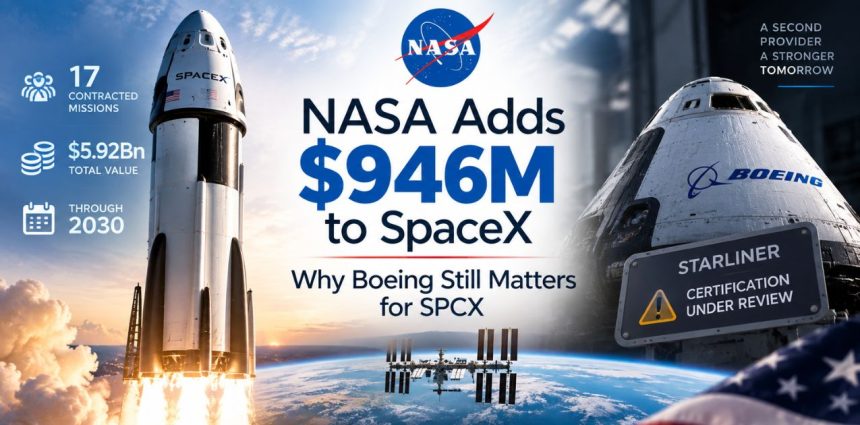
NASA has added $946 million to SpaceX’s ISS crew contract, taking its total contracted missions to 17 through 2030. But Boeing’s unfinished Starliner certification keeps NASA’s two-provider strategy in focus, and adds a new layer for SPCX investors.
NASA has just added $946 million of new work to SpaceX’s astronaut-transport contract. But the bigger signal is what the agency is doing at the same time: extending SpaceX’s role through 2030 while still trying to keep Boeing in the race as a second crew provider.
NASA said on September 18 that it awarded SpaceX a firm fixed-price contract modification covering Crew-15, Crew-16 and Crew-17. The award takes SpaceX’s total contracted missions under NASA’s Commercial Crew Transportation Capability (CCtCap) programme to 17 and lifts the cumulative contract value to $5.92 billion. The work runs through 2030 and includes ground processing, launch, in-orbit operations, return and recovery, cargo transportation and Dragon’s lifeboat capability while docked at the International Space Station.
That would already be notable. But the timing makes it more relevant for markets: SpaceX is now a publicly traded company under the ticker SPCX, turning a NASA contract award into news that public-market investors can directly track.
Also Read: SpaceX’s Starship Faces Crucial Test as IPO Pressure Builds Around Elon Musk’s Biggest Bet
Need to Know: $946M More, 17 Missions, 2030 Horizon
| SpaceX NASA contract | Latest detail |
|---|---|
| New contract modification | $946 million |
| Missions added | Crew-15, Crew-16, Crew-17 |
| Total contracted missions | 17 |
| Total CCtCap value | $5.92 billion |
| Contract period | Through 2030 |
| NASA crew certification | November 2020 |
| Current NASA crew mission | Crew-12 |
| Next crew mission | Crew-13, no earlier than early October 2026 |
NASA said the award follows its May notice of intent to purchase additional transportation services. The agency also said the modification does not prevent it from making further changes to the contract if additional transportation services are required.
SpaceX’s Crew-12 is currently docked at the ISS, while NASA’s current schedule lists Crew-13 for no earlier than early October 2026.
The immediate takeaway is that NASA has extended its established SpaceX crew-rotation pipeline deeper into the remaining ISS era.
But that is only half the story.
Also Read: SpaceX IPO Ends With $2 Trillion Shock: SPCX Jumps 19% in Biggest Stock Market Debut Ever
SpaceX vs. Boeing: Where the Two NASA Contracts Stand
NASA deliberately selected SpaceX and Boeing in 2014 as its Commercial Crew partners. The goal was not simply to create two spacecraft, but to preserve redundancy so a problem with one provider would not interrupt U.S. astronaut access to the space station.
| SpaceX / Crew Dragon | Boeing / Starliner | |
|---|---|---|
| Contract origin | 2014 CCtCap | 2014 CCtCap |
| Current contract position | 17 contracted missions | 4 definitive + 2 options |
| Total contract value | $5.92 billion after Sept. 18 modification | Boeing contract separately structured |
| NASA crew certification | Certified Nov. 2020 | Not yet certified |
| NASA crew rotations | Crew-12 currently in orbit | One crewed test flight in 2024 |
| Current status | Active crew-rotation provider | Certification and test work continuing |
| Next major flight | Crew-13, early October target | Starliner-1, timing under review |
NASA’s FY2027 budget documents say Boeing’s original CCtCap arrangement provided for up to six crewed ISS flights. In November 2025, NASA and Boeing reduced the definitive order to four missions, with two remaining as options. Starliner-1 is planned as a cargo mission without astronauts to validate system upgrades before crewed operations.
This is the key expectation gap: NASA is expanding SpaceX’s contracted workload while still maintaining a two-provider strategy that depends on Boeing eventually returning Starliner to crew service.
Why This Lands Differently Now: SpaceX Is a Public Stock
Until June, a NASA contract like this was primarily a government and aerospace story. Now it also has a direct listed-equity angle.
SpaceX priced its IPO at $135 a share, with shares beginning Nasdaq trading under SPCX on June 12, 2026. Nasdaq reported that the stock closed its first session at about $160.95, implying a market value of roughly $2.1 trillion at the time.
The September 18 session tells a more nuanced story than simply calling the NASA award a stock catalyst.
| SPCX snapshot | September 18, 2026 |
|---|---|
| IPO price | $135 |
| Previous close | $154.81 |
| September 18 close | $152.71 |
| September 18 move | -1.36% |
| 52-week range | $104.83–$225.64 |
SPCX had gained 5.15% on September 16 and 2.60% on September 17, but fell 1.36% on September 18, the day NASA announced the expanded crew contract.
So the NASA award should not be described as having triggered a one-day rally.
The more useful market question is what repeated government contracts mean for the visibility of SpaceX’s business as a public company. The new award provides another long-duration NASA revenue relationship, but it does not by itself determine SPCX’s valuation or future share-price performance.
That distinction matters because the stock market is likely to assess SpaceX across several businesses and long-term expectations, not just NASA crew flights.
Also Check: IPO Performance Tracker (IPO History Data): Latest
What NASA’s SpaceX Deal Means for Indian Investors
- Direct Nifty impact: Likely limited. NASA’s $946M award is a US government contract with SpaceX, so it does not directly change Indian corporate earnings.
- Indian space-sector relevance: India’s private space ecosystem is expanding rapidly; the government says the sector had around 440 registered space startups by August 2026, with the Indian space economy valued at about $9 billion.
- Potential long-term read-through: The deal highlights the growing commercialisation of space infrastructure and sustained demand for launch, satellite and related technologies. That is relevant to Indian space startups and listed companies as a sector theme, rather than as an immediate earnings trigger.
- Companies to watch: Instead of claiming they will benefit from the NASA deal, you can discuss Indian listed/unlisted space-sector companies separately and explain their actual business exposure.
- India-US opportunity: Recent comments from the US Ambassador to India point to greater US-India cooperation, investment and technology development in the space sector.
Boeing’s Starliner Problem Is More Than a Delay
Boeing’s Starliner remains the unresolved piece of NASA’s redundancy model.
Starliner’s 2024 Crew Flight Test was originally planned as an eight-to-14-day mission. Propulsion-system anomalies extended the mission to 93 days, and NASA ultimately returned the spacecraft without astronauts. Butch Wilmore and Suni Williams later returned to Earth aboard SpaceX’s Crew-9 Dragon in March 2025.
In February 2026, NASA classified the Starliner test flight as a Type A mishap, its highest-level mishap classification, citing the loss of spacecraft maneuverability and the potential for a significant mishap. NASA’s investigation identified an interplay of hardware failures, qualification gaps, leadership issues and organizational problems.
Starliner therefore is not simply waiting for another launch slot. It must work through technical and certification requirements before NASA can use it routinely for astronaut transportation.
NASA Has Already Paid for Some of the Delay
The financial consequences are also becoming visible.
A June 2026 NASA Office of Inspector General review said NASA had already spent an additional $17 million to accelerate SpaceX flights originally planned for Starliner. The watchdog also questioned $127.9 million in Boeing payments and warned that uncertainty around Starliner’s certification timeline could increase costs further.
The next Starliner flight is therefore designed to carry cargo rather than astronauts, allowing NASA and Boeing to validate modifications before attempting another crewed mission. NASA’s current schedule lists the timing as under review.
This creates a practical tension for NASA.
The agency wants two providers because redundancy lowers the risk that a technical problem at one company could interrupt U.S. access to the ISS. But as long as Boeing remains uncertified, SpaceX carries a larger share of the operational burden.
NASA Is Still Keeping Boeing in the Game
The latest SpaceX award does not mean NASA has abandoned Boeing.
Reuters reported on September 18, citing the Wall Street Journal, that NASA and Boeing are discussing 10 or more future Starliner missions. Those discussions should not be treated as a finalized 10-mission NASA contract, but the report is significant because it shows the agency is still pursuing a meaningful second provider alongside SpaceX.
That helps explain why NASA can simultaneously award SpaceX three more missions and continue working toward a larger future Starliner role.
The two moves are not contradictory. They reflect different parts of the same strategy: SpaceX provides the established crew-transport capability today, while Boeing remains part of NASA’s intended backup and competition framework.
The Bigger Question for SPCX and NASA
The $946 million modification does not fundamentally change SpaceX’s existing crew-rotation operation. What it changes is the contracted visibility of that operation, extending SpaceX’s NASA crew workload through 2030.
For NASA, the forward-looking risk is whether Boeing can complete Starliner certification in time to restore the two-provider redundancy the agency originally designed.
For SPCX investors, the question is different: how much weight should be placed on SpaceX’s established government and space businesses as the public market continues to price expectations around the broader company?
NASA’s latest award answers one part of that equation: SpaceX will remain a major U.S. crew-transport provider through the final years of the ISS programme.
It does not yet answer whether Boeing can return as a fully certified second provider—or how the market will ultimately value that increasingly visible NASA relationship.
Read Next: Smallcap Stocks Up 31% vs Nifty 5%: Why Largecaps Are Back in Focus
FAQ
How much is SpaceX’s NASA crew contract now worth?
NASA’s latest $946 million modification takes the total value of SpaceX’s CCtCap contract to $5.92 billion and the number of contracted missions to 17.
Which missions did NASA add?
The September 18 modification covers Crew-15, Crew-16 and Crew-17.
Is Boeing’s Starliner certified to carry NASA astronauts?
No. Starliner is still working through certification requirements. Its next mission, Starliner-1, is planned as an uncrewed cargo flight, with the current launch timing under review.
What happened during Starliner’s 2024 crewed test?
Propulsion anomalies extended the mission from its planned duration to 93 days. NASA returned Starliner without its two astronauts, who later came home on SpaceX’s Crew-9 Dragon. NASA subsequently classified the flight as a Type A mishap.
Is NASA abandoning Boeing?
No. Reuters reported on September 18 that NASA and Boeing are discussing 10 or more potential future Starliner missions, although those discussions are not a finalized award.
Disclaimer: This article is for informational purposes only and does not constitute investment advice. SpaceX/SPCX, Boeing and other aerospace-related securities can be volatile, and government contracts do not guarantee future share-price performance.