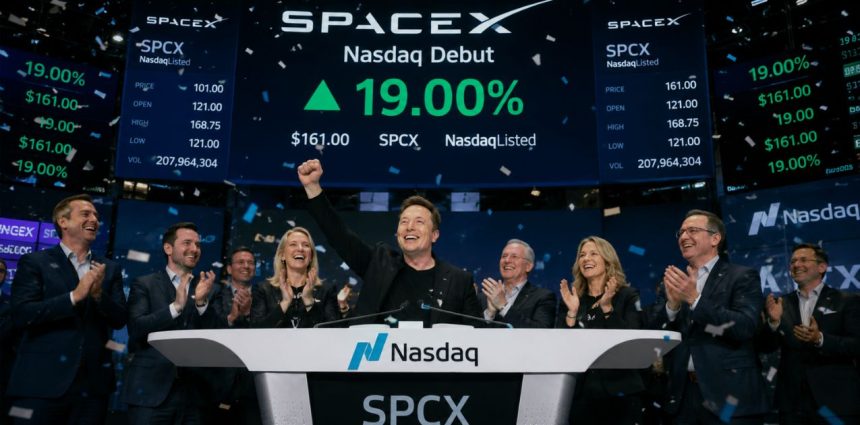
Elon Musk’s SpaceX made its Nasdaq debut on June 12, 2026, under ticker SPCX, raising $75 billion, closing at $161 a share, and surpassing a $2 trillion market cap in a single session. Here’s everything investors, including Indians, need to know.
Key Takeaways
- SPCX closed at $161 on its Nasdaq debut, up 19% from its $135 IPO price, with Class A trading volume exceeding 207 million shares and dollar volume near $33 billion, surpassing both QQQ and SPY in a single session.
- SpaceX sold 555.6 million shares at $135 each, raising $75 billion, more than double Saudi Aramco’s 2019 record. Underwriters hold an option to sell an additional 83.33 million shares worth $11.2 billion.
- Starlink generated $11.4 billion in revenue in 2025, growing roughly 50% year-on-year and accounting for 61% of SpaceX’s total $18.7 billion revenue; it is the only profitable segment in the company.
- Morningstar warned the stock is “significantly overvalued,” pegging fair value at $780 billion, less than half the IPO target of $1.75 trillion.
- Indian retail investors could not buy SPCX at the IPO price directly; the LRS route via international brokerage platforms remains the post-listing option for Indian investors.
Also Read: SpaceX IPO Opens Today: Shadow Markets Price a 35%+ Pop as Wall Street Splits on Valuation
The Numbers Behind the Biggest IPO in History
SpaceX set a fixed IPO price of $135 per share, valuing Elon Musk’s rocket, Starlink, and xAI group at roughly $1.77 trillion, making it the seventh-largest company in the US at debut, above Tesla’s then-market cap of approximately $1.6 trillion.
The session high on debut day was $168.75, up 25% from the IPO price. At that intraday peak, SpaceX’s market cap reached approximately $2.21 trillion, putting it within striking distance of Amazon’s roughly $2.54 trillion valuation. The stock eventually settled at $161, still up 19% on the day.
Goldman Sachs led the offering, followed by Morgan Stanley, Bank of America, Citigroup, and JPMorgan Chase. Musk will retain over 82% voting control after the offering.
SpaceX IPO — Key Data at a Glance
| Metric | Detail |
|---|---|
| Ticker | SPCX (Nasdaq) |
| IPO Price | $135 per share |
| Closing Price (June 12) | ~$161 per share |
| Day’s Gain | +19% |
| Intraday High | $168.75 (+25%) |
| Shares Sold | 555.6 million |
| Total Funds Raised | $75 billion |
| IPO Valuation | ~$1.77 trillion |
| Post-Debut Market Cap | $2 trillion+ |
| Retail Allocation | ~20–30% of public shares |
| Previous Record (Aramco, 2019) | $29 billion raised |
| Lead Banker | Goldman Sachs |
Source: CNBC, SEC filing, Investing.com — June 12, 2026
Read Next: ₹9.7 Lakh Crore in a Day: Inside the US–Iran Deal Rally, and the War Trade It Just Killed
What Does SpaceX Actually Do — And Where Is the Money Coming From?
SpaceX today is three businesses bundled into one ticker: rockets, internet, and AI.
Starlink — the engine that pays the bills. Starlink generated $3.26 billion in revenue in the latest quarter alone, accounting for 69% of total company revenue for that period. The company now has approximately 10.3 million Starlink subscribers. For full year 2025, the Starlink segment earned $4.42 billion in operating income; it is the only part of SpaceX currently profitable. The space business lost $619 million in operating terms in Q1 2026, and the AI unit lost $2.5 billion.
Launch a business—the brand, not yet the profit center. SpaceX is responsible for more than four-fifths of the mass launched into orbit over the past three years, but this segment is currently loss-making as Starship development continues.
xAI — the wildcard. SpaceX merged with Musk’s AI company xAI in February 2026, adding the Grok chatbot, subscription revenue, and AI compute infrastructure to SpaceX’s books. Cost of revenue in the AI segment jumped 29% to $2.18 billion in 2025, driven by infrastructure and cloud computing costs.
SpaceX Business Segment Breakdown (FY 2025)
| Segment | Revenue (2025) | Revenue Share | Profit/Loss |
|---|---|---|---|
| Starlink (Connectivity) | $11.4 billion | ~61% | Profitable — $4.42B operating income |
| Launch & Space | ~$5.7 billion | ~31% | Loss-making |
| xAI / AI Infra | ~$1.6 billion | ~8% | Heavy losses; burning ~$10B projected 2026 |
| Total | $18.7 billion | 100% | Net loss of ~$4.9 billion |
Source: SpaceX SEC filing, CNBC, Bleap Finance — FY2025 data
What Analysts Are Saying: Bulls vs. Bears
The SpaceX IPO has sharply divided Wall Street, and the gap between optimists and sceptics is unusually wide even by tech standards.
Morningstar, in initiating coverage in June 2026, set a fair value of $780 billion, less than half the IPO valuation. Morningstar analyst Nicolas Owens stated the company is “significantly overvalued,” noting that only Starlink is currently profitable while xAI is projected to burn approximately $10 billion in 2026.
CFRA Research also initiated coverage with a sell rating. Senior analyst Keith Snyder told CNBC he remains skeptical of whether SpaceX is genuinely worth $1.77 trillion at IPO.
On the bull side, investors like Nancy Tengler of Laffer Tengler Investments compared SpaceX’s trajectory to early Amazon — a company valued on vision and market transformation rather than near-term earnings.
| Analyst / Firm | Rating | Fair Value Estimate | Key Concern / Thesis |
|---|---|---|---|
| Morningstar | Sell / Wait | ~$780 billion | Only Starlink profitable; xAI burning cash |
| CFRA Research | Sell | Below IPO | Valuation not justified by fundamentals |
| Bulls (Institutional) | Buy | $2T+ | Starship optionality + Starlink growth |
| Laffer Tengler | Buy/Hold | Long-term play | Amazon-like generational opportunity |
Source: CNBC, Morningstar, TheStreet — June 2026
The Valuation Problem: 94x Revenue
At a $1.77 trillion valuation, investors are paying approximately 94 times SpaceX’s trailing annual revenue, a price-to-sales multiple that exceeds even Nvidia and Palantir at their peaks. For comparison, at the time of its IPO, Saudi Aramco was profitable and had decades of cash flow history. SpaceX posted a net loss of nearly $5 billion in 2025.
Nasdaq’s fast-entry rules make SPCX eligible for Nasdaq-100 index inclusion after just 15 trading days, which would force passive funds to buy the stock automatically, regardless of valuation. Limited supply plus forced buying equals short-term price support, but the real test comes months later.
SpaceX’s lockup structure is notably different from a standard IPO. Rather than a single 180-day lockup, the prospectus allows existing shareholders to sell 20% of their holdings as early as the first quarterly earnings report, with selling rights then stepping up at 70, 90, 105, 120, and 135 days post-IPO, creating steady float expansion through the end of 2026.
What This Means for Indian Investors
Indian retail investors could not buy SPCX at the IPO price directly, as the retail allocation of approximately 30% of shares, worth roughly $22.5 billion, went to US-based platforms, with India not included in the direct allocation.
Post-listing, Indian investors can access SPCX through international brokerage platforms under the RBI’s Liberalised Remittance Scheme (LRS), which allows up to $250,000 per year in overseas investments.
Platforms like INDmoney, Vested, and Groww’s US stocks feature support for LRS-based purchases of Nasdaq-listed stocks.
SpaceX has also deployed over 9,600 satellites in low-Earth orbit and has signed partnership agreements with both Bharti Airtel and Reliance Jio to bring Starlink broadband services to India, pending regulatory clearance.
This means the Starlink-India rollout, whenever it gets full regulatory green light, will directly impact Indian telecom stocks; watch AIRTEL and RIL on any major Starlink news.
| Indian Investor Route | Mechanism | Key Platforms | Annual Limit |
|---|---|---|---|
| LRS (post-listing) | Buy SPCX on Nasdaq via overseas broker | INDmoney, Vested, Groww US | $250,000/year |
| ETF Exposure | Nasdaq-100 ETFs (after SPCX inclusion in ~15 days) | Motilal Oswal N100 ETF | Fund-linked limits |
| Indirect — Airtel / RIL | Starlink India partnership | NSE / BSE | Standard equity limits |
Note: LRS investments in foreign equities are subject to 20% TCS (Tax Collected at Source) as per current Indian tax rules. Consult a SEBI-registered advisor before investing.
Bottom Line
SpaceX’s Nasdaq debut is a genuine market milestone, the largest IPO in history, a $2 trillion company created in a single session, and a stock that captivated retail and institutional investors alike.
The bull case rests entirely on Starlink’s profitable growth and Starship’s future optionality.
The bear case is plain: you are paying 94x revenue for a company that lost $5 billion last year, with a staggered lockup that will steadily increase selling pressure through late 2026.
For Indian investors, the Airtel and Jio-Starlink partnership makes this a story worth tracking even if you never buy a single SPCX share, because when Starlink lands in India at scale, the domestic broadband and DTH sectors will feel it.
Disclaimer: This article is for informational and educational purposes only and does not constitute investment advice. Investments in foreign securities carry currency risk, regulatory risk, and market risk. Please consult a SEBI-registered financial advisor before making any investment decisions. TCS applies on LRS remittances above ₹7 lakh per financial year.