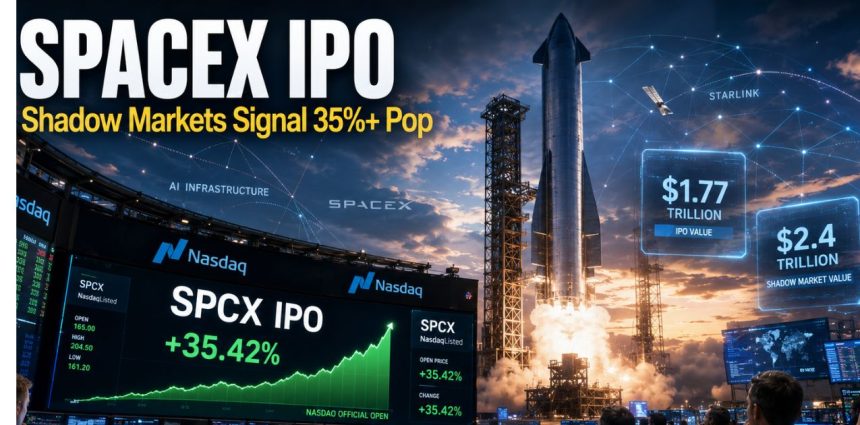
The AI-and-space cycle has its defining benchmark moment. SpaceX’s Nasdaq debut today sets the valuation floor, or ceiling, for every mega-IPO that follows in 2026.
Key Takeaways
- SpaceX priced at $135 per share, raising a record $75 billion at a $1.77 trillion valuation, among the largest IPOs ever completed globally, surpassing Saudi Aramco’s 2019 record in capital raised.
- Total demand surpassed $250 billion, leaving the offering roughly 3.5 to 4 times oversubscribed, with some individual institutional orders reportedly exceeding $10 billion each.
- Shadow markets signalled a 35%+ first-day pop ahead of the open, but these venues are thin, leveraged, and unregulated. Early signals may not survive the opening print once the hedge unwinds and profit-booking begins.
- Oppenheimer initiated with “outperform” and a $190 target, implying 41% upside, while Morningstar called SpaceX “significantly overvalued” at a $780 billion fair value, less than half the IPO price.
- Indian cryogenic play INOX India has surged over 21% in five sessions on sentiment alone, a thematic, not fundamental, link that is prone to sharp reversal.
SpaceX Begins Trading: The Numbers That Matter
SpaceX priced the biggest US initial public offering at $135 per share on the evening of June 11, raising $75 billion on the sale of 555.56 million shares and valuing the space, satellite, and AI company at $1.77 trillion. The stock began trading today on Nasdaq under the ticker SPCX.
The valuation places SpaceX seventh among the most valuable listed companies in the United States at debut, above Tesla’s current market cap of approximately $1.6 trillion. Goldman Sachs leads the deal across 21 underwriting banks, with retail investors allocated approximately 30% of the float, three times the standard norm for a mega-cap IPO.
The broader context framing this debut: Goldman Sachs has forecast US IPO proceeds could quadruple to a record $160 billion in 2026, driven by a pipeline that includes SpaceX, OpenAI and Anthropic. SpaceX is not just a listing, it is the opening stress test for the entire AI-and-space capital cycle of 2026.
Also Read: SpaceX’s $75 Billion IPO Puts INOX India in the Spotlight—Here’s the Cryogenic Connection
First-Day Trading Snapshot — June 12, 2026
| Data Point | Value | Sources |
|---|---|---|
| IPO Offer Price | $135.00 | SpaceX S-1 / Reuters |
| IPO Valuation | $1.77 trillion | Reuters |
| Hyperliquid Perpetual (SPCX) implied | ~$176–$183 (ahead of open) | Hyperliquid / IG International |
| Polymarket: odds of closing above $2T | 64–70% | Polymarket |
| MSCI Index Inclusion | From June 13 (T+1) | MSCI announcement |
| Live SPCX closing price | Updating — track on NiftyTrader dashboard | Nasdaq |
Live price data will be updated as the US session closes tonight (IST). Shadow market figures reflect readings ahead of the opening print.
What Shadow Markets Were Signalling — And Why to Read Them Carefully
Ahead of the open, unofficial derivative venues had been running their own live verdict on where SpaceX should trade.
A SpaceX-linked perpetual contract on Hyperliquid, trading as SPCX, was trading at approximately $176–$183, implying roughly a 36% premium over the $135 IPO price. IG International derivatives and Polymarket were also signalling strong demand, with implied valuations more than 35% above the IPO level and odds favouring a first-day close above $2 trillion.
These signals carried a credibility precedent: Cerebras Systems (CBRS), which listed on Nasdaq on May 14, 2026, showed Hyperliquid’s pre-IPO perpetual had priced it within 1.3% of the $350 opening price, one data point that these markets can reflect real price discovery ahead of listing. That said, one case study is not a track record.
Critical caveat: Shadow markets are structurally thin, operate with leverage, and carry no regulatory oversight. In the minutes around the opening print, hedge unwinding and profit-booking can cause implied prices to collapse sharply, independently of actual market demand. The Hyperliquid SPCX perpetual itself dropped from $216 to $153 within weeks before recovering, illustrating exactly this volatility. Shadow signals are an input, not a forecast.
Analyst Views: A Nearly $1 Trillion Gap in Fair Value Estimates
No two analysts are reading this IPO the same way.
Oppenheimer became the first brokerage outside the underwriting syndicate to publish formal coverage, initiating with an “outperform” rating and a $190 price target, implying roughly 41% upside from the IPO price and a $2.5 trillion market cap over 12–18 months.
Analyst Timothy Horan described SpaceX as “the only vertically integrated AI company with the required capital, data, LLMs, hardware, manufacturing and engineering talent.” New Street Research followed, initiating with a 12-month target of $165.
On the other side, Morningstar placed its fair value at $780 billion, roughly 55% below the IPO price, warning that SpaceX is “significantly overvalued” and that investors would find better entry opportunities after the opening enthusiasm fades.
The analysts described xAI as posing “a material threat of value destruction” with its economic moat as yet indeterminate.
Analyst Price Targets vs. IPO Price
| Firm | Rating | Price Target | Implied Market Cap | vs. IPO Price |
|---|---|---|---|---|
| Oppenheimer | Outperform | $190 | ~$2.5 trillion | +41% |
| New Street Research | Coverage initiated | $165 | ~$2.17 trillion | +22% |
| IPO Price (reference) | — | $135 | $1.77 trillion | Baseline |
| Morningstar (fair value) | — | ~$59 implied | $780 billion | –55% |
Sources: Reuters, Oppenheimer research note, Morningstar — June 2026.
The gap between Oppenheimer and Morningstar spans nearly $1 trillion in implied value. Bulls are pricing an AI-and-space infrastructure platform; bears are pricing the businesses SpaceX has actually delivered in financial terms so far.
SpaceX Financials: What the S-1 Actually Shows
Starlink is the profitable core of the business, generating $11.4 billion in 2025 revenue at a 63% adjusted EBITDA margin, with subscribers growing from 4.5 million at the start of 2025 to over 10.3 million by early 2026. The xAI division tells a different story: the AI segment incurred a $6.36 billion operating loss in 2025.
SpaceX Key Financial Metrics (S-1 Filing)
| Metric | Value |
|---|---|
| FY 2025 Total Revenue | $18.7 billion |
| YoY Revenue Growth | ~33% |
| Starlink Revenue (FY 2025) | $11.4 billion |
| Starlink Adjusted EBITDA Margin | 63% |
| xAI Operating Loss (FY 2025) | $6.36 billion |
| FY 2025 GAAP Net Loss | $4.94 billion |
| Q1 2026 Net Loss | $4.28 billion |
| IPO Offer Price | $135 per share |
| IPO Valuation | $1.77 trillion |
| Total Amount Raised | $75 billion |
Source: SpaceX S-1 filing with the SEC.
The company is simultaneously EBITDA-profitable at the Starlink level and GAAP loss-making at the consolidated level. Investors are being asked to pay $1.77 trillion for a business losing nearly $5 billion a year on reported earnings, a bet on future AI and Starlink cash flows not yet visible in the income statement.
Three Risks Worth Watching Beyond the Opening Bell
Valuation divergence risk. The spread between Oppenheimer’s $2.5 trillion bull case and Morningstar’s $780 billion fair value is the widest legitimate analyst gap for any major US listing in recent memory. This spread does not close at the opening print, it gets repriced over weeks and quarters as real business performance emerges.
Post-listing volatility shock risk. Large IPOs with heavy retail participation and aggressive shadow-market premiums frequently follow a two-stage pattern: a strong opening pop driven by scarcity demand and then rapid profit booking within the first one to three sessions as early allocatees exit. With total demand surging past $250 billion against a $75 billion float and retail orders alone topping $100 billion, the scarcity dynamic is severe, and so is the reversal risk once that premium is absorbed.
Shadow market liquidity distortion risk. The 35%+ pre-open shadow premium was built on leveraged, lightly traded, unregulated derivative contracts. When the actual opening trade printed, positions on Hyperliquid and similar venues had to reconcile with real market prices. That reconciliation can be disorderly and should not be mistaken for a floor under the stock.
The Indian Angle: INOX India and What This Means for Domestic Markets
INOX India surged 21.60% over the five trading sessions ahead of the SpaceX listing, with market attention increasing sharply on the back of strong IPO demand reports. The company manufactures cryogenic equipment and storage tanks used in space and industrial infrastructure.
This is a sentiment-driven move, not a fundamental one. INOX India has no revenue contract or structural dependency on SpaceX, only a thematic supply-chain association that investors priced in ahead of the debut.
Stocks that rally on distant IPO euphoria tend to retrace once the event passes, particularly if the primary listing shows post-debut weakness.
For Indian markets more broadly, the SpaceX debut is a clean real-time read on global risk appetite for AI and infrastructure assets, the same appetite that drives FII flows into Indian technology and new-age businesses.
Track live: INOX INDIA Share Price Chart: Live
Why This Debut Sets the Benchmark for OpenAI and Anthropic
The combined valuation of the three companies currently in the IPO pipeline, SpaceX, OpenAI, and Anthropic, stands at approximately $3.6 trillion, with OpenAI filing confidentially at $852 billion and Anthropic at $965 billion. OpenAI is targeting a listing as early as September 2026.
A SpaceX debut that absorbs its $1.77 trillion valuation and holds first-day gains hands bankers the clearest possible evidence that public markets can price trillion-dollar AI companies.
A pop that is then rapidly sold off sends the opposite message, and that message travels directly into the OpenAI and Anthropic roadshows.
Bottom Line
SpaceX is trading today, carrying genuine strategic weight and being the most watched IPO setup in recent market history.
Shadow market signals, oversubscription data, and analyst bulls all pointed the same direction into the open, but Morningstar’s $780 billion fair value, a widening GAAP loss, and the structural fragility of pre-open derivative pricing mean follow-through matters far more than the first print.
For Indian investors, INOX India is the local sentiment thermometer, not a fundamental trade. Watch tonight’s US session close for the real first data point in this cycle.
Data CTA: Track live FII flow data on NiftyTrader Markets dashboards.
Disclaimer: This article is for informational purposes only and does not constitute investment advice. NiftyTrader does not recommend buying or selling any security. Please consult a SEBI-registered financial advisor before making investment decisions.