SpaceX’s Starship Faces Crucial Test as IPO Pressure Builds Around Elon Musk’s Biggest Bet
SpaceX’s future may depend on far more than a successful launch.
Just weeks after its blockbuster IPO, Elon Musk’s company is under growing pressure to prove that Starship can deliver on its long-promised vision. Investors are watching closely as SpaceX attempts another critical SpaceX Starship Test Flight, a mission that could shape confidence in the company’s long-term growth, Starlink expansion, and multi-billion-dollar NASA ambitions.
SpaceX’s Starship launches its biggest test since the IPO
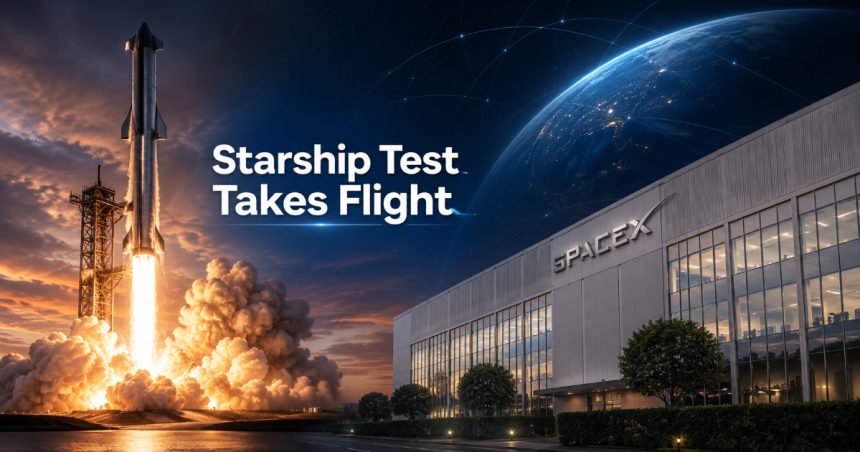
SpaceX successfully launched its SpaceX Starship Test Flight from the company’s Starbase facility in South Texas at 5:51 p.m. local time on Friday.
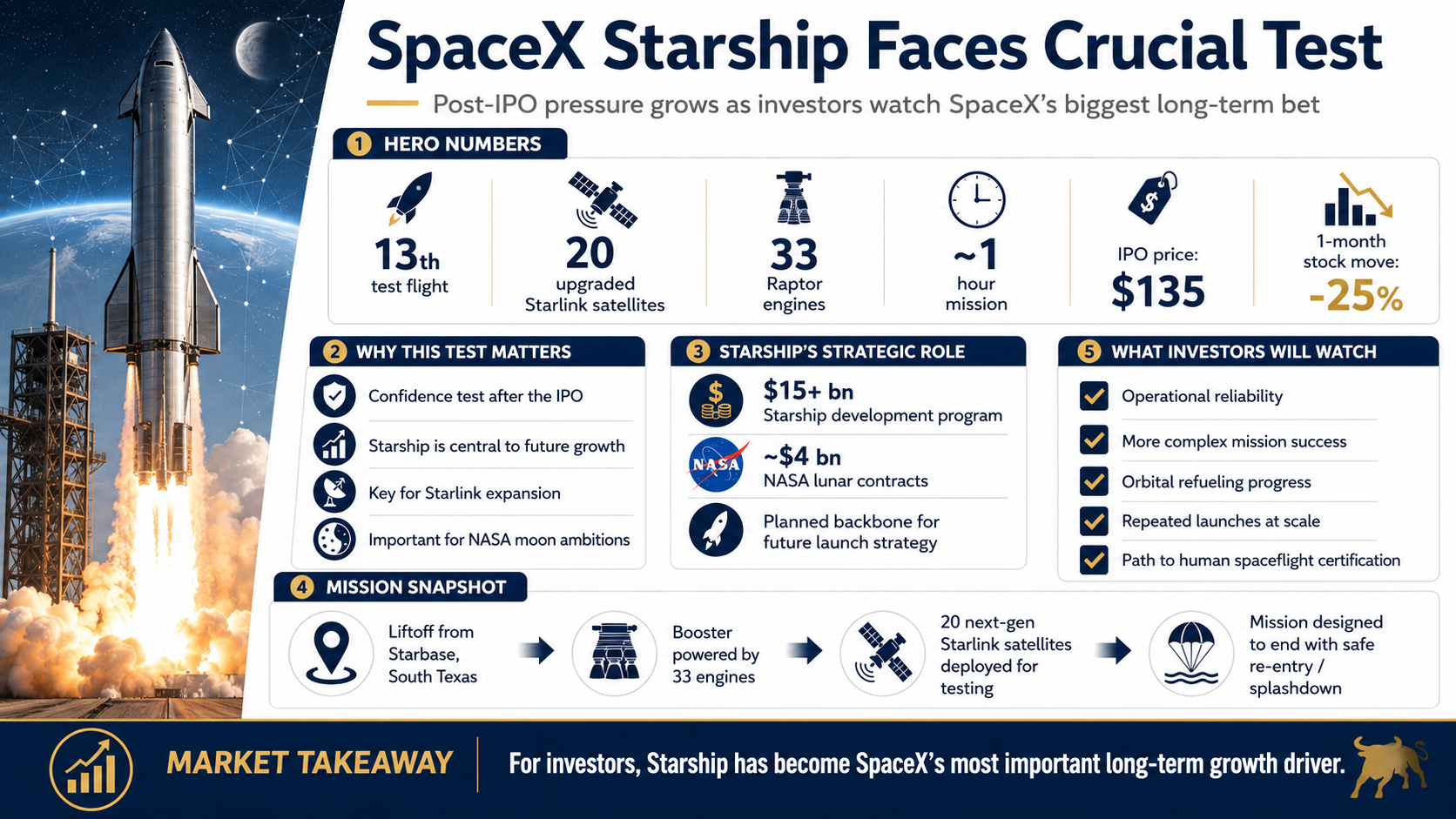
Mounted on top of the massive Super Heavy booster, Starship lifted off carrying 20 upgraded Starlink satellites that are designed to test next-generation communication technology before safely burning up in Earth’s atmosphere.
The test mission is expected to last around one hour and represents the 13th Starship flight in the rocket’s development program.
Track Live : NSE Option Chain — Live
Why this SpaceX Starship test matters more than ever
This mission comes at a crucial time for SpaceX.
Following its highly anticipated IPO, investors have become increasingly sensitive to delays and technical setbacks surrounding Starship. Earlier mission postponements have weighed on market sentiment, reflecting concerns over the risks associated with the company’s rapid “fly, fail, fix” development philosophy.
SpaceX shares closed nearly 3% lower on Friday and have declined about 25% over the past month, trading well below the company’s $135 IPO price.
The latest SpaceX Starship Test Flight is therefore being viewed not only as an engineering milestone but also as an important confidence test for shareholders.
Track Live : IPO – Latest & Upcoming IPOs List 2026 | Check Live BSE NSE IPOs
Starship & SpaceX Quick Facts
| Metric | Value |
|---|---|
| Test Flight | 13th |
| Development Cost | $15+ Billion |
| NASA Contracts | $4 Billion |
| Starlink Satellites | 20 |
| Booster Engines | 33 Raptor engines |
| Mission Duration | About 1 Hour |
| IPO Share Price | $135 |
| One-Month Stock Change | About -25% |
SpaceX’s 13th Starship test flight carried 20 next-generation Starlink satellites powered by a Super Heavy booster with 33 Raptor engines. The approximately one-hour mission is part of the company’s more than $15 billion Starship program, which also supports roughly $4 billion in NASA lunar contracts. Since its IPO at $135 per share, SpaceX stock has fallen about 25% over the past month, reflecting investor concerns over the risks associated with Starship’s ambitious development program.
Starship carries upgraded Starlink satellites into space
After liftoff, the Super Heavy booster ignited all 33 Raptor engines, propelling Starship toward near-orbital velocity.
Following stage separation, the booster successfully splashed down in the Gulf of Mexico. Unlike previous missions, SpaceX intentionally skipped attempting its dramatic mid-air booster catch.
Once in space, Starship is scheduled to perform several key demonstrations.
These include restarting one of its engines in orbit and deploying 20 upgraded Starlink satellites.
The satellites will unfold their solar arrays and attempt to establish laser-based communication links with the existing Starlink network before re-entering Earth’s atmosphere approximately 20 minutes later, where they are expected to burn up safely.
The spacecraft itself is scheduled to splash down in the Indian Ocean roughly one hour after launch.
Read More : Tata Consumer Q1 Numbers Strong: Profit Up 28%, Revenue Hits Rs 5,348 Cr
Starship remains central to Elon Musk’s long-term vision
Starship is far more than another launch vehicle for SpaceX.
The fully reusable rocket is expected to support the rapid expansion of the Starlink broadband network, enable large-scale cargo transportation, deploy future space-based data centers, and eventually transport astronauts to the Moon and Mars.
SpaceX has invested more than $15 billion in developing Starship, making it one of the most expensive aerospace programs ever undertaken by a private company.
The company is also increasingly shifting its long-term launch strategy toward Starship.
According to recent reports, SpaceX has stopped accepting reservations for dedicated Falcon rocket missions beyond 2028, signaling that Starship will eventually replace Falcon as the company’s primary launch system.
NASA contracts make Starship’s success even more important
Starship is also essential to SpaceX’s partnership with NASA.
The company currently holds approximately $4 billion in NASA contracts to develop a lunar landing system capable of returning astronauts to the Moon under the Artemis program, with missions expected as early as 2028.
However, several major technical challenges remain.
SpaceX still needs to demonstrate orbital refueling, perform multiple consecutive launches within a short period, complete a full orbital mission successfully, and certify the spacecraft for human spaceflight before astronauts can board the vehicle.
These milestones remain among the biggest hurdles facing the Starship program.
SpaceX After the 2026 IPO: Financial & Key Benefits
| Metric | Status / Value | Why It Matters |
|---|---|---|
| IPO Year | 2026 | One of the largest IPOs in history |
| First Post-IPO Earnings | Expected August 4, 2026 | Investors are awaiting official financial results. |
| 2025 Revenue (Pre-IPO) | Approximately $15–16 billion | Demonstrates strong business growth before listing. |
| 2025 Operating Profit (Reported by Reuters Sources) | About $8 billion (EBITDA) | Indicates healthy operating performance before major expansion spending. |
| Main Revenue Sources | Starlink, Launch Services, NASA & Defense Contracts | Diversified revenue base supports long-term growth. |
| Starship Development Cost | $15+ Billion | Largest long-term investment in reusable launch technology. |
| NASA Starship Contracts | Approximately $4 Billion | Provides long-term government-backed revenue opportunities. |
How SpaceX Has Benefited From the IPO
| Benefit | Impact on SpaceX |
|---|---|
| Raised Significant Capital | Strengthened the balance sheet and provided funding for large-scale expansion projects. |
| Accelerated Starship Development | Increased investment in reusable rocket technology and production capacity. |
| Expanded Starlink Network | More funding for next-generation satellites and global broadband coverage. |
| Higher Investor Visibility | Improved access to institutional investors and global capital markets. |
| Stronger Competitive Position | Better positioned to compete in commercial launches, satellite internet, AI infrastructure, and space exploration. |
| Enhanced Government Business | Supports execution of NASA Artemis missions and U.S. defense contracts. |
SpaceX’s Main Revenue Streams
- Starlink Internet Services – Monthly subscription revenue from consumers, businesses, aviation, maritime, and government customers.
- Commercial Launch Services – Falcon 9, Falcon Heavy, and future Starship launches for commercial satellite operators.
- NASA Contracts – Artemis Moon missions, cargo transportation, and human spaceflight programs.
- Defense & National Security Missions – Launch services for U.S. government and military payloads.
- Future Starship Operations – Expected to reduce launch costs and enable larger satellite deployments and deep-space missions.
Here’s what happened today and why traders reacted
Today’s successful SpaceX Starship Test Flight marked another important step toward validating the company’s long-term strategy.
Although the launch itself was successful, investors remain focused on whether Starship can consistently complete increasingly complex missions without major failures.
The recent decline in SpaceX’s share price reflects growing market expectations that future valuation will depend heavily on Starship achieving operational reliability.
Any technical success strengthens confidence in the company’s commercial launch business, Starlink expansion plans, and government contracts.
What impact could this have on investors?
For investors, Starship has become the single most important growth driver for SpaceX.
Consistent mission success could improve investor confidence, strengthen the company’s competitive position in the global launch market, and support future revenue from Starlink services, commercial launches, and NASA missions.
On the other hand, repeated delays or technical failures could continue to pressure the stock, especially after the company’s public listing placed greater emphasis on quarterly execution and operational milestones.
As SpaceX accelerates its transition toward a fully reusable launch system, upcoming SpaceX Starship Test Flight results are likely to remain one of the most closely watched catalysts for both the aerospace industry and investors.