Shareholders ratify the FY26 payout this week even as a widening gap between revenue and profit growth keeps the June-quarter print under close watch
Key Takeaways
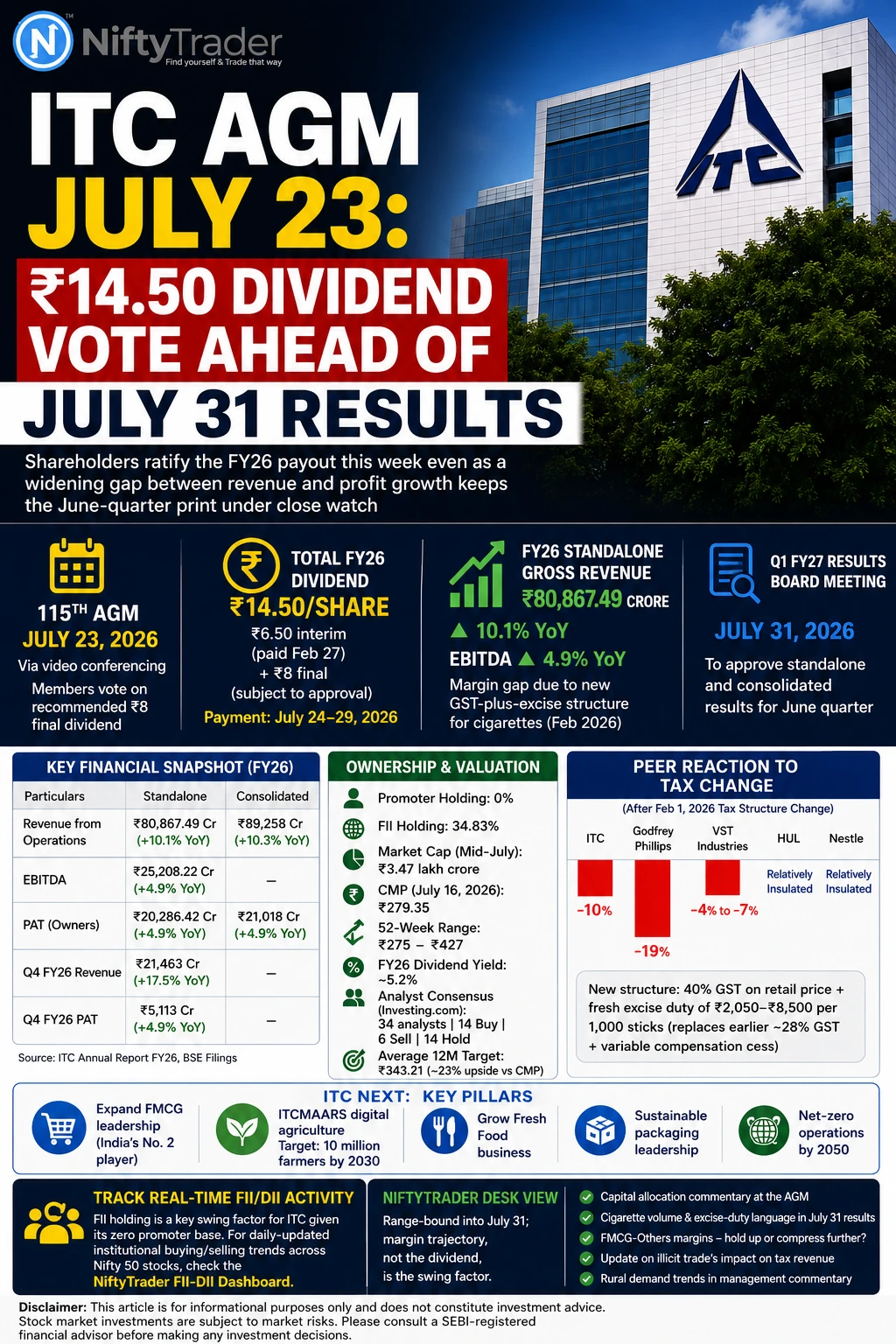
- ITC’s 115th AGM will be held on July 23, 2026, via video conferencing, where members vote on the recommended Rs 8 final dividend.
- Total FY26 dividend stands at Rs 14.50/share (Rs 6.50 interim + Rs 8 final); payment window is July 24–29, 2026.
- FY26 standalone gross revenue rose 10.1% to Rs 80,867.49 crore, while EBITDA grew a slower 4.9%, a gap tied to the new GST-plus-excise cigarette tax structure effective February 2026.
- Q1 FY27 board meeting is set for July 31; ITC shares closed at Rs 279.35 on July 16, more than 34% below the 52-week high of Rs 427.
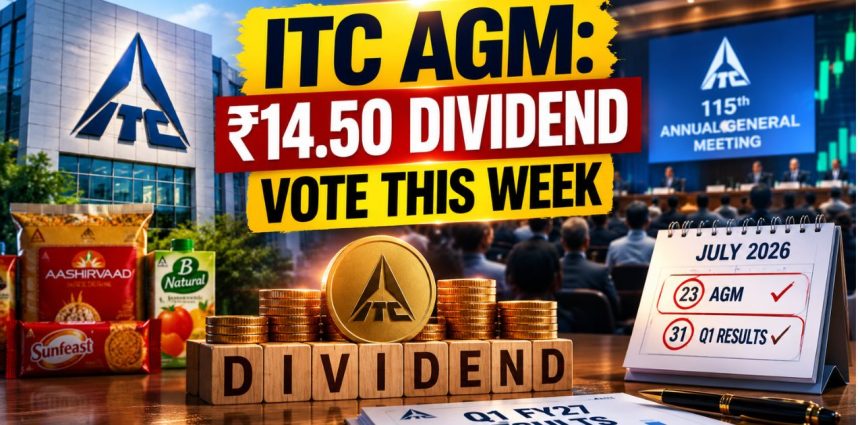
ITC Ltd’s calendar turns eventful this week. The company holds its 115th Annual General Meeting on July 23, where shareholders vote on a Rs 8 final dividend that takes the total dividend for the financial year ended March 31, 2026, to Rs 14.50 per ordinary share.
Eight days later, on July 31, the board meets again to approve Q1 FY27 standalone and consolidated results.
The two dates bracket a period in which ITC’s stock has struggled to keep pace with its own earnings growth, and investors are treating the AGM as a checkpoint before the real test arrives with the Q1 print.
AGM Agenda: Dividend Confirmation And Board Continuity
The AGM’s core business is procedural but consequential. If approved, the Rs 8 final dividend, together with the Rs 6.50 interim dividend declared on January 29, 2026, will be paid between July 24 and July 29, 2026.
The board has also recommended re-appointing an existing director for a fresh five-year term, signalling continuity in governance rather than any strategic reset.
Key Dates At A Glance
| Event | Date |
|---|---|
| 115th Annual General Meeting (Dividend Vote) | July 23, 2026 |
| Final Dividend Payment Window | July 24–29, 2026 |
| Q1 FY27 Board Meeting (Results Announcement) | July 31, 2026 |
| Interim Dividend Paid | February 27, 2026 |
Q1 FY27 Preview: The Base That Matters
July 31 results will be measured against a Q1 FY26 base of Rs 23,129 crore in revenue from operations and Rs 5,244.20 crore in net profit attributable to owners.
According to a trailing-growth model from Univest’s Uniresearch desk, Q1 FY27 revenue could range between Rs 21,278 crore and Rs 23,966 crore, a wide band reflecting real uncertainty over how cigarette volumes absorbed February’s tax increase. That’s the expectation gap markets will resolve on results day.
Where FY26 Revenue And Profit Diverged
ITC’s FY26 print already previewed this tension. Standalone Q4 revenue rose 17.5% to Rs 21,463 crore, but EBITDA grew just 7.3% and PAT only 4.9% to Rs 5,113 crore, as the shift to the new GST-and-excise duty structure for cigarettes, effective February 1, 2026, distorted comparisons.
ITC has separately flagged that steep taxes are pushing consumers toward illicit trade, estimating an annual tax loss to the government of nearly Rs 23,000 crore, an argument it will likely repeat if volumes disappoint. On the consolidated side, FY26 revenue rose 10.3% to Rs 89,258 crore and profit grew 4.9% to Rs 21,018 crore.
Check Live: ITC Option Chain (ITC) — Live OI, IV, Greeks & PCR
Ownership And Valuation Signals
ITC carries no promoter holding, with foreign institutional investors owning 34.83% of the company. Market cap stood near Rs 3.47 lakh crore as of mid-July, with the stock closing at Rs 279.35. At that price, the confirmed Rs 14.50 total dividend implies a yield of about 5.2%.
Against this, 34 tracking analysts (per Investing.com’s consensus) hold an average 12-month target of Rs 343.21, 14 buy, 6 sell, 14 hold, with the consensus rating Neutral and roughly 23% implied upside from current levels.
📊 Track Real-Time FII/DII Activity FII holding is a key swing factor for ITC given its zero promoter base. For daily-updated institutional buying/selling trends across Nifty 50 stocks, check the NiftyTrader FII-DII Dashboard.
ITC Next: The Strategy Question At The AGM
Beyond the dividend vote, shareholders will be watching for Chairman and Managing Director Sanjiv Puri’s commentary on “ITC Next”, the medium-term strategy laid out in the FY26 annual report, built around expanding the FMCG business (where ITC remains India’s No. 2 player behind Hindustan Unilever), scaling the ITCMAARS digital agriculture platform toward a target of 10 million farmers by 2030, growing the Fresh Food and sustainable-packaging businesses, and targeting net-zero operations by 2050.
With cigarette earnings under sustained tax pressure, how convincingly management frames these newer, less tobacco-dependent growth vectors will shape how the market reads the AGM beyond its procedural business.
Peer Read: Tax Shock Rippled Unevenly
When the new cigarette tax structure took effect on February 1, 2026, a fresh per-stick excise duty of Rs 2,050-8,500 per 1,000 sticks stacked on a GST rate fixed at 40% of the printed retail price, replacing the earlier regime of roughly 28% GST plus a variable compensation cess, ITC fell as much as 10% intraday, Godfrey Phillips tumbled close to 19%, and VST Industries slipped around 4-7%.
Diversified peers like HUL and Nestle have been comparatively insulated, why ITC’s non-cigarette FMCG business, at Rs 24,210 crore in FY26 with a 10.5% five-year CAGR, matters more to its story now.
NiftyTrader Desk View
| Metric | Reading |
|---|---|
| CMP | ₹279.35 |
| 52-Week Range | ₹275 – ₹427 |
| Analyst Consensus | Neutral (Avg. Target: ₹343.21) |
| FY26 Dividend Yield | ~5.2% |
| Consolidated Revenue Growth (FY26) | +10.3% YoY |
| Consolidated PAT Growth (FY26) | +4.9% YoY |
| Desk View | Range-bound into July 31; margin trajectory, not the dividend, remains the key swing factor. |
Key Things To Watch
- Capital allocation commentary at the AGM beyond the dividend
- Cigarette volume and excise-duty language in the July 31 results
- Whether FMCG-Others margins hold up or compress further
- Any update on illicit trade’s impact on reported tax revenue
- Rural demand trends in management commentary
Why It Matters Today
The AGM is a formality, but it locks in a real cash payout while the stock is under pressure — a reason for income-focused holders to stay put. The bigger swing factor sits nine days later: if Q1 FY27 shows EBITDA catching up with revenue growth, it would ease the margin concern that’s kept the stock over 34% below its peak.
Final Take
The next catalyst isn’t the dividend vote, it’s whether the July 31 numbers show ITC’s tax-related margin compression was a one-quarter shock or a structural drag. A clean beat on FMCG-Others margins could start closing the gap to analyst targets; a repeat of Q4’s pattern keeps the stock range-bound into the festive season.
Read Next: CDSL Penalty, L&T Mega Orders and Q1 Earnings Set Up a High-Impact Trading Day
FAQs
Q1. When is the ITC AGM 2026?
ITC’s 115th AGM is scheduled for July 23, 2026, conducted via video conferencing.
Q2. What is ITC’s total dividend for FY26?
Rs 14.50 per share in total — Rs 6.50 paid as interim dividend in February, plus a Rs 8 final dividend subject to AGM approval, payable between July 24 and July 29, 2026.
Q3. When will ITC announce Q1 FY27 results?
The board meets on July 31, 2026, to approve standalone and consolidated results for the quarter ended June 30, 2026.
Q4. Why did ITC’s profit growth lag revenue growth in FY26?
A new tax structure for cigarettes, a 40% GST slab on retail price plus a fresh per-stick excise duty, effective February 1, 2026, compressed margins even as revenue kept growing.
Q5. What is the “ITC Next” strategy?
ITC’s medium-term growth plan centred on FMCG expansion, digital agriculture through ITCMAARS, the Fresh Food business, sustainable packaging, and a 2050 net-zero target.
Q6. What do analysts currently make of ITC stock?
Consensus is Neutral, with brokerage targets spread roughly between Rs 290 and Rs 486, reflecting split views on whether FMCG and newer businesses can offset cigarette-tax headwinds.
Disclaimer: This article is for informational purposes only and does not constitute investment advice. Stock market investments are subject to market risks. Please consult a SEBI-registered financial advisor before making any investment decisions.