
Tiger Global Ticked Every Compliance Box In Mauritius — Yet Lost Its Tax Case In India
The Tiger Global tax ruling has once again put India’s investment climate under the spotlight. Just months after the Supreme Court ruled against Tiger Global in the Flipkart tax case, former NITI Aayog CEO Amitabh Kant has warned that the judgment has hurt investor sentiment and renewed calls for a stable tax regime.
For investors, the bigger question is no longer about Tiger Global alone. It is whether India can continue attracting global capital while tightening its anti-tax avoidance framework. That debate is now at the centre of discussions among foreign investors, private equity funds and market participants.
Track Live : NSE Option Chain — Live
Tiger Global tax ruling becomes a turning point for foreign investors
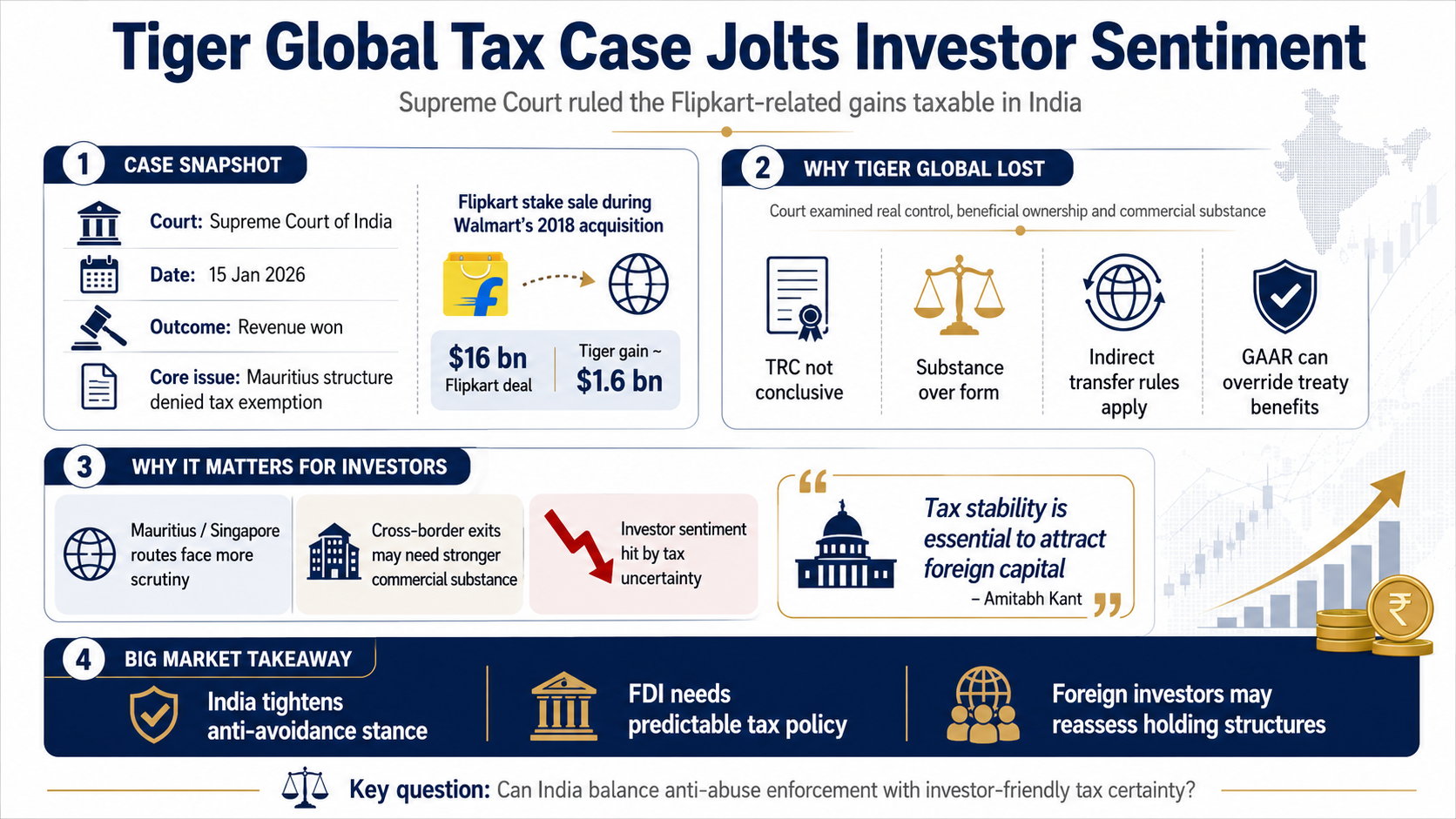
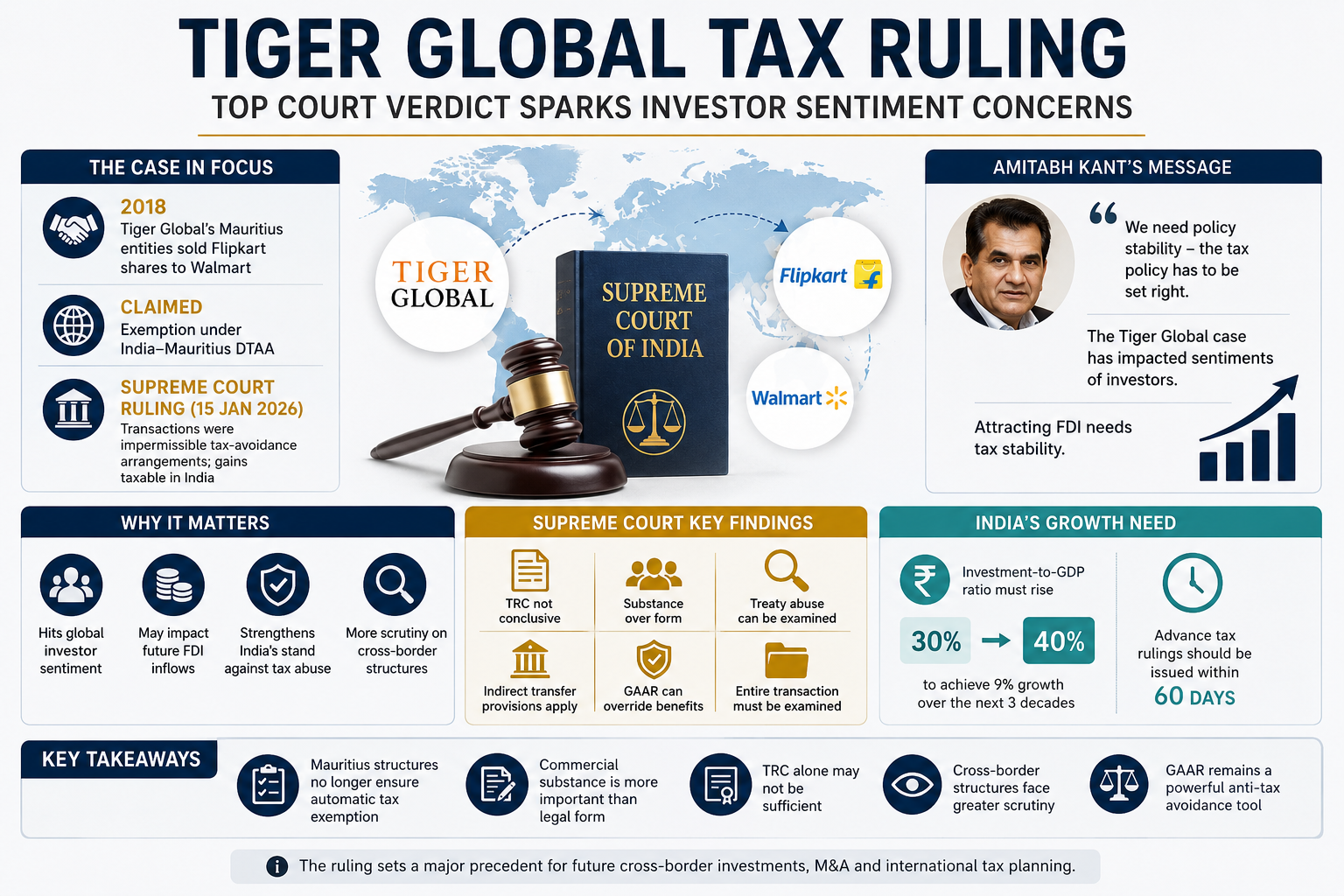
The Tiger Global tax ruling stems from Walmart’s acquisition of Flipkart in 2018. Tiger Global’s Mauritius-based investment entities sold shares of Flipkart’s Singapore holding company and claimed exemption under the India-Mauritius Double Taxation Avoidance Agreement (DTAA).
The Supreme Court overturned the Delhi High Court’s earlier verdict and ruled that the transactions were impermissible tax-avoidance arrangements, making the capital gains taxable in India.
“The transactions in the instant case are impermissible tax-avoidance arrangements,” the Supreme Court observed while allowing the Revenue’s appeals.
The Court said tax authorities have the right to examine commercial substance, beneficial ownership and the actual management of overseas investment structures instead of relying only on Tax Residency Certificates.
Highlights
- Court: Supreme Court of India
- Date: 15 January 2026
- Case: Authority for Advance Rulings (Income Tax) vs. Tiger Global International Holdings
- Outcome: Revenue (Income Tax Department) won.
- Key Decision: The Supreme Court set aside the Delhi High Court judgment and held that the Tiger Global transactions were prima facie tax avoidance arrangements, making the gains taxable in India.
Read More : Why India’s Richest Investors Are Turning to Real Estate Instead of the Stock Market
Main Background
The dispute arose after Tiger Global’s Mauritius investment entities sold shares of Flipkart Singapore during Walmart’s acquisition of Flipkart.
Important facts:
- Tiger Global II, III and IV Holdings were incorporated in Mauritius.
- They held Tax Residency Certificates (TRCs) issued by Mauritius.
- They sold Flipkart Singapore shares in 2018.
- Flipkart Singapore derived substantial value from Indian assets.
- Tiger Global claimed exemption under the India-Mauritius DTAA.
- The Income Tax Department denied treaty benefits and sought to tax the gains in India.
Amitabh Kant says tax stability is essential after the Tiger Global tax ruling
Reacting to the Tiger Global tax ruling, Amitabh Kant urged India to focus on policy certainty rather than retrospective taxation.
“We need policy stability – the tax policy has to be set right,” Kant said in an interview with Moneycontrol.
According to him, the Tiger Global tax ruling has affected global investor sentiment and India must send a clear message that it welcomes businesses and foreign investors.
“The Tiger Global case has impacted sentiments of investors. As a country, we need to do this as a mission,” he said.
Kant believes predictable tax policies are critical if India wants to remain a preferred investment destination.
Revenue’s Main Arguments
The Income Tax Department argued that:
- Tiger Global’s Mauritius companies were only conduit entities.
- Real control was exercised from the United States.
- The Mauritius entities lacked commercial substance.
- The investment structure was created primarily to obtain treaty benefits.
- GAAR (General Anti-Avoidance Rules) should apply.
- The transaction amounted to an indirect transfer of Indian assets and should therefore be taxed in India.
Tiger Global’s Main Arguments
Tiger Global argued that:
- It held valid Mauritius Tax Residency Certificates.
- The Mauritius entities had board meetings, offices, employees and bank accounts there.
- The investment was genuine and long term.
- Shares had been acquired before 1 April 2017 and were therefore grandfathered under the DTAA.
- The Delhi High Court had correctly granted treaty benefits.
Why attracting FDI matters more than ever
Kant said India’s domestic savings alone are not sufficient to support its long-term growth ambitions.
He noted that India’s investment-to-GDP ratio is currently around 30%, while it must rise to nearly 40% if the country aims to sustain 9% economic growth over the next three decades.
“Attracting FDI needs tax stability,” Kant said.
He also proposed that advance tax rulings should be issued within 60 days so businesses receive certainty before undertaking major transactions.
Authority for Advance Rulings (AAR)
The AAR ruled against Tiger Global, finding that:
- Real management was not in Mauritius.
- Mr. Charles Coleman effectively controlled major decisions.
- The Mauritius companies were “see-through” entities.
- The structure was designed primarily to obtain DTAA benefits.
- The arrangement was prima facie meant for tax avoidance.
Delhi High Court Decision
The High Court ruled in favour of Tiger Global, holding that:
- The companies had sufficient commercial substance.
- TRCs issued by Mauritius should be respected.
- Treaty shopping alone is not illegal.
- Investments made before 1 April 2017 were grandfathered.
- The gains were not taxable in India.
Here’s what happened today and why traders reacted
The Tiger Global tax ruling, along with Amitabh Kant’s remarks, has reignited concerns over India’s investment environment.
The Supreme Court’s verdict strengthens India’s ability to investigate treaty abuse and aggressive tax planning. At the same time, Kant’s comments have revived the debate over balancing strong tax enforcement with investor-friendly policies.
Although the judgment is not expected to impact benchmark indices immediately, it has become an important sentiment driver for foreign institutional investors (FIIs), private equity firms and venture capital funds.
Major companies linked to the Tiger Global tax ruling
The case revolves around Walmart’s $16 billion acquisition of Flipkart, one of India’s biggest technology deals.
Tiger Global generated nearly $1.6 billion by selling its Flipkart stake during the transaction.
While Walmart and Flipkart continue to operate normally, the Tiger Global tax ruling establishes an important legal precedent for future cross-border mergers, acquisitions and investment exits.
Global investment firms using Mauritius or Singapore investment structures are expected to review their tax strategies following the judgment.
Why the Tiger Global tax ruling matters for India’s growth story
The Tiger Global tax ruling highlights India’s commitment to tackling treaty abuse and protecting its tax base. However, Amitabh Kant believes attracting foreign investment requires equally strong policy stability and tax certainty.
As India works towards becoming a multi-trillion-dollar economy, foreign capital will remain essential for infrastructure, manufacturing, technology and digital growth.
The Tiger Global tax ruling therefore serves as both a legal milestone and a reminder that India’s long-term investment story will depend not only on strong regulations but also on building global investor confidence through transparent and predictable tax policies.
Supreme Court’s Key Findings
The Supreme Court disagreed with the High Court and held that:
1. TRC is not conclusive
A Tax Residency Certificate alone does not automatically guarantee treaty benefits.
2. Substance over form matters
Authorities can examine:
- Actual management
- Beneficial ownership
- Commercial substance
- Purpose of the investment structure
3. Treaty abuse can be examined
Even where treaty benefits are claimed, Indian tax authorities may investigate whether the arrangement is abusive.
4. Indirect transfer provisions apply
The transaction involved shares of a Singapore company whose value was substantially derived from Indian assets, bringing it within India’s indirect transfer rules.
5. GAAR can apply
The Court accepted that General Anti-Avoidance Rules may override treaty benefits where an arrangement lacks commercial substance.
6. Entire transaction must be examined
The Court emphasized that tax authorities are entitled to examine the complete investment structure—not just the final sale of shares—to determine whether there is tax avoidance.
Final Judgment
The Supreme Court held that:
- The arrangements were impermissible tax avoidance arrangements.
- GAAR applies.
- Capital gains arising after 1 April 2017 are taxable in India.
- The Delhi High Court judgment was set aside.
- All appeals filed by the Revenue were allowed.
Important Takeaways for Investors
- India has strengthened its stance against treaty abuse.
- Mauritius structures no longer automatically guarantee tax exemption.
- Commercial substance has become more important than legal form.
- Tax Residency Certificates alone may not be sufficient.
- Cross-border investment structures are likely to face greater scrutiny.
- GAAR remains a powerful anti-tax avoidance tool.
- Foreign investors using treaty jurisdictions should reassess their holding structures.
Market Significance
This judgment is significant because it:
- Clarifies India’s approach to indirect transfers.
- Strengthens the Revenue’s powers in treaty abuse cases.
- May influence future FDI structures through Mauritius, Singapore and similar jurisdictions.
- Sets an important precedent for international tax planning and cross-border M&A transactions.