
SEBI Cash Margin Rules May Cut Upfront Margin for Cash Trades, But Here’s the Bigger Shift Investors Should Watch
The way investors trade in India’s cash market could soon change significantly. SEBI upfront margin for cash market trades is under review, and if the proposal goes ahead, investors in highly liquid stocks may need to block less capital before placing buy orders.
The proposed framework could improve market liquidity, lower funding requirements for traders, and make cash market participation more efficient. However, it may also reshape how stocks are classified based on liquidity, potentially affecting Margin Trading Facility (MTF) eligibility for several companies.
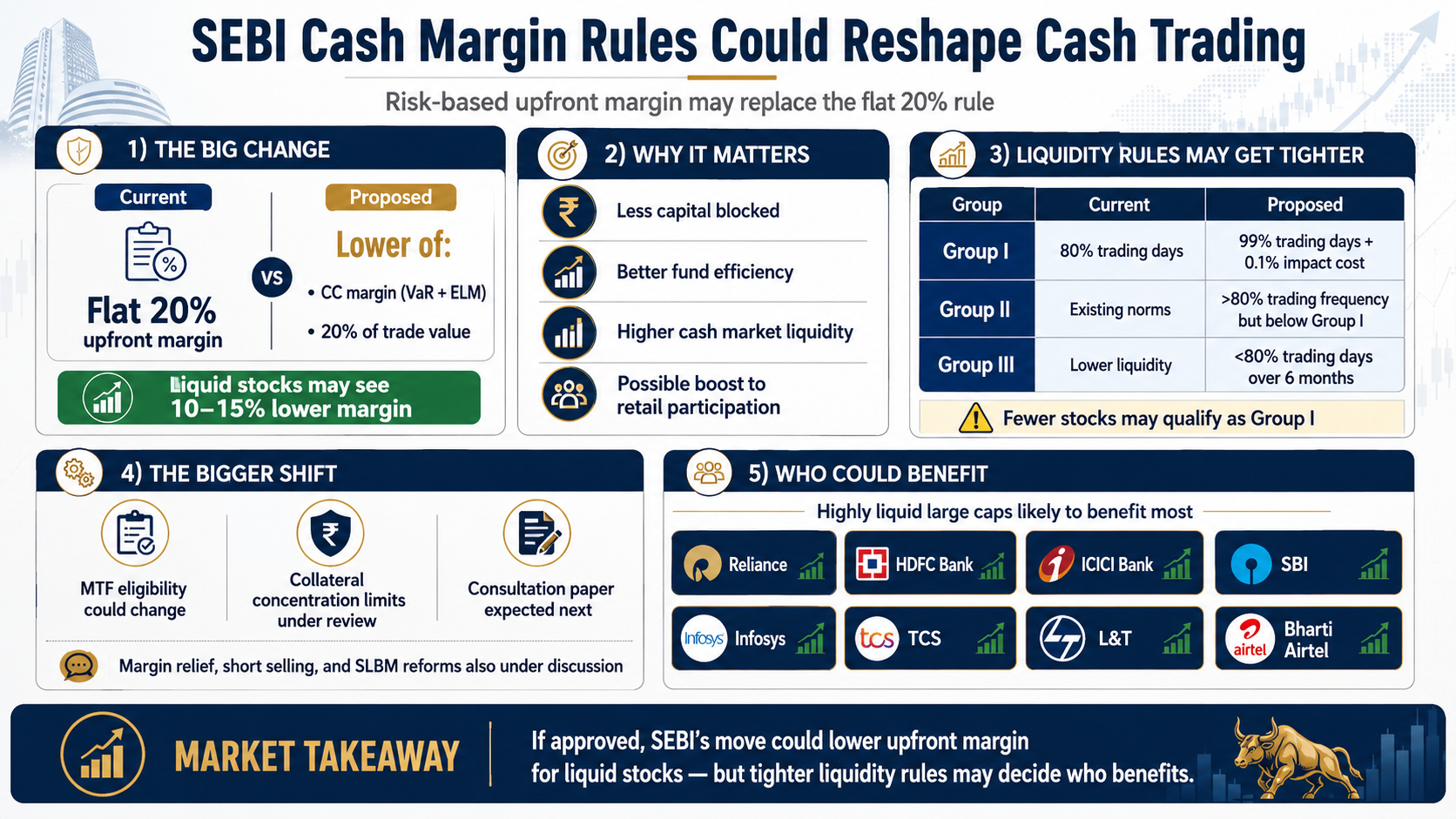
SEBI plans to replace the flat 20% upfront margin with a risk-based framework
According to sources, the Securities and Exchange Board of India (SEBI) is working on a proposal to replace the current mandatory 20% upfront margin for cash market trades with a risk-based margin system.
Instead of collecting a fixed 20% margin from every investor, brokers may be required to collect the lower of:
- The applicable Clearing Corporation Margin (Value at Risk (VaR) + Extreme Loss Margin (ELM))
- 20% of the transaction value
The proposal is expected to better align margin requirements with the actual market risk of individual stocks.
Sources indicate that SEBI has been discussing the framework with market participants for several months, and a consultation paper is likely to be released soon.
Why the current margin system is under review
At present, brokers must collect a minimum upfront margin of 20% from clients to avoid short collection penalties.
However, for many highly liquid large-cap stocks, clearing corporations typically levy margins of around 12.5%, consisting of:
- Around 9% Value at Risk (VaR)
- Around 3.5% Extreme Loss Margin (ELM)
This means investors often block substantially more capital than the actual market risk requires.
According to preliminary analysis based on data from the country’s top 10 brokers, the proposed framework could reduce upfront margin requirements by approximately 10% to 15% for investors trading highly liquid stocks without materially increasing systemic risk.
One person familiar with the discussions said:
“The proposal was long under discussion with stakeholders and is nearly final.”
Read More : SBI Funds Management Stock Cools Off After Strong Debut; Here’s the Analyst Verdict
SEBI may tighten liquidity norms for stock classification
Alongside the proposed SEBI upfront margin for cash market trades reforms, the regulator is also considering stricter liquidity criteria for classifying listed securities.
A working group of clearing corporations has recommended:
- Raising the trading frequency requirement for Group I stocks from 80% to 99% of trading days.
- Reducing the impact cost threshold from 1% to 0.1%.
For Group II securities, stocks would need either:
- Trading frequency between more than 80% and 99%, or
- Impact cost of 0.1%.
Meanwhile, Group III would include stocks traded on less than 80% of trading days over the previous six months.
Market participants believe these tighter criteria could reduce the number of stocks qualifying as Group I securities, prompting suggestions for a phased implementation to allow markets sufficient time to adjust.
| Category | Current Criteria | Proposed Criteria |
|---|---|---|
| Group I | Trading on at least 80% of trading days | Trading on 99% of trading days and impact cost reduced from 1% to 0.1% |
| Group II | Existing liquidity norms | Trading frequency above 80% but below Group I requirements |
| Group III | Lower liquidity stocks | Trading on less than 80% of trading days over the previous six months |
Why the liquidity classification matters
The proposed classification changes extend beyond margin calculations.
The liquidity grouping also determines a stock’s eligibility under the Margin Trading Facility (MTF), making the revised criteria particularly important for brokers, traders, and long-term investors.
The existing framework was introduced in 2005 and has remained largely unchanged despite significant growth in India’s equity market.
As the market has expanded over the years, the number of stocks classified under Group I has also increased considerably, making a review necessary.
SEBI also reviewing collateral concentration limits
The working group has additionally recommended introducing concentration limits on securities accepted as collateral by clearing corporations.
The working group has proposed:
- A clearing corporation-level cap of 20% of non-promoter holdings for F&O stocks.
- For non-F&O stocks, the lower of:
- 20% of non-promoter holdings, or
- Three times the average daily traded quantity over the previous six months.
- Clearing member-level limits of 50% of the average daily traded quantity over six months.
The recommendations also include broker-level concentration limits and a three-month transition period before enforcement to help market participants adjust.
Additional reforms under discussion
SEBI is simultaneously examining several initiatives aimed at improving liquidity in the cash market, including:
- Margin relief for buy-side trades through the Early Pay-In (EPI) mechanism.
- Expanding the list of stocks eligible for short selling.
- Strengthening the Stock Lending and Borrowing Mechanism (SLBM).
These proposals are part of the regulator’s broader effort to deepen cash market participation while maintaining prudent risk management standards.
Which Stocks Could Benefit If SEBI Introduces Risk-Based Upfront Margins?
Large-cap market leaders with exceptionally high trading volumes are expected to benefit the most if SEBI adopts its proposed risk-based upfront margin framework. Under the proposal, stocks that satisfy the stricter liquidity criteria—such as 99% trading frequency and a maximum 0.1% impact cost—would likely remain in Group I, allowing investors to trade them with lower upfront margins linked to actual market risk rather than the current flat 20% requirement. The final eligibility, however, will depend on SEBI’s consultation paper and the data-driven framework it eventually notifies.
Highly Liquid Sectors & Potential Beneficiary Stocks
Track Live : NSE-Listed Companies and Indian Stock List
| Sector | Stock | Current Share Price* |
|---|---|---|
| Private Banking | Reliance Industries | ₹1,271.80 |
| Private Banking | HDFC Bank | ₹745.80 |
| Private Banking | ICICI Bank | ₹1,435.60 |
| Public Banking | State Bank of India (SBI) | ₹1,011.50 |
| Information Technology | Infosys | ₹1,044.00 |
| Information Technology | Tata Consultancy Services (TCS) | ₹2,243.10 |
| Capital Goods & Infrastructure | Larsen & Toubro (L&T) | ₹3,793.50 |
| Telecommunications | Bharti Airtel | ₹1,931.80 |
*Prices are approximate current market levels and may change during trading hours.
Here’s what happened today and why traders reacted
News that SEBI may replace the flat upfront margin system with a risk-based framework was viewed positively by many market participants.
Lower upfront margin requirements could improve cash market participation by reducing the amount of capital investors need to block before executing trades in highly liquid stocks.
At the same time, traders are closely watching the proposed liquidity classification changes, as they could alter which stocks remain eligible for Margin Trading Facility benefits.
The market’s attention is now shifting to the expected consultation paper, which will provide greater clarity on the implementation timeline and final framework.
What could be the impact on traders and investors?
If implemented, the proposal could have several implications:
- Lower capital requirement for investors trading liquid large-cap stocks.
- Better utilisation of available trading funds.
- Improved cash market liquidity and trading efficiency.
- Potential increase in retail participation.
- Possible changes in MTF eligibility for certain stocks if liquidity norms become stricter.
However, investors should also monitor whether stocks move between liquidity groups, as this may influence leverage availability and trading costs.
Market outlook: What investors should watch next
The proposal is still under discussion, and SEBI is expected to issue a consultation paper before taking a final decision.
Investors should monitor:
- The final margin calculation methodology.
- Revised liquidity classification rules.
- Changes in MTF eligibility.
- Any implementation timeline or transition period announced by SEBI.
These reforms could become one of the most significant structural changes in India’s cash equity market in recent years, aiming to improve market efficiency while keeping risk management aligned with actual market conditions.