Need to Know
- The BSE IPO index, which tracks the exchange’s mainboard debutants, surged 35% in the first five months of FY27 (April–August), its strongest April-August run in three years, and closed at an all-time high on Monday, September 7.
- The BSE SME IPO index jumped 55% over the same stretch, its best five-month showing in two years, and is now roughly 5% below its own record.
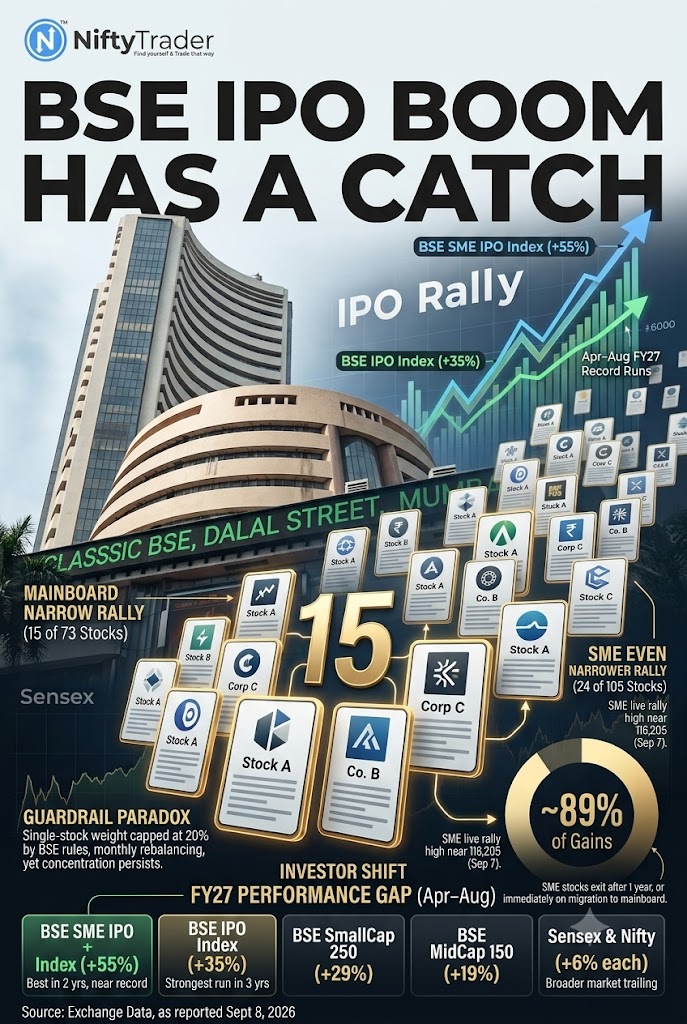
- Both benchmarks left the broader market behind: Sensex and Nifty gained 6% each between April and August, while the BSE MidCap 150 rose 19% and the BSE SmallCap 250 climbed 29%.
- The rally is narrow: just 15 of the mainboard index’s 73 stocks generated about 80% of its gains, and 24 of the SME index’s 105 stocks drove roughly 89% of its rise.
- BSE’s own rulebook caps any single mainboard IPO stock at 20% of the index weight, rebalanced every month, a guardrail that hasn’t stopped the concentration.
- A fund manager quoted in the original report says retail and HNI investors are rotating into fresh listings and away from legacy large-caps weighed down by FPI selling pressure.
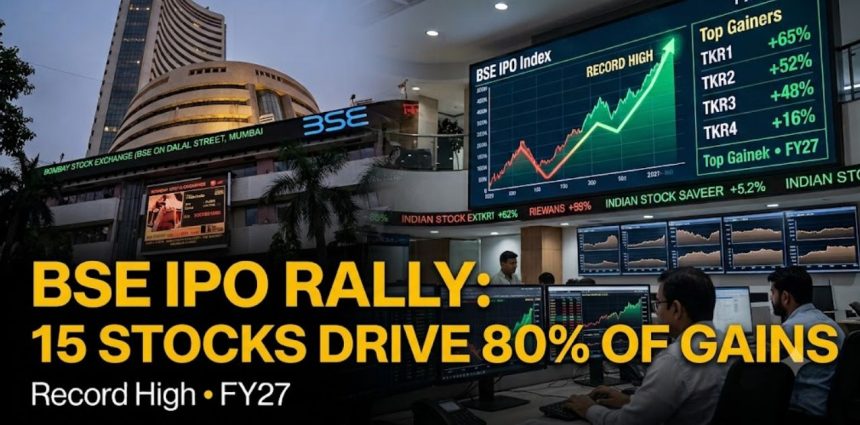
Fresh stock-market debutants are outrunning almost everything else on Dalal Street this year. The BSE IPO index, the benchmark that tracks the exchange’s most recent mainboard listings, climbed to an all-time high on Monday, September 7, after surging 35% in the first five months of FY27 (April–August 2026). That’s its strongest April-to-August performance in three years, and it puts fresh listings well ahead of every major broad-market gauge.
The SME segment did even better on a relative basis. The BSE SME IPO index jumped 55% over the same five months, its best showing for the period in two years, though it remains about 5% short of its own all-time high. In a separate market update from Monday’s session, the SME gauge was also seen touching an intraday level near 116,205, underlining how live the rally still is.
How the IPO Rally Stacks Up Against Sensex, Nifty
The scale of the outperformance becomes clear once fresh listings are set beside the rest of the market. The Sensex and Nifty each rose 6% between April and August, roughly a sixth of the mainboard IPO index’s gain. Even the BSE MidCap 150 (up 19%) and BSE SmallCap 250 (up 29%), which usually lead risk-on rallies, trailed both IPO benchmarks.
| Index | Gain (Apr–Aug FY27) |
|---|---|
| BSE IPO Index | +35% |
| BSE SME IPO Index | +55% |
| BSE SmallCap 250 | +29% |
| BSE MidCap 150 | +19% |
| Sensex | +6% |
| Nifty | +6% |
Source: exchange data, as reported September 8, 2026
A Concentrated Rally — 15 Stocks, 80% of the Gains
The headline numbers hide a lopsided rally. Of the 73 stocks in the BSE IPO index, just 15 accounted for close to 80% of the gains. On the SME side, 24 of 105 constituents drove about 89% of the rise, meaning a small pool of debutants is effectively carrying each benchmark on its own.
| Index | Total Constituents | Stocks Driving Most Gains | Share of Gains From Those Stocks |
|---|---|---|---|
| BSE IPO Index | 73 | 15 | ~80% |
| BSE SME IPO Index | 105 | 24 | ~89% |
Source: exchange data, as reported September 8, 2026
That concentration matters for anyone using either index as a proxy for “how new-age India is doing”; a handful of winners, not a broad base of debutants, is doing the heavy lifting.
Check Live: IPO—Latest & Upcoming IPOs List 2026 | Check Live BSE NSE IPOs
Behind the Index—Eligibility, Weight Caps, and Rebalancing Rules
Few readers ever see the rulebook behind an index that’s making headlines, but it explains a lot about why concentration happens even with safeguards in place.
According to BSE Index Services’ own methodology document (August 2026 edition), a company must have a minimum float-adjusted market capitalisation of Rs 100 crore, based on its issue price, to enter the mainboard IPO index, and it’s added on the third day of listing.
It exits at the opening of the Monday following the third Friday of the month after completing one year on the index, with a minimum of 10 constituents maintained at all times. Weights are float-adjusted-market-cap based, capped at 20% per stock, and rebalanced monthly.
The SME IPO index follows a similar entry rule but on a faster clock: a stock joins on just the second day of listing and exits on the same one-year schedule, or immediately if it migrates from the SME platform to the mainboard, even before the year is up.
| Rule | BSE IPO Index | BSE SME IPO Index |
|---|---|---|
| Eligible universe | Mainboard IPOs (not FPOs) | SME-platform IPOs (not FPOs) |
| Entry | 3rd day of listing | 2nd day of listing |
| Min. float-adjusted market cap | Rs 100 crore (issue price basis) | Not specified on the same basis |
| Exit | 1 year after listing, on schedule above | Same, or immediately on migration to mainboard |
| Min. constituents maintained | 10 | 10 |
| Rebalancing | Monthly | Monthly |
Source: BSE Index Services Pvt Ltd, BSE Indices Methodology, August 2026
That one-year churn is worth flagging for the BSE IPO index specifically: today’s biggest winners have a shelf life inside it, so sustaining the rally will depend on fresh debutants holding up their end as this year’s leaders cycle out.
What’s Driving the Money—Retail and HNI Bet on Fresh Stories
The buying isn’t coming from a single pocket of the market. Retail and HNI investors are the ones pushing money into new listings, according to a fund manager quoted in the original report, who pointed to established large-cap stocks carrying baggage that fresh names don’t: FPI-related overhang, rich valuations built up over years, and less certainty about near-term earnings.
A newly listed stock, by contrast, offers a cleaner growth story and, as the data above shows, the potential for outsized, fast-moving gains that legacy names rarely deliver in a five-month window, a big part of why the BSE IPO index has outrun the rest of the market.
The India Angle—FPI Caution Meets a Reviving Primary Market
This isn’t happening in isolation. It comes as India’s broader IPO market is racing to close the gap with last year: 2025’s total fundraising stood at around Rs 1.76 lakh crore, and a revival in issuance since July has put 2026 in the range of a record Rs 2 lakh crore haul, according to market analysts, provided one or both of the two mega issues still awaited, Jio Platforms and NSE, actually hit the Street this year. A steady queue of mid- and small-sized IPOs is expected to keep the primary market busy regardless.
The report points to retail and HNI investors showing stronger interest in fresh listings as established large-caps face FPI-related pressure, a dynamic that lines up with the IPO index’s concentration data, even if it isn’t something broader FII/DII flow tables directly capture.
Track Live: FII DII Data Today: NSE/BSE Cash & F&O Activity
The Real Test Ahead — What Happens When Today’s Leaders Roll Off the Index
Here’s the tension investors tracking the BSE IPO index should sit with: the index is designed around a roughly one-year holding window for eligible new listings, after which constituents are rotated out under the index rules.
That means the 15 mainboard stocks and 24 SME stocks responsible for nearly all of this year’s gains will eventually exit, and the index’s next leg depends on whichever debutants replace them living up to the act.
A rally built on such a small base is easier to sustain when new listings keep clearing the bar; it’s considerably more fragile if the next batch of IPOs disappoints or if listing-day enthusiasm cools before FY27 is out.
The index performance shows strong appetite for select recent listings, but the return distribution remains highly concentrated.
Read Next: FPI G-Sec Rules Just Got Easier: SEBI Drops a Key Disclosure
FAQ
Q1: What is the BSE IPO index?
It’s a BSE benchmark that tracks companies that listed on the exchange’s mainboard through an IPO. A stock enters on the third day of listing (subject to a Rs 100 crore minimum float-adjusted market cap) and exits about a year later, with weights capped at 20% per stock and rebalanced monthly.
Q2: How much has the BSE IPO index gained in FY27 so far?
It surged 35% in the first five months of FY27 (April–August 2026), its strongest April-August run in three years, and hit an all-time high on Monday, September 7, 2026.
Q3: What’s the difference between the BSE IPO index and the BSE SME IPO index?
The mainboard index tracks BSE main-platform listings (73 stocks), while the SME index tracks BSE SME-platform listings (105 stocks). SME stocks enter a day earlier (day two of listing) and exit immediately if they migrate to the mainboard, even before completing a year.
Q4: Why is this IPO rally being called “concentrated”?
Because a small number of stocks are responsible for most of the gains, about 15 of 73 stocks drove roughly 80% of the mainboard index’s rise, and 24 of 105 stocks drove about 89% of the SME index’s gains, despite the 20% single-stock weight cap on the mainboard index.
Q5: Is the rally driven by FIIs or domestic investors?
The report attributes the buying mainly to retail and HNI investors rotating out of legacy large-caps facing FPI overhang and into fresh listings, against a backdrop of India’s 2026 primary market racing toward a possible record Rs 2 lakh crore in fundraising.
Disclaimer: This article is for informational purposes only and does not constitute investment, financial or trading advice. Market data and index performance figures are based on publicly available exchange and regulatory information. Readers should conduct their own research or consult a SEBI-registered investment adviser before making investment decisions.