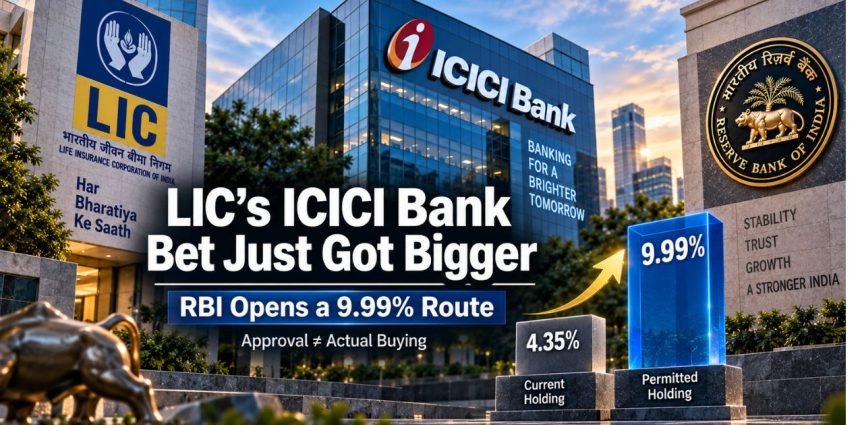
The Reserve Bank of India has cleared Life Insurance Corporation of India (LIC) to significantly raise its holding in ICICI Bank, but the approval itself doesn’t mean the insurer will immediately buy in.
ICICI Bank told exchanges on Saturday it had received RBI’s approval letter, dated September 4, 2026, permitting LIC to acquire an aggregate holding of up to 9.99% of the bank’s paid-up share capital or voting rights. The approval is valid for one year from that date and lapses automatically if unused.
Key Takeaways
- RBI has approved LIC for an aggregate holding of up to 9.99% in ICICI Bank.
- The approval is valid for one year from September 4, 2026.
- LIC held about 4.35% of ICICI Bank as of June 30, 2026; the approval gives it room to more than double that position.
- This is LIC’s second such approval in 16 days, after RBI cleared an identical 9.99% ceiling on its HDFC Bank stake on August 19.
Check Live: LIC Option Chain (LICI)—Live OI, IV, Greeks & PCR
Why This Approval Matters Right Now
LIC is already one of the largest institutional shareholders in Indian banking, and this clears a regulatory hurdle rather than commits it to a trade. LIC currently holds around 4.35% of ICICI Bank, giving it significant room to increase its position if it chooses to use the approval, but any actual purchase depends on its own portfolio calls and continued compliance with statutory conditions.
LIC’s balance sheet gives it real firepower to act if it wants to: assets under management stood at ₹59.39 lakh crore at the end of Q1 FY27, with investment income up 6% year-on-year to ₹1.09 lakh crore.
The Market Expectation Gap
RBI has permitted LIC to acquire up to 9.99%; it hasn’t required LIC to get there, and there’s no disclosed purchase schedule or timeline. That gap between regulatory permission and actual capital deployment is where the next market-moving information could emerge. If LIC buys gradually, the effect on ICICI Bank looks very different than if it moves quickly through the open market.
Two Approvals, 16 Days Apart
| Bank | LIC’s Stake at Approval | RBI-Approved Ceiling | Approval Date |
|---|---|---|---|
| HDFC Bank | 4.11% (Aug 14, 2026) | Aggregate holding “up to 9.99%” | Aug 19, 2026 |
| ICICI Bank | 4.35% (Jun 30, 2026) | Aggregate holding “up to 9.99%” | Sep 4, 2026 |
Getting near-identical clearance for two of India’s biggest private lenders inside 16 days is unusual even for an investor as active as LIC. It doesn’t confirm intent to use either approval fully, but it shows LIC keeping both doors open at once.
| Stakeholder | Potential Impact | Why It Matters |
|---|---|---|
| ICICI Bank shareholders | Possible added institutional demand | LIC is a long-horizon holder, not a trading desk |
| LIC | Flexibility without fresh RBI approval for a year | Can act opportunistically on price |
| Banking sector broadly | Two major clearances in barely two weeks | Signals continued domestic institutional appetite for large private banks |
What Traders Should Watch Next
LIC’s next shareholding disclosure—whether the stake moves materially above 4.35%.
Confirmed open-market buying—the actual demand trigger, not the RBI letter.
The one-year clock—the approval lapses automatically if unused by September 4, 2027.
Whether LIC uses both approvals—HDFC Bank and ICICI Bank are now both live options in the same window.
Also Check: HDFC BANK Options Chart | Nifty Trader
Bottom Line
RBI has cleared LIC for an aggregate holding of up to 9.99% in ICICI Bank, with a one-year window from September 4, 2026. The bigger question isn’t whether LIC can buy, it’s whether, and how fast, it actually does, especially with a matching HDFC Bank approval open at the same time.
Related Reading: ICICI Bank Nears HDFC Bank’s Top Spot in Nifty 50 as Goldman, Jefferies Stay Bullish
Track institutional flow alongside this on our FII/DII Tracker.
This article is for informational purposes only and does not constitute investment advice. Please consult your financial advisor before making investment decisions. Readers are advised to independently verify market data before trading.