
BSE Shares Rally 5% as SEBI Reconsiders Derivatives Settlement Rules
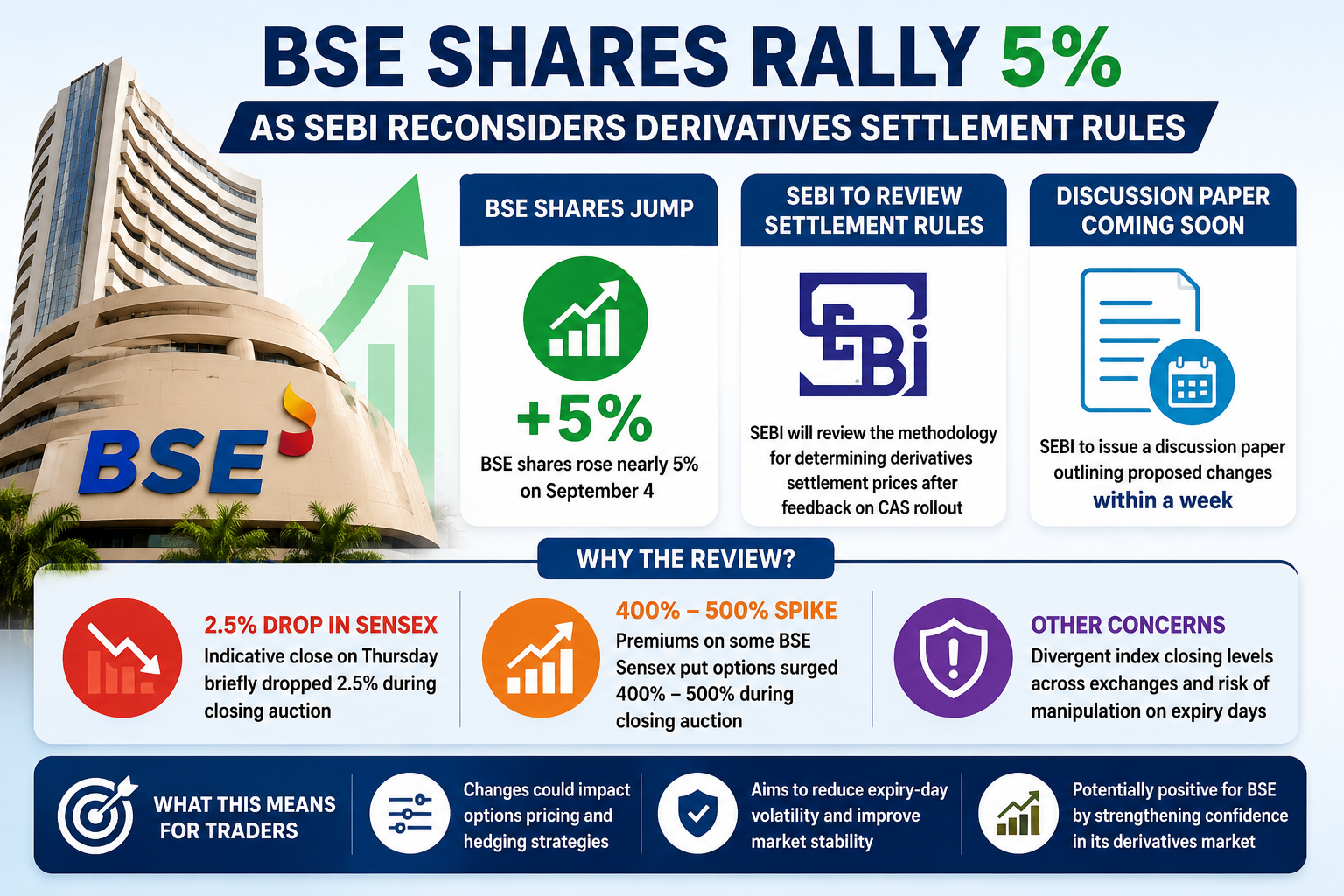
BSE shares jumped nearly 5% on September 4 after the Securities and Exchange Board of India (SEBI) said it would review the methodology used to determine derivatives settlement prices following concerns around the newly introduced closing auction session (CAS).
The development has caught traders’ attention because the settlement-price methodology can directly influence derivatives pricing, especially on expiry days. With SEBI expected to release a discussion paper within a week, investors are now watching for changes that could reduce unusual volatility around market closing.
Track Live : BSE Option Chain — Live Sensex & Bankex Options Data Today | Sensex Levels Today
BSE Shares Rally gain as settlement-price concerns come into focus
The SEBI review is particularly important for BSE because the exchange has seen heightened activity in its derivatives segment.
The latest regulatory move suggests that SEBI is responding to concerns emerging from the early experience of CAS rather than leaving the existing framework unchanged.
For BSE investors, any changes that make derivatives settlement more predictable could potentially support confidence in the exchange’s growing derivatives business.
At the same time, traders will closely examine the discussion paper to understand whether the proposed changes could alter expiry-day trading dynamics or options pricing.
Why BSE Shares Jumped
- Extreme Options Volatility: On Thursday, the indicative close for the BSE Sensex briefly dropped 2.5%, causing premiums on certain Sensex put options to spike between 400% and 500% during the closing auction.
- Index Divergence: The new mechanism led to divergent index closing levels across different exchanges, confusing traders and distorting benchmark valuations.
- Manipulation Risks: Stakeholders raised sharp concerns over potential price manipulation, especially on high-stakes derivatives expiry days.
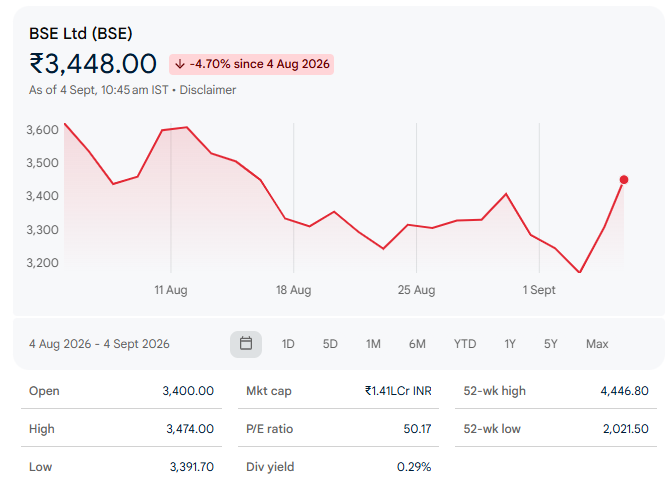
Thursday’s sharp move highlighted the problem
The concerns became particularly visible on Thursday, when the indicative close for India’s benchmark stock index briefly dropped 2.5%, according to BSE’s website.
The sharp move during the closing auction session had an immediate impact on derivatives pricing.
Premiums on some BSE Sensex put options reportedly surged between 400% and 500% during the closing auction, highlighting how sensitive options can become to sudden changes in the underlying index close.
For traders holding expiry-day positions, such movements can significantly change the value of options within a very short period.
Read More : Sensex Closing Auction Fuels Volatility, Index Swings 2,100 Points Before Closing 417 Points Lower
What Happens Next?
- Discussion Paper: SEBI will issue a formal discussion paper outlining its proposed methodology changes within a week.
- Stakeholder Feedback: The paper will be open for public and institutional feedback before any permanent changes to the derivative settlement rules are codified.
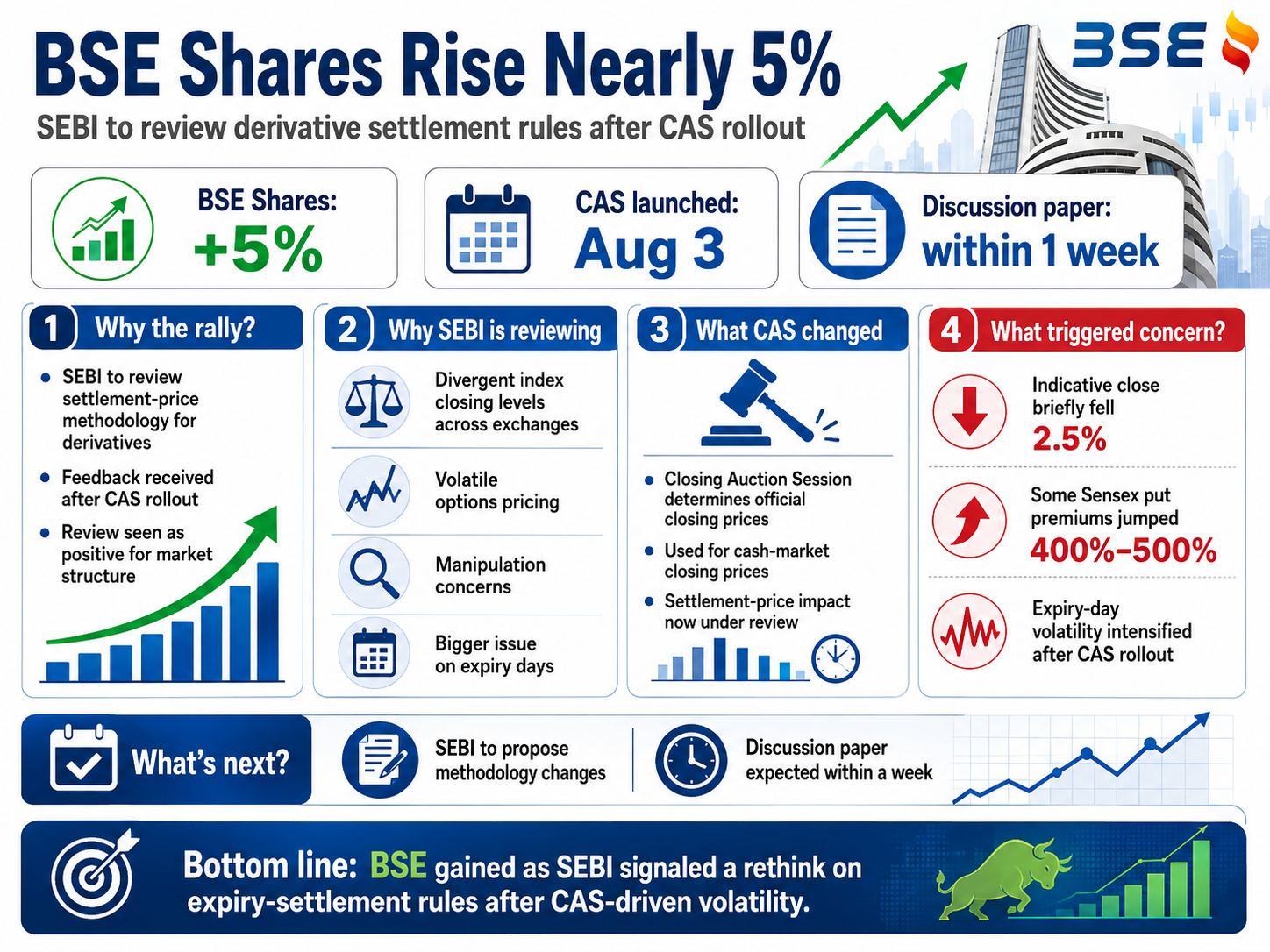
Why SEBI’s decision matters for derivatives traders
The settlement price is an important reference point for derivative contracts reaching expiry. Any sharp or unusual movement in the closing price can therefore have a direct impact on traders with open positions.
The issue becomes even more important on index and derivatives expiry days, when trading volumes and market sensitivity are typically higher.
If SEBI changes the settlement-price methodology, traders may need to adjust their expiry-day strategies, particularly those involving options.
The key question now is whether the proposed framework will reduce discrepancies between exchanges and limit extreme price movements during the closing auction.
What could happen to BSE shares in the coming days
The immediate reaction in BSE shares has been positive, but investors may now shift their focus from the headline SEBI announcement to the details of the proposed changes.
The upcoming discussion paper could become an important near-term trigger for BSE stock. A framework viewed as improving transparency and stability in derivatives settlement could support sentiment toward the exchange.
However, investors should also watch whether the changes affect trading volumes, derivatives participation or the attractiveness of existing expiry mechanisms.
Track Live : NSE Option Chain — Live
How the CAS Mechanism Works
- Order Collection Window: Traders enter, modify, or cancel buy and sell orders. No trades are executed during this specific timeframe.
- Order Matching & Price Discovery: The exchange’s system calculates an “equilibrium price”—the exact price at which the maximum volume of shares can be traded. All matching orders are then executed at this single price.
- The Settlement Link: This final equity cash price is directly used to settle the expiry value of corresponding derivatives contracts (like options and futures).
Why It Caused Market Chaos
- Liquidity Illusions: Because orders aggregate without matching in real-time, the “indicative price” can fluctuate wildly. This led to a brief 2.5% artificial drop in the Sensex, catching algorithms off-guard.
- The Derivative Contagion: Because derivative expiries depend on this exact final price, the sudden equity volatility caused BSE Sensex put options to surge 400% to 500% in minutes, creating massive losses for option sellers.
- Arbitrage Exploitation: Traders noticed different closing levels for the same index across BSE and NSE, opening doors for speculative manipulation rather than safe price discovery.
Investor-focused angle
- BSE shares: BSE gained nearly 5% on September 4 as investors reacted to SEBI’s decision to review the settlement-price framework.
- Why SEBI is reviewing it: CAS, introduced on August 3, has created concerns around differences in index closing levels, options-price volatility and possible manipulation, particularly on expiry days.
- Major volatility: On Thursday, the Sensex’s indicative closing level briefly fell about 2.5%, triggering a 400–500% spike in premiums on some BSE Sensex put options.
- What changes could mean: The review could alter how derivative expiry settlement prices are calculated when the CAS-derived closing price is used.
- Important for traders: Any change could affect options pricing, hedging strategies, expiry-day volatility and risk management.
- For BSE: The development is potentially positive because a regulatory adjustment could address concerns around CAS-related market distortions while improving confidence in the exchange’s derivatives market.
SEBI has said the proposed changes will be detailed in a discussion/consultation paper within about a week, so the exact impact on BSE and derivatives traders will depend on the methodology ultimately proposed.
The next major catalyst is now SEBI’s proposed discussion paper. Its details could determine whether the market sees the CAS concerns as a temporary adjustment issue or as a reason for a broader change in derivatives settlement rules.