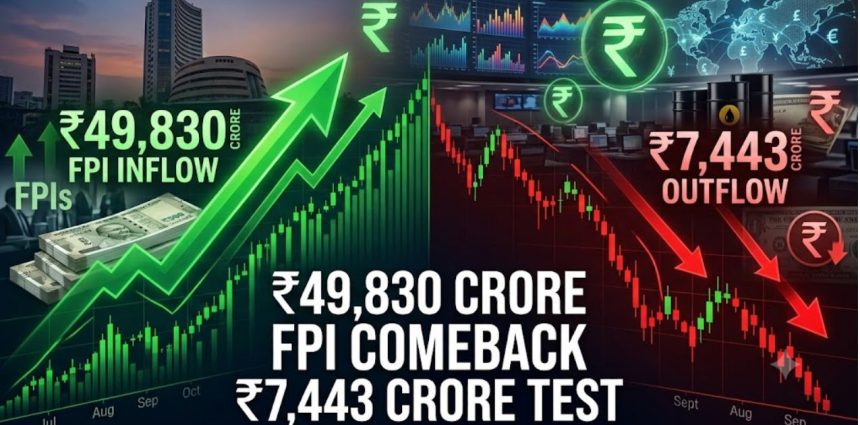
Foreign investors made a dramatic comeback to Indian equities in July and August, but the rally in foreign flows is already facing its first test.
Foreign portfolio investors (FPIs) invested a net ₹49,830 crore across Indian equities in July and August, extending their buying streak to five consecutive fortnights by the end of August. Consumer Services, Healthcare, Consumer Durables, and Financial Services emerged among the biggest beneficiaries of the foreign-money rotation.
But the momentum did not carry cleanly into September.
FPIs turned net sellers in the first four trading days of September, pulling ₹7,443 crore from Indian equities through September 4, according to NSDL data. Rising crude prices, higher US bond yields, and a firmer dollar have weighed on emerging-market risk appetite.
That creates a more important market question than the headline ₹49,830-crore comeback:
Was the July-August foreign buying the start of a durable allocation shift, or a tactical rebound that is already being tested by global risk?
Key Takeaways
- FPIs invested ₹49,830 crore in Indian equities across July and August.
- The buying streak reached five consecutive fortnights by August 31.
- Consumer Services led the sector rotation, attracting ₹18,618 crore across July-August.
- Healthcare drew ₹13,686 crore, while Financial Services saw a sharp August reversal.
- August foreign buying reached about ₹29,619 crore, the strongest monthly inflow in nearly two years.
- The comeback has already hit a speed bump: FPIs sold ₹7,443 crore in the first four trading days of September.
- The next test for Indian equities is whether foreign money returns once crude, yields and global risk sentiment stabilise.
Check Live: Participant Wise OI — FII, DII, Client, Pro Positions Today
From Four Months of Selling to ₹49,830 Crore Buying
The July-August turnaround was significant because it followed one of the sharpest periods of foreign selling in recent years.
FPIs had remained net sellers for four consecutive months before turning buyers in July. Foreign investors then added roughly ₹20,200 crore in July, followed by another ₹29,619 crore in August, according to NSDL-linked data.
August was particularly notable.
Reuters reported that foreign investors put about $3.1 billion into Indian equities in August, making it their biggest monthly inflow in nearly two years and the second consecutive month of net buying.
FPI Flow Reversal at a Glance
| Period | Net FPI Equity Flow |
|---|---|
| July 2026 | +₹20,200 crore |
| August 2026 | +₹29,619 crore |
| July + August | +₹49,830 crore |
| September 1–4 | -₹7,443 crore |
The message: the July-August comeback was powerful, but September has introduced an early warning signal.
Five Fortnights of Buying—Then September Changed the Picture
By August 31, foreign investors had bought Indian equities for five consecutive fortnights.
In the second half of August alone, FPIs invested ₹13,010 crore, following ₹16,609 crore in the first half, according to NSDL data cited by Economic Times. That took August’s total to more than ₹29,600 crore. Consumer Services, Financial Services, and Healthcare were among the biggest beneficiaries during the fortnight.
The streak was significant because it suggested that the July reversal was not merely a one-off event.
But the first week of September has changed the narrative.
The ₹7,443-crore outflow through September 4 means the five-fortnight streak is now over.
For traders, that makes the latest data more useful than simply celebrating the earlier inflows.
Consumer Services Was the Biggest Foreign-Money Magnet
The most striking feature of the July-August flow data was the concentration in domestic-facing sectors.
Consumer Services attracted ₹18,618 crore across the two months, making it the biggest recipient among the leading sectors. Healthcare followed with ₹13,686 crore.
This is important because it suggests that foreign investors were increasingly positioning around India’s domestic consumption and services story.
Rather than simply chasing export-heavy or technology themes, overseas money moved towards businesses with exposure to India’s internal demand.
Where Foreign Money Went
| Sector | July-August FPI Buying |
|---|---|
| Consumer Services | ₹18,618 crore |
| Healthcare | ₹13,686 crore |
| Consumer Durables | ₹11,245 crore |
| Financial Services | ~₹9,800 crore |
Sector figures are based on NSDL-linked reporting; the sector totals should not be added to recreate the ₹49,830-crore net market-wide figure because the latter nets buying and selling across the full sector universe.
Financials Deliver One of the Biggest Reversals
Financial Services also produced a notable change in foreign positioning.
FPIs were net sellers of the sector by around ₹694 crore in July, but August brought a sharp reversal, with about ₹10,494 crore of buying.
That left Financial Services with roughly ₹9,800 crore of net buying across the two months.
The reversal matters because financial stocks are among the largest components of the Indian market. Sustained foreign buying here can have a disproportionate effect on large-cap indices.
But September’s early market weakness shows why traders need to distinguish between two-month flows and the latest flow direction.
Healthcare Emerges as Another Major FII Bet
Healthcare attracted ₹13,686 crore during July and August, making it the second-largest recipient among the sectors highlighted in the latest data.
The combination of Healthcare and Consumer Services is notable.
Both sectors offer relatively strong exposure to India’s domestic demand, giving the recent FPI rotation a distinctly India-growth-oriented character.
That is different from a market rally driven purely by global technology or commodity themes.
Consumer Durables Also Draw Strong Foreign Interest
Consumer Durables attracted approximately ₹11,245 crore during July-August.
Together, Consumer Services, Healthcare and Consumer Durables represented a substantial portion of the gross buying in the leading sectors.
The pattern reinforces the broader message:
Foreign investors were not simply returning to Indian equities. They were returning selectively.
Not Every Sector Benefited
The foreign-money comeback was never broad-based.
Telecom remained under pressure, while Capital Goods and some other sectors also saw foreign selling during the period. The divergence is important because it challenges the simple interpretation that a ₹49,830-crore inflow automatically means a broad-based bullish market.
| Foreign Buying | Continued Selling Pressure |
|---|---|
| Consumer Services | Telecom |
| Healthcare | Capital Goods |
| Consumer Durables | Power |
| Financial Services | Select other sectors |
| IT | — |
This is the real market signal hidden behind the headline.
Why Did Foreign Investors Return?
Several factors helped improve India’s relative appeal during July and August.
1. Stronger-than-Expected Growth
India’s real GDP expanded 7.8% in Q1 FY27, beating the RBI’s earlier 7% projection and the market consensus of 7.1%. Growth was supported by investment, manufacturing and services.
That provided foreign investors with a stronger macroeconomic backdrop than markets had feared earlier in the year.
2. Better Earnings Expectations
Better-than-expected April-June corporate earnings also helped improve the investment case for Indian equities.
Reuters noted that the August FPI rebound was supported by the earnings outlook of domestic companies, alongside RBI measures aimed at stabilising the rupee.
3. More Attractive Relative Valuations
After four months of heavy selling, Indian equities offered foreign investors a more attractive entry point than they had earlier in the year.
The July-August recovery therefore came from a combination of valuation adjustment, earnings resilience and improved macro sentiment.
4. Global Money Was Rotating
Another part of the story was the changing global technology trade.
Foreign investors had previously shifted significant capital towards AI-related markets such as South Korea and Taiwan. As that trade cooled, India became relatively more attractive. Reuters noted that investors had withdrawn heavily from India during the year while moving towards AI-focused markets, making the August reversal particularly notable.
The GDP Number Comes With Its Own Debate
The strong 7.8% GDP print is supportive for the Indian market, but investors should not treat the number as a risk-free signal.
India’s new GDP series and methodology have triggered debate over revisions and measurement, although the statistics authorities have defended the changes as methodological improvements. Reuters reported that the revised methodology incorporates more granular pricing data and a new 2022-23 base year.
This matters for foreign investors because macro confidence is partly a confidence-in-the-data story.
The headline growth number is strong, but the market will ultimately want to see that strength reflected in earnings, investment, and consumption.
September Has Already Delivered the First Warning
This is where the latest FPI data becomes more interesting.
After two consecutive months of foreign buying, FPIs pulled ₹7,443 crore from Indian equities in the first week of September.
The immediate pressure points are familiar:
- Rising crude oil prices
- Higher US Treasury yields
- A stronger dollar
- Geopolitical uncertainty
- Emerging-market risk appetite
The latest market backdrop reinforces the concern. On September 8, Brent crude was around $98 a barrel, while Indian equities remained under pressure as Middle East tensions pushed oil higher.
For India, this matters disproportionately because the country is heavily dependent on imported crude.
The Big Expectation Gap
The market could easily read ₹49,830 crore of July-August FPI buying as confirmation that foreign investors have turned structurally bullish on India.
The September data says, “Not so fast.”
The first four trading days of September have already produced a ₹7,443-crore outflow.
That does not erase the July-August comeback. But it does show that foreign capital remains highly sensitive to global variables.
The more useful interpretation is therefore
FIIs have returned to India, but they have not yet committed to staying.
That distinction could become critical for the next leg of the market.
What Traders Should Watch Now
1. Will FPI selling continue?
A few days of selling do not establish a new trend.
The key signal will be whether September’s outflow continues through the next fortnight or reverses as crude and global yields stabilise.
2. Will Consumer Services retain its lead?
Consumer Services was the biggest foreign-money beneficiary in July-August.
If that leadership continues despite September volatility, it would strengthen the domestic-consumption thesis.
3. Will Financials hold the August reversal?
Financial Services saw one of the sharpest improvements in foreign positioning.
Continued buying would be important for the broader large-cap market.
4. What happens to crude?
This may be the most important external variable.
Higher crude prices can worsen India’s import bill, inflation outlook, and current-account dynamics, potentially reducing foreign investors’ appetite for Indian equities. The latest September selling has already been linked to the rebound in crude.
5. US yields and the dollar
Higher US yields increase the relative attractiveness of dollar assets and can pressure emerging-market allocations.
If US yields remain elevated while the dollar strengthens, India’s recent FPI recovery could face another test.
What the FII Rotation Means for the Market
The July-August foreign buying has changed the market narrative.
After months of relentless selling, foreign investors demonstrated that India can once again attract substantial global capital when valuations, earnings, and macro conditions become more supportive.
But the sector pattern is arguably more important than the headline.
Consumer Services, Healthcare, Consumer Durables, and Financials attracted substantial foreign interest, while other sectors continued to face selling.
That means traders should focus less on the question “Are FIIs buying?” and more on:
“Which sectors are FIIs buying—and are they still buying them?”
Track Live: FII DII Data Today: NSE/BSE Cash & F&O Activity
Bottom Line
Foreign investors’ ₹49,830-crore July-August comeback was one of the strongest positive shifts in India’s 2026 market story.
August was particularly powerful, with around ₹29,619 crore of foreign buying, the highest monthly inflow in nearly two years.
Consumer Services led the sector rotation with ₹18,618 crore, followed by Healthcare at ₹13,686 crore, while Financial Services also saw a sharp reversal in August.
But the story has already acquired a new twist.
FPIs pulled ₹7,443 crore from Indian equities in the first four trading days of September, breaking the five-fortnight buying run.
So the next market signal is not another headline about the July-August comeback.
It is whether foreign investors return after this early-September risk-off phase.
If they do, the recent flows could mark the beginning of a more durable rotation towards Indian equities. If crude US yields and geopolitical risks remain elevated, the ₹49,830-crore comeback could prove to be more tactical than structural.
For now, foreign money is back—but September has reminded investors that it can leave just as quickly.
Read Next: Persistent Systems Share Price Target: CLSA’s ₹5,643 Call Meets the Nagarro Test
Disclaimer: This article is for informational purposes only and does not constitute investment advice. NiftyTrader.in does not recommend buying, selling, or holding any securities. Readers should consult a SEBI-registered financial adviser before making investment decisions. Investments in securities markets are subject to market risks.