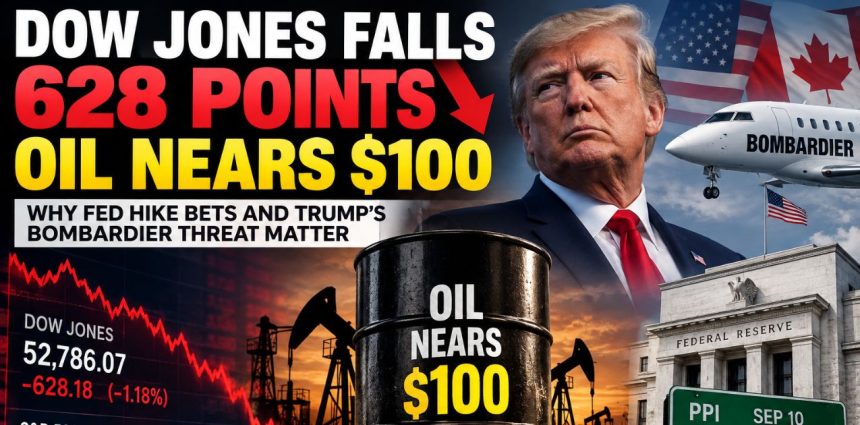
The Dow Jones fell 628 points on September 8 as Brent crude briefly approached $100 and the 10-year Treasury yield hovered near 4.8%. The combination revived inflation fears and pushed markets to price roughly a 60% chance of a September Fed rate hike, while Trump’s Bombardier threat added another trade-policy risk.
The immediate question for traders is no longer simply why Wall Street fell.
It is whether oil, inflation, interest rates, and trade tensions are beginning to reinforce each other, just as the market heads into two major US inflation reports and the Federal Reserve’s September meeting.
Key Takeaways
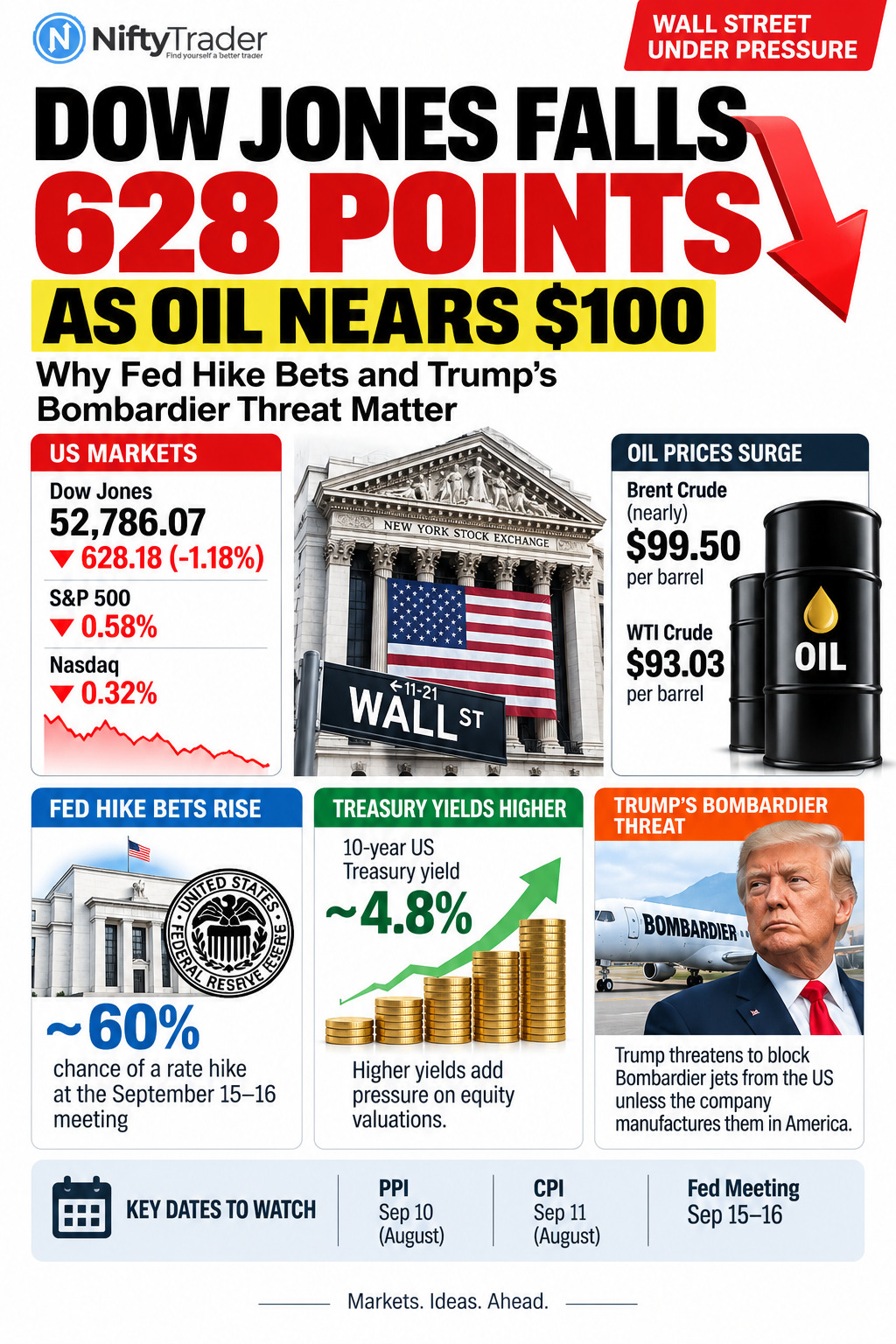
- The Dow Jones Industrial Average fell 628.18 points, or 1.18%, to 52,786.07 on September 8. The S&P 500 declined 0.58%, while the Nasdaq Composite slipped 0.32%.
- Brent crude briefly approached $99.50 a barrel, while WTI also climbed sharply as Middle East tensions intensified. The move revived concerns that higher energy costs could keep inflation elevated.
- The 10-year US Treasury yield hovered around 4.8%, adding another valuation headwind for equities.
- Traders were pricing roughly a 60% chance of a Federal Reserve rate hike at the September 15–16 meeting, making upcoming inflation data particularly important.
- Trump has threatened to block Bombardier jets from the US market unless the Canadian aircraft maker manufactures them in America, adding another layer to the US-Canada trade dispute.
- Bombardier has about 3,500 US employees, with more than 40% in Wichita, and Kansas Republicans have pushed back against the threat because of its potential impact on local jobs.
- The next major market tests are the August PPI on September 10, the August CPI on September 11, and the Fed’s September 15–16 meeting.
Check Live: FII DII Data Today: NSE/BSE Cash & F&O Activity
The Dow’s 628-Point Fall Is Only the Starting Point
The Dow Jones Industrial Average dropped 628.18 points, or 1.18%, on Tuesday, when US markets reopened after the Labor Day holiday. The S&P 500 fell 0.58% and the Nasdaq declined 0.32%.
But the size of the Dow’s decline does not tell the whole story.
The market was dealing with several pressures simultaneously.
Oil prices moved sharply higher as the conflict involving Iran and the wider Middle East intensified. Reuters reported that Iran-backed Houthi attacks on Saudi facilities added to concerns about energy supply disruption, while Brent moved toward the psychologically important $100 level.
At the same time, the 10-year Treasury yield hovered around 4.8%, keeping pressure on rate-sensitive equity valuations.
Then came another escalation in the US-Canada trade dispute.
Trump threatened to prevent Bombardier from selling its aircraft in the United States unless the company manufactures planes domestically.
That leaves Wall Street watching three connected risks:
Oil is raising inflation risk.
Trump is raising trade and policy uncertainty.
Higher yields are making the Fed’s next move more important.
That combination is more important than the Dow’s point decline by itself.
Oil Near $100 Is Becoming the Bigger Market Signal
The most important macro move may be happening outside the stock market.
Brent crude briefly approached $99.50 a barrel on Tuesday, while oil continued climbing into Wednesday trading as Middle East tensions intensified. Reuters reported Brent at around $99.49 early Wednesday, showing that the $100 threshold remains firmly in focus.
For investors, the key question is not simply whether Brent touches $100.
It is why oil is rising.
This is primarily a geopolitical supply-risk story rather than a straightforward demand-driven rally.
Iran-backed Houthi attacks on Saudi energy facilities have added to concerns about disruption, while the broader US-Iran conflict continues to threaten energy flows in the region.
That creates a more uncomfortable setup for equities.
Higher oil can push up transportation, manufacturing and input costs while also reducing consumers’ purchasing power.
The market transmission mechanism is straightforward:
Oil higher → costs higher → inflation risk higher → Fed flexibility falls → yields stay elevated → equity valuations face pressure.
This is why oil could ultimately matter more to Wall Street than the Bombardier headline.
Why $100 Oil Matters to the Fed
The $100 level is psychologically important, but the real issue is whether higher crude prices persist long enough to influence broader inflation expectations.
If oil rises sharply but retreats quickly, the impact could remain relatively contained.
If crude stays elevated for weeks, however, the market has to consider whether higher fuel and transportation costs begin feeding into other prices.
That distinction matters for monetary policy.
Federal Reserve Governor Christopher Waller said on September 3 that inflation remained meaningfully above the Fed’s 2% goal, while noting that incoming data would influence whether he supported holding rates or raising them at the September meeting.
That makes the timing of this oil shock particularly important.
The market is not entering the Fed meeting with inflation risk fully resolved.
It is entering the meeting with oil moving higher and key inflation data still ahead.
Trump’s Bombardier Threat Opens a New Trade Front
Trump has threatened to stop Bombardier jets from being sold in the United States unless the Canadian company builds them in America.
The statement came as Canada’s retaliatory tariffs on roughly $20 billion of US goods took effect, turning Bombardier into one of the most visible corporate flashpoints in the expanding US-Canada trade dispute.
Bombardier shares fell sharply after the threat, although the market reaction was smaller than the initial opening decline. Reuters reported that the stock fell about 3.6% following the announcement.
But investors should distinguish between a political threat and an implemented restriction.
There is still uncertainty about how Washington could actually prevent Bombardier aircraft from reaching US customers, particularly because the company’s aircraft have FAA approval.
That creates an important expectation gap.
The question is no longer simply:
Will Trump target Bombardier?
He already has.
The more important question is:
Will the threat become an enforceable policy?
If it does, the financial impact could extend beyond Bombardier itself.
Bombardier Is More Closely Tied to the US Than the Headline Suggests
Bombardier is headquartered in Canada, but its US footprint is substantial.
The company employs approximately 3,500 people in the United States, with more than 40% of those employees based in Wichita, Kansas.
That has already triggered political pushback.
Kansas Republican Senators Roger Marshall and Jerry Moran have contacted the White House over Bombardier’s contribution to the state, while other Kansas politicians have also raised concerns about the potential effect on local employment.
This adds a new dimension to the trade story.
A policy designed to force more Bombardier manufacturing into the US could encourage additional domestic investment.
But an outright restriction on Bombardier sales could also affect American employees, suppliers, and the wider aerospace ecosystem.
The trade weapon could potentially cut in both directions.
That is why the Bombardier episode is more than another tariff headline.
It is a test of how far trade policy can move from tariffs into corporate market-access restrictions.
Canada’s Counter-Tariffs Add Another Layer
The US-Canada dispute has also moved beyond threats.
Canada has imposed retaliatory tariffs covering roughly $20 billion of US goods, with rates reaching as high as 50% on some products.
For companies operating across North American supply chains, the bigger problem is not necessarily one individual tariff.
It is uncertainty over what comes next.
Businesses make sourcing, investment, and inventory decisions based on expected costs.
When tariffs can be changed quickly, or when market access itself becomes part of the dispute, those calculations become harder.
Bombardier is the clearest current example.
The Fed Rate-Hike Question Is Back in Focus
The oil shock is arriving at an awkward time for US monetary policy.
Markets were pricing roughly a 60% probability of a rate hike at the Federal Reserve’s September meeting, according to Tuesday market pricing cited by Reuters.
That probability is not a forecast and can change quickly.
But the direction matters.
A stronger-than-expected August jobs report had already forced investors to reassess the Fed’s next move. Higher oil prices now add another inflation variable.
The timing is crucial.
The Bureau of Labor Statistics is scheduled to release the August Producer Price Index on September 10 at 8:30 a.m. ET, followed by the August Consumer Price Index on September 11 at 8:30 a.m. ET.
The Federal Reserve’s next FOMC meeting is scheduled for September 15–16.
That creates a clear sequence for traders:
PPI → CPI → Fed expectations → Treasury yields → equity valuations.
Also Check: NiftyTrader: Live Options Analytics & F&O Trading Tools
The 10-Year Treasury Yield Adds Another Pressure Point
The 10-year Treasury yield hovered around 4.8% during Tuesday’s market stress.
That matters because higher yields increase the discount rate applied to future corporate earnings.
The impact is particularly important for high-valuation growth stocks, where a larger portion of the investment case depends on profits expected further into the future.
This also explains why the market reaction was broader than the US-Canada trade dispute.
A company does not need direct exposure to Canada to be affected by rising Treasury yields.
If oil remains elevated, inflation expectations rise and the Fed becomes less comfortable with easing, yields can remain higher for longer.
That creates a valuation headwind across equities.
The Three-Way Risk Wall Street Is Watching
The current setup can be simplified into three forces:
| Risk | What It Could Mean |
|---|---|
| Oil near $100 | Higher inflation and input-cost pressure |
| Fed-hike expectations | Higher yields and tighter financial conditions |
| Trump-Bombardier escalation | Greater trade and market-access uncertainty |
These risks do not operate independently.
That is what makes the current setup more important.
Markets can absorb a trade headline when inflation is falling.
They can absorb an oil spike when interest rates are declining.
They can absorb political uncertainty when earnings expectations are improving.
But when energy inflation, rate uncertainty, and trade-policy risk appear together, investors have fewer reasons to look through the headlines.
AI Weakness Adds Another Layer to the Selloff
There was also a separate pressure point inside US equities.
Reuters reported that software stocks fell sharply on renewed concerns about competition from artificial intelligence. Salesforce, Intuit, and ServiceNow were among the companies hit, while the broader software and services index declined 1.4%.
That matters because it shows Tuesday’s selloff was not driven by one single catalyst.
Oil and inflation concerns were major macro pressures, while technology-specific worries added another source of weakness.
This distinction is important for traders.
If oil retreats but software and AI concerns persist, parts of the Nasdaq could remain under pressure.
If oil stays near $100 and yields rise further, the selling could broaden.
Which Sectors Are Most Exposed?
Airlines and Transport
Higher crude prices can directly pressure fuel costs and margins.
If oil remains elevated, airlines and transport companies may need stronger pricing power to protect profitability.
Technology and Growth
Higher Treasury yields are the bigger concern.
When discount rates rise, high-valuation growth stocks can face pressure even without direct exposure to the oil or trade shocks.
Consumer Companies
Tariffs and higher input costs can squeeze margins, particularly for companies with limited pricing power.
Energy
Energy producers could remain relative beneficiaries if crude stays elevated, although geopolitical volatility can also increase operational and market risks.
Industrials
Industrials face a mixed setup. Domestic manufacturing investment could benefit from localisation policies, while companies dependent on cross-border supply chains could face higher costs.
What Traders Should Watch Next
1. Brent Crude
$100 remains the key psychological level.
A sustained move above it would strengthen the inflation-risk narrative.
A sharp retreat would suggest that supply fears are easing.
2. US PPI — September 10
The Producer Price Index is the first major inflation checkpoint this week. A hotter reading could reinforce concerns that higher energy prices are feeding into producer costs.
3. US CPI — September 11
The CPI is even more important because it arrives immediately before the Fed meeting.
A hotter-than-expected reading could strengthen the case for tighter policy, while a softer reading could ease some of the pressure on rate expectations.
4. Treasury Yields
If oil remains near $100 while the 10-year yield moves materially above the 4.8% area, equity valuation pressure could intensify.
5. Trump’s Next Bombardier Move
A formal restriction would make the threat substantially more consequential.
A clarification, exemption, or negotiation could reduce some of the uncertainty surrounding Bombardier and the broader aerospace supply chain.
6. US-Canada Negotiations
Any sign of de-escalation could reduce the trade-risk premium.
Further tariffs or restrictions on market access could increase it.
Is the Dow’s 628-Point Fall a Warning or a One-Day Shock?
The Dow’s 628-point decline does not automatically signal the beginning of a prolonged Wall Street correction.
The broader market remains well above its levels from the start of the year. Tuesday’s decline was significant, but the S&P 500 fell 0.58% and the Nasdaq 0.32%, indicating that the market was under pressure without entering a full-scale indiscriminate selloff.
The next few sessions will therefore be more informative than Tuesday’s point decline alone.
The market could stabilise if:
- Oil retreats from the $100 area,
- Middle East supply fears ease,
- Treasury yields stabilise,
- PPI and CPI remain manageable, and
- Washington and Ottawa move toward negotiations.
The risk becomes more serious if the opposite occurs.
If oil remains elevated, inflation data surprise higher, Treasury yields climb, and the US-Canada dispute escalates, investors may have to reassess earnings, inflation, and monetary policy simultaneously.
That would turn several individual headlines into a broader macro trade.
Bottom Line
The Dow Jones’ 628-point decline was not simply a Trump-Bombardier story.
Oil was a major part of Tuesday’s market pressure, with Brent briefly approaching $100 as Middle East tensions intensified. Higher crude prices revived inflation concerns at precisely the time investors were already debating the Federal Reserve’s next move.
The Bombardier threat adds a separate risk.
The company’s substantial US workforce and supplier footprint make the dispute more complicated than a conventional Canada-US tariff fight. The political pushback from Kansas lawmakers also shows that any attempt to restrict Bombardier’s US market access could create domestic economic consequences.
For Wall Street, however, the bigger question is whether these risks reinforce one another.
If oil retreats, inflation cools and trade tensions ease, the Dow’s 628-point fall could remain a short-term risk-off episode.
If oil stays near $100, inflation proves sticky, yields remain elevated, and the trade dispute worsens, investors may have to price in a much tougher combination of inflation, rates, and geopolitical risk.
That is why the next moves in Brent crude, Treasury yields, and Fed expectations may matter more than the Dow’s 628-point decline itself.
And with PPI due Thursday, CPI due Friday, and the Fed meeting next week, the market now has a clear set of catalysts to watch.
Read Next: Forex Profit and Loss Calculator: Calculate Your Trading Profit or Loss
Disclaimer: This article is based on publicly available market reports and official sources and is intended for informational purposes only. Market prices, oil levels, and Fed expectations can change rapidly, and this should not be treated as investment advice.