Adani Ramps Up Fundraising plans $2.5 billion refinancing as group taps global lenders
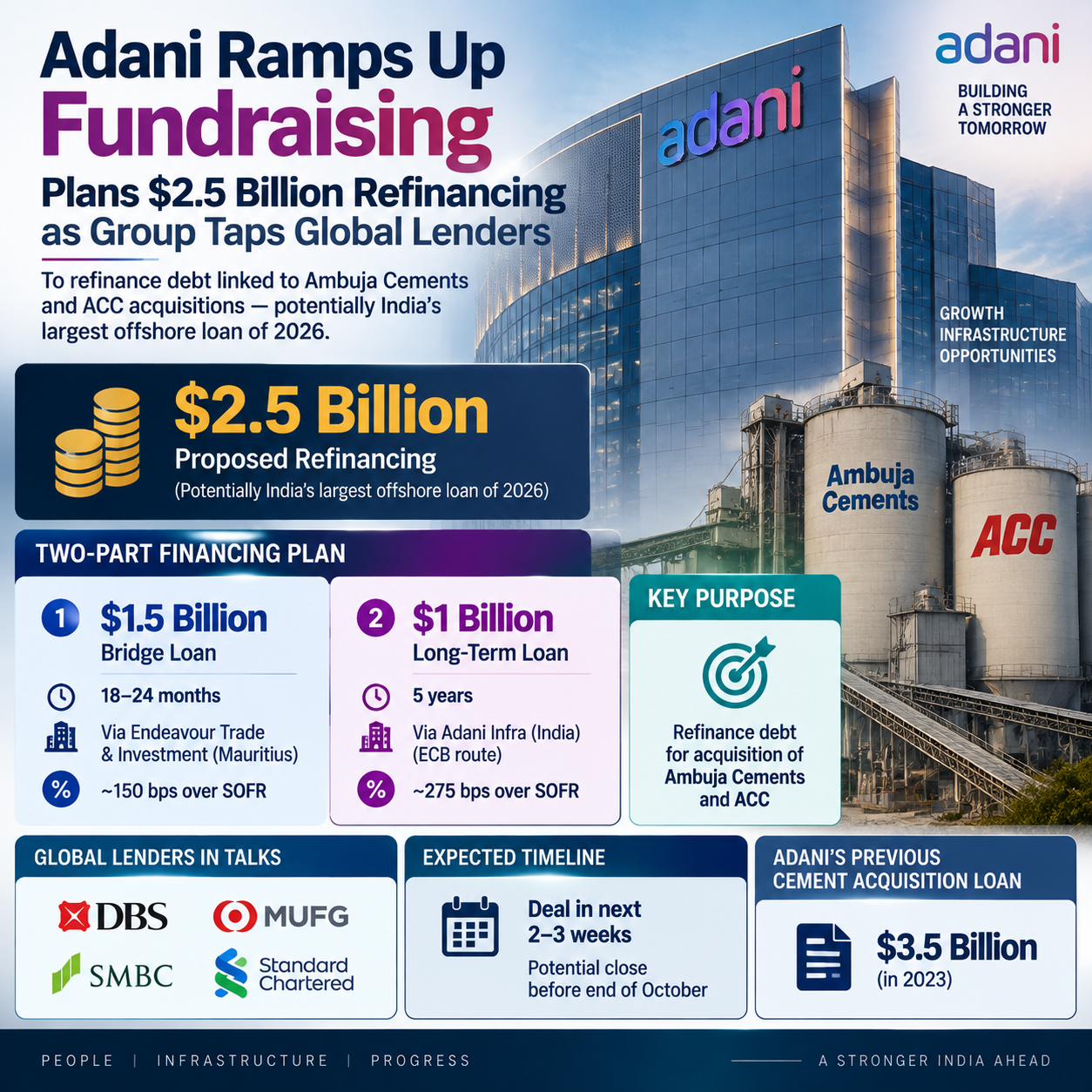
The Adani Group is planning to raise $2.5 billion from global lenders to refinance debt linked to its acquisition of cement manufacturers Ambuja Cements and ACC, in what could become India’s largest offshore loan of 2026, according to people familiar with the matter.
The proposed financing comes as the conglomerate led by Gautam Adani steps up fundraising across its businesses and seeks to optimise its borrowing costs amid changing conditions in global credit markets.
The overall refinancing is being structured through two separate facilities. One will be raised through a Mauritius-based family-owned entity, while another will be borrowed through an Adani infrastructure company under the Reserve Bank of India’s external commercial borrowing framework.
Track Live : NSE Option Chain — Live
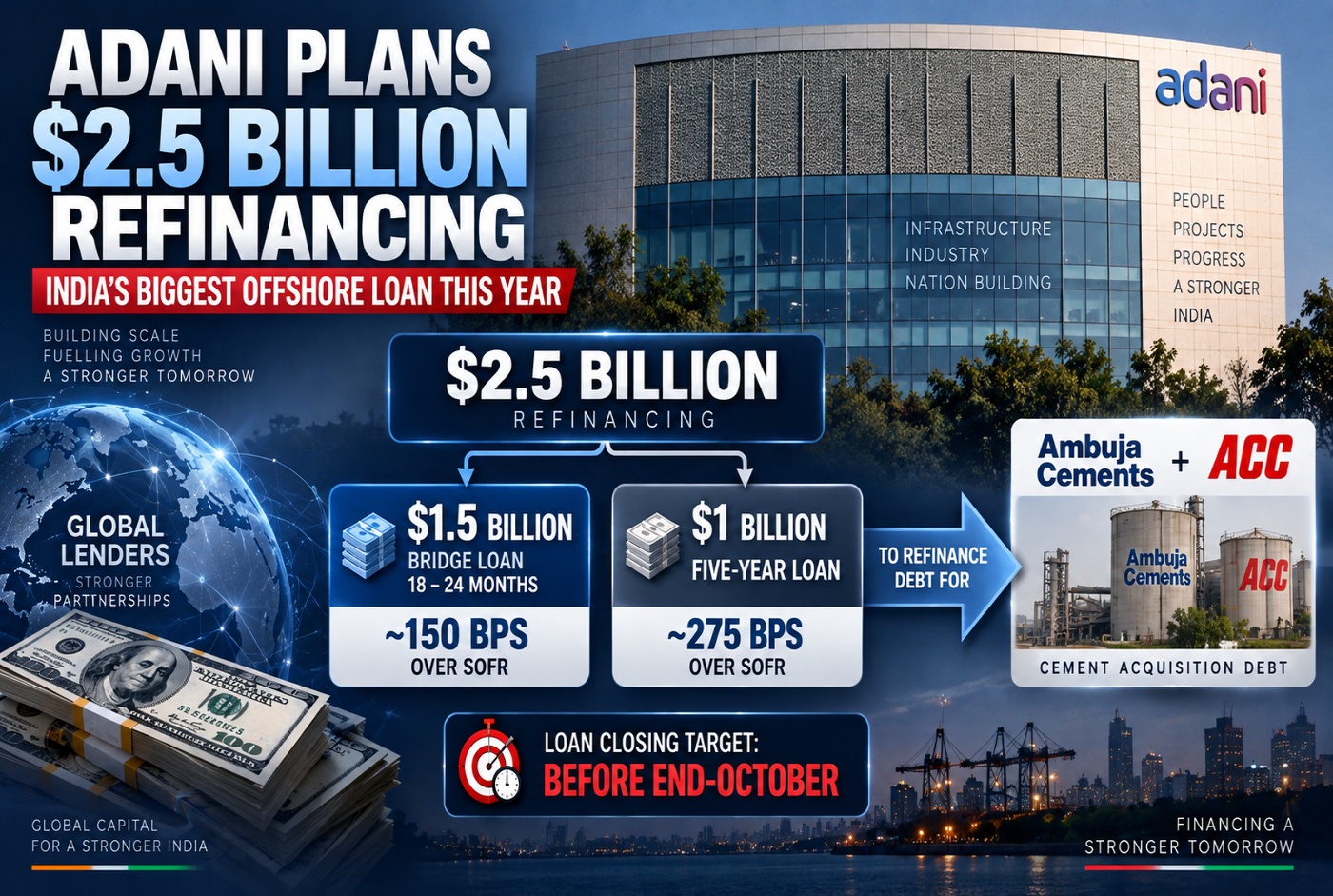
Adani Ramps Up Fundraising Why Adani is splitting the $2.5 billion borrowing into two parts
The two-part structure allows the group to access different sources of liquidity across offshore and domestic markets.
The approach could also help Adani reduce overall financing costs and manage refinancing requirements more efficiently as credit-market conditions change.
The RBI’s concessional foreign-exchange swap facility is another factor supporting overseas borrowing. The facility was designed to lower hedging costs for companies raising funds overseas at a time when the rupee has faced pressure.
If completed as planned, the combined transaction would surpass Adaniconnex Pvt Ltd.’s $1.13 billion borrowing and become the largest offshore loan for an Indian borrower this year, according to Bloomberg data.
Adani Group Plans $2.5 Billion Refinancing
- $2.5 billion: Proposed refinancing could become India’s largest offshore loan of 2026.
- $1.5 billion: 18–24 month bridge loan through Endeavour Trade & Investment, linked to Adani’s cement acquisition financing.
- $1 billion: Five-year loan planned by Adani Infra (India) through the RBI’s external commercial borrowing route.
- Pricing: The two facilities could be priced at roughly 150 bps and 275 bps over SOFR, respectively.
- Purpose: Refinance debt associated with the acquisition of Ambuja Cements and ACC. Adani had previously raised $3.5 billion for the acquisition financing in 2023.
- Banks in talks: DBS, MUFG, SMBC and Standard Chartered are among the lenders reportedly involved in discussions.
- Timeline: The deal could be signed within the next few weeks and closed before the end of October, if completed as planned.
Structure of the $2.5 Billion Deal
- $1.5 Billion Bridge Loan: Issued via Mauritius-based SPV Endeavour Trade and Investment Ltd. It features an 18-to-24-month tenor, priced at 150 basis points over the US SOFR benchmark. It will eventually be replaced by domestic rupee loans from lenders like State Bank of India (SBI) and HDFC Bank.
- $1 Billion Long-Term Loan: Issued via Adani Infra (India) Ltd. using the RBI’s External Commercial Borrowing (ECB) window. It carries a 5-year tenor, priced at 275 basis points over US SOFR, utilizing currency swap facilities to lower hedging costs.
Global banks line up as Adani seeks fresh financing
Adani Group is in active discussions with several international banks for the two financing legs.
The lenders involved in discussions include DBS Group Holdings, Mitsubishi UFJ Financial Group, Sumitomo Mitsui Banking Corporation and Standard Chartered.
The banks are expected to sign the transaction within the next two to three weeks, with the loans potentially closing before the end of October.
For investors, the successful completion of the deal would provide another indication of lenders’ willingness to finance the group at substantial scale.
The pricing of the loans will also be important. Lower-than-expected borrowing costs could signal improved credit-market confidence, while higher pricing could indicate that lenders continue to demand a premium for Adani-related exposure.
Key Background & Global Players
- Lining up Global Banks: Adani is in advanced talks with a major syndicate of international lenders including DBS Group Holdings, MUFG, SMBC, and Standard Chartered.
- Clearance of US Legal Hurdles: This major capital raise follows Gautam Adani’s recent dismissal of US securities fraud charges and a separate $275 million OFAC settlement involving Adani Enterprises over past Iran-linked LPG shipment sanctions.
- Flurry of Deals: This announcement follows another massive move on Wednesday, where Adani Airport Holdings agreed to raise ₹98.25 billion ($1.18 billion) via a stake sale to a consortium including Temasek Holdings and BlackRock.
Cement acquisitions remain at the centre of the refinancing
The proposed transaction represents the second major loan exercise aimed at refinancing debt associated with Adani’s acquisition of Ambuja Cements and ACC.
The group secured a $3.5 billion funding package in 2023 to support the cement acquisition.
According to the people familiar with the matter, Adani Group is also planning another $1 billion refinancing leg in 2027.
This means the latest $2.5 billion transaction should be viewed as part of a longer-term debt-management programme rather than a standalone fundraising exercise.
For investors in Adani Group companies, the ability to refinance acquisition-related debt on competitive terms will remain important for assessing future interest costs and balance-sheet flexibility.
Adani’s fundraising push gains momentum after US legal developments
The refinancing plans come after several significant legal and fundraising developments involving the group.
Last month, founder Gautam Adani won dismissal of US securities-fraud charges, according to the information provided. That development has removed a major legal overhang and could support the group’s expansion plans in India and overseas.
Earlier, Adani Airport Holdings Ltd. announced plans to raise ₹98.25 billion, or about $1 billion, through a stake sale to a consortium that includes Temasek Holdings and funds managed by BlackRock.
However, the group continues to face scrutiny related to earlier US matters.
In May, Adani Enterprises reached a $275 million settlement with the US Department of the Treasury’s Office of Foreign Assets Control (OFAC) over apparent sanctions violations related to liquefied petroleum gas shipments linked to Iran.
The US Justice Department had also dropped criminal charges against Adani and his nephew related to solar-energy contracts in India.
The Refinancing Roadmap
Track Live : Opening Price Clues – What Pre-Market Data Says Today
What the $2.5 billion refinancing means for Adani investors
For investors, the biggest positive from the proposed refinancing is potentially improved debt maturity management and access to international liquidity.
Refinancing acquisition-related borrowings can reduce near-term repayment pressure and provide the group with greater flexibility to deploy capital across infrastructure, airports, cement and other businesses.
But the transaction also highlights the scale of debt associated with Adani’s expansion strategy.
Investors should therefore focus on interest costs, refinancing terms, leverage, cash flows and the maturity profile of debt, rather than viewing the size of the loan itself as automatically positive.
Currency risk will also remain relevant because part of the financing is being raised offshore. Changes in the rupee-dollar exchange rate can affect the cost of foreign-currency liabilities, although hedging arrangements and the RBI’s swap facility can mitigate some of that exposure.
Read More : Mahatransco IPO Takes Shape as Maharashtra Power Utility Eyes Rs.10,000-Crore Share Sale
Here’s what happened today and why traders reacted
The proposed $2.5 billion refinancing is important for investors because it signals continued access to large pools of international capital for the Adani Group.
Endeavour Trade and Investment Ltd., a Mauritius-based special purpose vehicle owned by the Adani family, plans to raise around $1.5 billion through an 18- to 24-month bridge loan.
The facility could be priced at approximately 150 basis points over the US benchmark Secured Overnight Financing Rate (SOFR).
The bridge loan would subsequently be refinanced through a rupee-denominated loan from domestic lenders, including State Bank of India and HDFC Bank, according to the people familiar with the matter.
Separately, Adani Infra (India) Ltd. is looking to raise approximately $1 billion through a five-year loan using the RBI’s external commercial borrowing window.
That facility could carry pricing of around 275 basis points over SOFR.
What could happen to Adani stocks and the market in coming days
The immediate market reaction is likely to be most relevant for Adani Group companies and lenders involved in the financing.
A successful refinancing at competitive rates could be viewed positively because it demonstrates continued access to large-scale funding and potentially extends the group’s debt maturity profile.
For broader markets, the transaction is unlikely to be a major index-wide catalyst. Its significance lies instead in what it says about credit availability, offshore borrowing conditions and investor confidence in large Indian infrastructure groups.
The next major triggers will be the final loan agreements, pricing, participating banks and the eventual completion of the refinancing.
For investors, the key takeaway is that Adani is using multiple funding pools to refinance its cement-acquisition debt while seeking to keep borrowing costs under control. The success of the $2.5 billion transaction could become an important indicator of how global and domestic lenders currently assess the group’s credit profile.