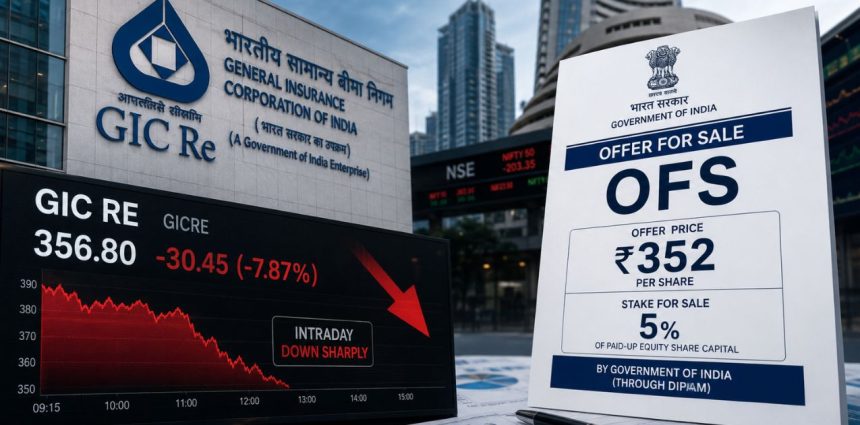
Shares of GIC Re fell nearly 8% on June 16 as the government’s ₹3,088 crore offer for sale opened at a ₹352 floor price. Even if the full 5% stake is sold, government holdings may still remain above SEBI’s 75% minimum public shareholding threshold.
Key Takeaways
- GIC Re shares fell sharply as the government’s OFS opened at a ₹352 floor price.
- The floor price is about 9.10% below the previous close of ₹387.25.
- The government is selling 2% base stake, with a 3% greenshoe option.
- If fully subscribed, the OFS could raise about ₹3,087.74 crore.
- Even after a full 5% sale, government holding may fall only to 77.40% — still above the 75% MPS threshold.
Why GIC Re Is in Focus Today
General Insurance Corporation of India (GIC Re), India’s only domestic reinsurer, is at the centre of one of the most anticipated disinvestment moves of FY27.
The government is selling up to 5% stake at a floor price of ₹352 per share through an offer for sale, with the issue opening for non-retail investors on June 16 and for retail investors and employees on June 17, according to DIPAM Secretary Arunish Chawla via a post on X.
The news triggered a sharp sell-off. GIC Re opened at ₹371.20, already well below the previous close of ₹387.25, and touched a day low of ₹356 during intraday trade.
The NiftyTrader live screen showed ₹356.80 at 2:47 PM IST, reflecting a decline of approximately 7.87% from the previous close. The stock’s 52-week range stands at ₹350–₹418, putting the OFS floor price of ₹352 just ₹2 above the 52-week low.
GIC OFS 2026: Complete Structure
| OFS Parameter | Details |
|---|---|
| Floor Price | ₹352 per share |
| Discount to Previous Close | ~9.10% (vs ₹387.25) |
| Base Offer Size | 3.51 crore shares (2% stake) |
| Greenshoe Option | 5.26 crore shares (3% stake) |
| Total Offer (if fully exercised) | 8.77 crore shares (5% stake) |
| Total Proceeds (at floor price) | ₹3,087.74 crore |
| T-Day (Institutional Bids) | June 16, 2026 |
| T+1 Day (Retail + Employees) | June 17, 2026 |
| Government Holding (Pre-OFS) | 82.40% |
Source: BSE Exchange Filing, DIPAM disclosures (June 15, 2026)
Three-Tier OFS Reservation Breakdown
| Investor Category | Reservation |
|---|---|
| Mutual Funds & Insurance Cos | Min 25% of non-retail portion |
| Retail Investors | 10% of total OFS shares |
| Eligible Employees | Up to 20,000 shares |
Source: GIC Re Exchange Filing, NSE OFS Guidelines
The MPS Math: Why This OFS May Not Be the Last
This is the critical calculation missing from most coverage of this OFS. Even if the government exercises the full greenshoe option and sells the entire 5% stake, here is where the promoter holding lands:
| Scenario | Govt Holding |
|---|---|
| Pre-OFS (current) | 82.40% |
| After base offer only (2%) | 80.40% |
| After full OFS + greenshoe (5%) | 77.40% |
| SEBI MPS threshold | 75.00% |
| Still above MPS limit by | 2.40% |
Source: BSE Shareholding Data (March 2026 quarter), SEBI MPS norms
Further dilution may be required unless the government uses another approved route or receives regulatory relief. Reuters reported in 2024 that the government had planned to divest up to 10% of its stake in GIC Re in tranches to comply with SEBI’s MPS norms.
The current 5% OFS is the second tranche in that multi-year plan, the first being the 3.4% stake sale completed in September 2024 at a floor price of ₹395 per share.
As of March 2026, around 2.07 lakh retail investors collectively hold a 1.4% stake in GIC Re. The government’s phased dilution will only expand this retail base over coming tranches.
Day 1 Subscription Status: Tepid Opening
Non-retail bids stood at approximately 23% of the base offer as of 11:57 AM IST on June 16, 2026 (Source: BusinessToday). The retail window opening on June 17 will be the real test of demand, given the discount on offer. A minimum of 25% of the non-retail portion is mandatorily reserved for mutual funds and insurance companies.
GIC Re FY26 Financials: The Business Behind the OFS
| Financial Metric | Value |
|---|---|
| Gross Premium Income | ₹44,006.7 crore (+6.9% YoY) |
| PAT — Full Year FY26 | ₹8,392.2 crore (+25.2% YoY) |
| QTR Profit YoY Growth | +80.70% (Strong) |
| Claims Ratio | 85.4% (improved YoY) |
| Dividend Recommended | ₹13.25 per share |
| Market Cap (approx.) | ₹67,588 crore |
| P/E vs Sector | 6.9x vs 18.2x (62.3% cheaper) |
| P/B vs Sector | 1.14x vs 2.2x (48.2% cheaper) |
| Face Value | ₹5 per share |
Source: GIC Re FY26 results / exchange filings; market data from NiftyTrader and StockEzee (NSE live, June 16, 2026)
GIC Re trades at a significant discount to its sector on both PE and PB basis, 62.3% cheaper than sector PE and 48.2% cheaper than sector PB, even as quarterly profit growth has remained strong at +80.70% YoY. This valuation gap is a key reason institutional interest in the OFS exists despite the near-term price pressure.
GIC Re Share Price Performance
| Period | Return |
|---|---|
| 1 Week | -5.70% |
| CY2026 YTD | +2% |
| 3 Years | +103% |
| 5 Years | +92% |
Data as of June 16, 2026. Source: StockEzee / NSE
Note: The 1-week return has been updated to -5.70% as shown on the StockEzee live screen, replacing the earlier -1% figure which reflected a different data point.
Check Live: General Insurance Corporation of India Share Price Chart: Live| Niftytrader
Part of a Broader Government Disinvestment Push
The GIC Re OFS follows a series of successful PSU stake sales in recent months. The government saw strong investor participation in Coal India, NHPC, NLC India, and Central Bank of India OFS transactions, collectively raising ₹13,389.42 crore in the first three months of FY27 alone. The government’s broader FY27 disinvestment target stands at ₹80,000 crore from PSU divestment and asset monetisation.
Other major divestment initiatives in the pipeline include the long-pending strategic sale of IDBI Bank and potential future stake dilution in LIC to meet MPS requirements.
Also monitor institutional activity through NiftyTrader’s FII-DII data dashboard during the OFS window.
What Retail Investors Must Know Before Bidding on June 17
- The floor price of ₹352 is the minimum bid; no bids below this are accepted.
- The OFS floor price of ₹352 is just ₹2 above GIC Re’s 52-week low of ₹350, meaning the floor offers limited downside buffer if market sentiment deteriorates post-OFS.
- 10% of total OFS shares are reserved exclusively for retail investors.
- Retail investors can bid for shares worth up to ₹2 lakh under the standard OFS retail category.
- Up to 20,000 shares are reserved for eligible GIC Re employees at the same floor price.
- If GIC Re trades near or below ₹352–356 at Wednesday open, the OFS entry is at a thin or nil discount to market; monitor secondary market price closely before bidding.
- GIC Re’s valuation metrics and FY26 earnings growth are useful context, but OFS participation should also depend on price, subscription demand, and individual risk appetite.
Bottom Line
The GIC Re OFS is simultaneously a compliance exercise and a significant capital market event, but with one critical caveat: even full execution of this 5% OFS leaves the government at 77.40%, still 2.40% above the 75% SEBI MPS ceiling.
Further dilution may be required unless an alternative regulatory route is pursued. GIC Re trades at a steep discount to its sector, PE of 6.9x against a sector average of 18.2x, and quarterly profit growth of +80.70% YoY provides earnings support.
However, with the floor price sitting just ₹2 above the 52-week low of ₹350, retail investors should track Wednesday’s secondary market price carefully before placing a bid at ₹352.
Read Next: HDFC Bank Eyes $500 Million Dollar Bond via RBI Swap Window
Data as of June 16, 2026.
Sources: NSE Live, BSE Exchange Filing, DIPAM (X post — Secretary Arunish Chawla), GIC Re FY26 exchange filings, BusinessToday (June 16, 2026, 11:57 AM IST), Business Standard, Reuters (2024 report). Market data: NiftyTrader.
Disclaimer: This article is for informational purposes only and does not constitute investment advice. Investments in securities are subject to market risks. Please read all related documents carefully before investing. NiftyTrader is not a SEBI-registered investment advisor.
SEBI Disclaimer: Securities discussed in this article are subject to market risks. Past performance is not indicative of future results.