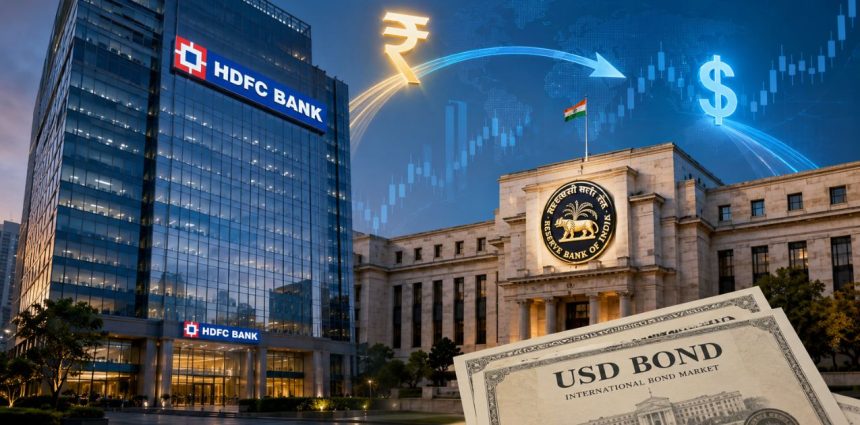
India’s largest private lender is set to tap the overseas bond market this week using the RBI’s new low-cost swap facility, a route that slashes hedging costs and could improve net interest margins if final pricing tightens from initial guidance.
Data as of June 16, 2026.
Key Takeaways
- HDFC Bank plans to raise at least $500 million via five-year dollar bonds this week.
- Initial price guidance is 5-year US Treasury yield plus 120 basis points; sources expect final pricing to tighten below 100 bps.
- The issue uses RBI’s new ECB swap window, which caps hedging cost at a fixed 1.5% per annum, far below the normal market rate of 3–3.5%.
- Proceeds will fund HDFC Bank’s foreign branches, foreign subsidiaries, and general corporate purposes.
- HDFC Bank shares were trading at ₹785.60, up 1.07% on NSE at the time of reporting.
- Merchant bankers project $15–20 billion in total ECB inflows through this route over the next six months.
What HDFC Bank Is Raising and Why Now: HDFC Bank,
India’s largest private sector bank is preparing a five-year dollar bond issue this week, targeting at least $500 million. Initial price guidance stands at 5-year US Treasury yield plus 120 basis points, but that is only the opening number.
Sources tracking the book-building process say the final cutoff could settle below 100 basis points over US Treasury yields, reflecting strong anticipated demand from global institutional investors. The bank may also upsize the issue beyond $500 million if investor appetite warrants.
This is not a routine fundraise. The timing is deliberate. HDFC Bank is among the first large private sector lenders to deploy the Reserve Bank of India’s newly activated subsidised swap window for eligible overseas borrowings, a facility that fundamentally changes the economics of dollar bond issuance for Indian banks.
HDFC Bank had not officially confirmed the issue at the time of this report. Sources requested anonymity as they are not authorised to speak to media.
HDFC Bank Dollar Bond — Key Issue Details
| Particular | Detail |
|---|---|
| Issuer | HDFC Bank |
| Expected issue size | At least $500 million (may upsize) |
| Instrument | Dollar-denominated senior bonds |
| Tenor | 5 years |
| Initial price guidance | 5-year US Treasury yield + 120 bps |
| Expected final pricing | Could tighten below US Treasury + 100 bps |
| Hedging route | RBI’s ECB swap window at fixed 1.5% p.a. |
| Use of proceeds | Foreign branches, subsidiaries, general corporate purposes |
| Official confirmation | Not confirmed by HDFC Bank as of June 16, 2026 |
Understanding the RBI’s Subsidised ECB Swap Window
The real story behind this bond issue is not just the size; it is the funding route that makes it possible at competitive terms.
The Reserve Bank of India recently opened a concessional forex swap facility for eligible overseas borrowings by banks and external commercial borrowings (ECBs) by public sector entities.
Under this window, eligible flows can be swapped with the RBI at a fixed rate of 1.5% per annum, compounded semi-annually, covering flows received up to December 31, 2026, with access open until January 15, 2027.
Normally, when a bank raises dollars overseas and needs rupees domestically, it must hedge the currency exposure. That hedge carries a market cost of approximately 3–3.5% per annum when rupee volatility or forward premia are elevated.
By absorbing this burden at a subsidised fixed rate, the RBI hands Indian lenders a roughly 200 basis point cost advantage on every dollar raised through this route.
How the RBI Swap Mechanism Works — Step by Step
| Step | What Happens |
|---|---|
| 1 | HDFC Bank raises dollar bonds from global investors |
| 2 | Bank sells the dollars to RBI under the swap at spot rate |
| 3 | RBI provides rupees for the bank’s domestic use |
| 4 | At maturity, the bank pays back rupees plus 1.5% p.a. swap premium |
| 5 | RBI returns the original dollars; bank repays bond investors |
The maximum swap tenor is aligned with the repayment schedule of the borrowing, capped at five years, exactly matching HDFC Bank’s planned bond tenor.
Track Live:
What This Means for HDFC Bank Stock and NIM
HDFC Bank shares were trading at ₹785.60, up 1.07% on the NSE on June 16, 2026, with a stock score of 7/10 and a strong buy consensus from 37 out of 38 analysts polled. The stock’s PE ratio stands at 15.94 — reasonable by historical standards for the lender.
For shareholders, the bond issue carries a meaningful funding angle. Domestic deposit mobilisation has remained a pressure point for Indian banks post the credit boom of recent years, with HDFC Bank itself navigating a period of elevated cost of funds.
A successful dollar bond at sub-100 bps over US Treasuries, combined with the RBI’s 1.5% swap rate versus the normal 3–3.5% hedging cost, could shave meaningful basis points off the bank’s blended cost of overseas funds.
This in turn provides marginal relief to net interest margins, which have been under pressure. The proceeds are ring-fenced for foreign branch and subsidiary funding, so the direct domestic NIM impact will be indirect, but any reduction in the overall liability cost trajectory matters to analysts tracking the bank’s margin recovery.
HDFC Bank’s Dollar Bond Track Record
This is not the bank’s first time in the international bond market. HDFC Bank has been a consistent overseas issuer:
| Year | Amount Raised | Tenor | Coupon / Spread |
|---|---|---|---|
| 2013 | $500 million | 5-year | 3.00% (230 bps over UST) |
| 2013 | $500 million | 3-year | 3.13% (255 bps over UST) |
| February 2024 | $750 million (3Y + 5Y) | 3Y & 5Y | 5.196% / 5.180% (95 / 108 bps over UST) |
| June 2026 (planned) | ≥$500 million | 5-year | Initial guidance: T+120 bps |
In the comparable 2013 RBI swap scheme, launched to defend the rupee during the taper tantrum, HDFC Bank mobilised $3.4 billion, the largest quantum among all participating banks, representing 7% of its total deposits at the time. ICICI Bank, SBI, and select foreign banks followed. This historical precedent positions HDFC Bank as the natural frontrunner again in 2026.
Who Else Is Using This Route
HDFC Bank is joining a queue forming rapidly. State Bank of India and Bank of Baroda were the first movers, each targeting around $500 million through five-year dollar bonds under the same RBI window, with plans to close their issues before the end of June 2026.
Public sector undertakings, which typically raise $10–12 billion annually via ECBs, are also expected to fast-track overseas borrowing plans, with PSU ECB issuances in FY27 potentially crossing $15 billion.
Projected Inflows Through the RBI Swap Route
| Institution / Source | Estimated Total Inflows |
|---|---|
| Merchant bankers (ECB route alone) | $15–20 billion over 6 months |
| Barclays (FCNR base case) | $25–30 billion |
| MUFG Bank | $20 billion base case |
| SBI Research (FCNR route) | $40–45 billion |
| Jefferies (FCNR + ECB combined) | $50–70 billion |
Jefferies noted the 2026 framework is structurally more supportive than the 2013 scheme, with zero hedging cost for FCNR-B deposits and leverage benefits making NRI participation more attractive than a decade ago.
What Investors Should Watch
For HDFC Bank shareholders, the signals to track are final bond pricing, issue size at close, investor demand quality, and how efficiently the bank deploys the proceeds across its foreign offices.
A sub-100 bps final spread would mark a meaningful confidence signal in HDFC Bank’s international credit standing.
For broader market participants, the key variables are how many Indian banks activate this window before September 30, 2026; whether the projected $15–20 billion ECB inflow materialises on schedule; and whether sustained dollar inflows help stabilise the rupee and compress forward premia, a positive feedback loop that would further lower hedging costs for all participants.
Bottom Line
HDFC Bank’s planned $500 million dollar bond issue is the cleanest private-sector test yet of the RBI’s subsidised ECB swap window. With initial guidance at T+120 bps, strong demand anticipated, and the RBI absorbing the bulk of the hedging cost at 1.5%, the effective cost of overseas funds could turn meaningfully competitive.
Alongside SBI and Bank of Baroda, this issuance marks the opening of what could be a $15–20 billion ECB-driven dollar inflow cycle over the next six months, a tailwind for India’s forex reserves, rupee stability, and bank funding conditions.
HDFC Bank shareholders should watch final pricing and the NIM trajectory closely over the next two quarters.
Sources: Reuters report carried by Economic Times; RBI ECB swap facility circular; Business Standard; Jefferies; EBC Financial Group. Data as of June 16, 2026.
Disclaimer: This article is for informational and educational purposes only. It does not constitute investment advice or a recommendation to buy or sell any security. Please read all official disclosures and consult a SEBI-registered investment advisor before making financial decisions.
FAQs
What is HDFC Bank’s dollar bond plan for June 2026?
HDFC Bank plans to raise at least $500 million via five-year dollar bonds this week, using the RBI’s subsidised ECB swap window. Initial price guidance is 5-year US Treasury yield plus 120 basis points, with final pricing expected to tighten below 100 bps on strong demand.
What is the RBI’s ECB swap window, and who is eligible?
The RBI’s ECB swap window allows eligible banks and public sector undertakings to hedge their overseas dollar borrowings with the RBI at a fixed rate of 1.5% per annum, compounded semi-annually, versus the normal market hedging cost of 3–3.5%. It is open for flows received until December 31, 2026.
How does this bond issue affect HDFC Bank’s net interest margins?
Cheaper overseas funding via the RBI swap window reduces HDFC Bank’s blended cost of foreign-currency borrowings. While proceeds are earmarked for foreign branches and subsidiaries, any reduction in liability costs provides indirect relief to domestic NIM, which has been under pressure from elevated deposit rates in recent years.
What is the difference between the FCNR-B route and the ECB bond route?
FCNR-B deposits are foreign currency deposits mobilised from NRIs by banks, where the RBI absorbs the full hedging cost. ECB bonds are wholesale dollar borrowings from global institutional investors, eligible for the concessional 1.5% swap rate. Both instruments serve the same strategic goal, pulling dollar inflows into India to support forex reserves and rupee stability.
Is HDFC Bank the only bank using this window?
No. State Bank of India and Bank of Baroda were the first users, each targeting around $500 million. Public sector undertakings are also expected to fast-track ECB plans under this facility, with total ECB inflows through this route projected at $15–20 billion over six months by merchant bankers.