KEY TAKEAWAYS
- Petroleum ministry is drafting a policy to let ethanol run alongside LPG in Indian kitchens, not replace it
- Draft policy expected by September; subsidy structure and stove infrastructure are the two open questions
- India’s ethanol capacity has crossed 20 billion litres/year, with ~7 billion litres sitting unused annually
- Policy push is tied to LPG supply risk from the ongoing Strait of Hormuz disruption since February
- OMCs are researching ethanol stoves and “ethanol ATM” refill points at existing fuel outlets
- Early industry estimates put ethanol refill costs well below an ₹800+ LPG cylinder, pending stove efficiency data
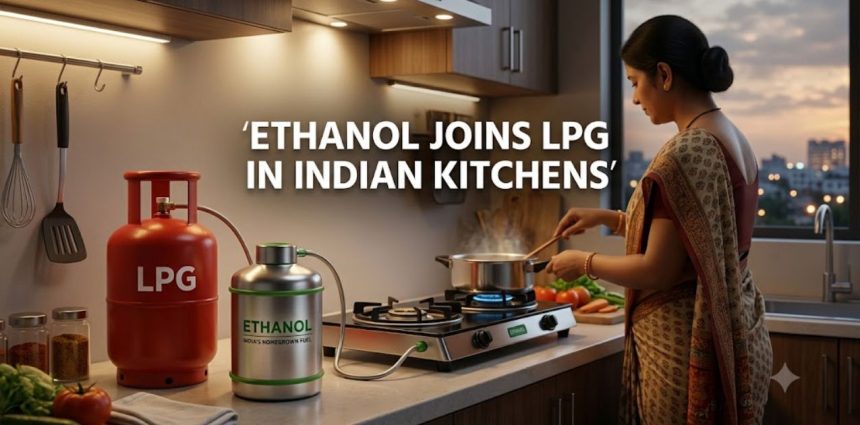
Mumbai’s fuel stations could soon dispense more than petrol and diesel. India’s petroleum ministry is drafting a policy framework to introduce ethanol as a mainstream cooking fuel, positioning it as a companion to LPG in Indian kitchens rather than a replacement, according to industry executives aware of the development. The draft policy is expected to be ready by September, and it will address two things traders and investors should track closely: subsidy design and supply-chain build-out.
Why This Policy Is Happening Now
The timing is not accidental. Since the West Asia conflict escalated in February, India’s LPG supply chain has been tested repeatedly, with Gulf-origin cargoes facing delays through the Strait of Hormuz, a route that still carries a significant share of India’s cooking gas imports.
State-run oil marketing companies have since drawn up a nearly 30-day strategic LPG storage buffer to guard against future shocks. Ethanol, unlike LPG, is almost entirely domestic, which is precisely why policymakers see it as a hedge against imported fuel risk.
India’s Ethanol Surplus Is the Real Trigger
This is as much a supply-side story as an energy-security one. India’s ethanol production capacity has crossed 20 billion litres a year, with another 4 billion litres of capacity coming online this financial year, according to a CareEdge Ratings report.
Demand, however, has not kept up. The government’s E20 petrol-blending programme absorbs roughly 11 billion litres annually, and non-fuel users such as liquor, pharma and chemical makers take another 3 to 3.5 billion litres.
That leaves close to 7 billion litres of ethanol capacity sitting idle every year, a surplus large enough to have triggered talk of exports to Nepal, Bangladesh and Indonesia, none of which have the distilling capacity to meet their own blending targets.
India’s Ethanol Supply-Demand Snapshot (FY26)
| Metric | Volume (Billion Litres/Year) |
|---|---|
| Total production capacity | 20+ |
| Additional capacity coming online (FY26) | 4 |
| E20 blending programme demand | ~11 |
| Non-fuel demand (liquor, pharma, chemicals) | 3–3.5 |
| Unutilised annual surplus | ~7 |
What The Subsidy And Infrastructure Plan May Look Like
Two structures are reportedly under discussion: a one-time capital subsidy to help households and retailers acquire ethanol-compatible stoves, or an ongoing fiscal support mechanism similar to LPG subsidies.
Oil marketing companies are already researching ethanol-based stove technology and are said to be scouting partnerships or acquisitions to speed up commercialisation.
One idea gaining traction is ethanol “ATMs” at existing fuel retail outlets, where households could refill canisters much like they top up cooking gas cylinders today, without India needing to build an entirely new distribution network from scratch.
Why Traders And Investors Should Watch This Space
For the market, this is a distribution and utilisation story before it is a consumption story.
Oil marketing companies such as Indian Oil, BPCL and HPCL stand to gain a new retail revenue stream if ethanol dispensing rolls out through their existing outlets. Sugar and grain-based ethanol producers, which have been sitting on underutilised capacity amid weak E20 offtake growth, gain a fresh demand channel if the cooking-fuel policy scales.
The bigger question is cost: LPG cylinders currently retail above ₹800, and industry pilots have floated ethanol refill costs well below that, though ethanol’s lower calorific value means stove design and burn efficiency will decide whether the economics actually work at kitchen level.
NiftyTrader Desk View — Sectors on the Radar
| Segment | Companies to Watch | Why It’s on the Radar |
|---|---|---|
| OMC / Fuel Retail | IOC, BPCL, HPCL | Potential new ethanol dispensing revenue stream through existing retail fuel outlets. |
| Sugar & Ethanol | Balrampur Chini, EID Parry, Dwarikesh Sugar | Fresh demand channel could improve utilisation of idle ethanol production capacity. |
| Grain-based Ethanol Technology | Praj Industries | Potential beneficiary through ethanol plant engineering and clean-fuel technology solutions. |
| LPG-linked Consumer Theme | OMC subsidy-linked names | Wider ethanol adoption could gradually reduce the long-term LPG subsidy burden if the policy scales successfully. |
Check Live:
INDIAN OIL CORPORATION Option Chain (NSE) — Live OI, PCR & Greeks
Bharat Petroleum Corpn Share Price Chart: Live
HINDUSTAN PETROLEUM CORPORATION Ltd Futures — Live Price, Open Interest & Basis Analysis
What Could Go Wrong
The gap between announcement and adoption is where most clean-fuel transitions stall. Retrofitting India’s LPG-dependent kitchen habits, building a last-mile ethanol distribution network, and proving stove safety and cooking-time parity at scale will all take longer than the September policy deadline suggests.
A parallel report by the International Institute for Sustainable Development estimates that a broader shift to e-cooking and biogas could save India more than ₹2 lakh crore in cumulative LPG subsidies by 2050, but that is a multi-decade horizon, not a near-term catalyst.
Bottom Line
The ethanol cooking fuel policy is less about replacing LPG overnight and more about India using a fuel it already overproduces to cut import dependence built up during the ongoing Strait of Hormuz disruption.
Watch the September policy announcement, the subsidy structure it proposes, and how quickly oil marketing companies move from stove research to actual rollout, since execution speed will determine whether this becomes a real second income stream for OMCs and ethanol producers or another clean-fuel plan that stays on paper.
Read Next: The Real Story Behind Monday’s Rally Was Hidden Inside the Q1 Numbers
FREQUENTLY ASKED QUESTIONS
What is India’s ethanol cooking fuel policy?
It’s a draft government framework to promote ethanol as a household cooking fuel alongside LPG, not as a full replacement, aimed at cutting import dependence.
When will the ethanol cooking fuel policy be finalised?
Industry executives cited in reports expect the policy framework to be ready by September.
Will ethanol replace LPG cylinders completely?
No. The current plan positions ethanol as a supplementary option alongside LPG, not a full substitute.
Why does India have a surplus of ethanol?
Production capacity has crossed 20 billion litres a year while E20 blending and industrial use together consume only about 14-14.5 billion litres, leaving roughly 7 billion litres unused.
How much cheaper is ethanol than LPG for cooking?
Early industry pilots suggest ethanol refills could cost significantly less than an LPG cylinder priced above ₹800, though final costs depend on stove efficiency and distribution setup.
Which stocks could benefit from the ethanol cooking fuel push?
OMCs like IOC, BPCL and HPCL, along with sugar and grain-based ethanol producers such as Balrampur Chini, EID Parry and Praj Industries, are among the sectors in focus.
Is ethanol safe as a cooking fuel?
Oil marketing companies are still researching and developing ethanol-based stove technology; safety and performance standards are part of what the upcoming policy is expected to address.
Track real-time FII/DII activity, sector flows and institutional positioning on the NiftyTrader FII-DII Dashboard before you trade this theme.
Disclaimer: This article is for informational purposes only and should not be construed as investment advice. Stock market investments are subject to market risks. Please consult a SEBI-registered financial advisor before making any investment decisions. NiftyTrader.in does not guarantee the accuracy or completeness of the information and is not responsible for any losses arising from its use.