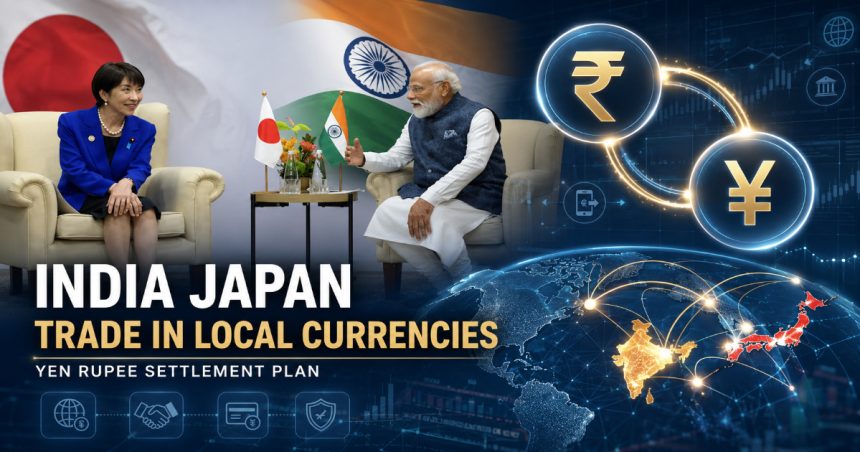
India, Japan may replace dollar with yen-rupee settlement as trade ties deepen
Could India and Japan take a major step toward reducing the US dollar’s dominance in global trade? As Prime Minister Narendra Modi prepares to host Japanese Prime Minister Sanae Takaichi, both countries are expected to unveil a landmark yen-rupee settlement framework that could reshape bilateral trade, lower transaction costs, and strengthen India’s push for rupee internationalisation. Here’s why investors are closely watching the summit.
India Japan yen-rupee settlement likely to feature in summit declaration
India and Japan are expected to announce a India Japan yen-rupee settlement framework during the 16th India-Japan Annual Summit in New Delhi this week, marking a significant step towards conducting bilateral trade without routing payments through the US dollar.
According to reports, the proposed framework will allow businesses and financial institutions in both countries to settle trade directly in Japanese yen and Indian rupees, reducing dependence on the dollar for cross-border transactions.
If approved, this would be the first time currency cooperation is formally included in a joint leaders’ statement between India and Japan.
Track Live : GIFT Nifty Live – Today Price, Chart, Timings and Nifty Opening Signal
Why the India-Japan partnership matters
Japan remains one of India’s largest strategic and investment partners.
According to recent government data:
- Bilateral trade reached $27.5 billion in FY26.
- Japanese investment in India stood at $3.2 billion between April and December 2025.
- Around 1,400 Japanese companies currently operate in India, with nearly half engaged in manufacturing.
Japan has also pledged to increase its cumulative investment in India to more than $61 billion over the next decade.
The two countries continue collaborating on major infrastructure projects, including the Mumbai-Ahmedabad High-Speed Rail Corridor, while Japanese companies are increasing investments in India’s banking, manufacturing and technology sectors.
Read More : Sensex Sheds 250 Points, Nifty Slips Below 23,900 as IT Stocks Drag
How will the yen-rupee settlement framework work?
Under the proposed India Japan yen-rupee settlement mechanism, Japanese companies operating as non-residents in India will be allowed to open accounts with Indian banks.
The framework will enable banks in both countries to process payments directly in yen and rupees, eliminating the need to first convert local currencies into US dollars.
This is expected to:
- Reduce foreign exchange conversion costs.
- Lower cross-border remittance charges.
- Speed up trade settlements.
- Reduce dependence on correspondent banks located in third countries.
- Improve payment efficiency for exporters and importers.
The initiative is aimed at making bilateral trade faster, cheaper and more efficient.
Modi-Takaichi summit expected to focus on trade and investment
Japanese Prime Minister Sanae Takaichi will visit India from July 1 to July 3 for her first official trip since assuming office in late 2025.
She is scheduled to hold talks with Prime Minister Narendra Modi during the 16th India-Japan Annual Summit, where both leaders are expected to review cooperation across trade, investment, infrastructure, technology and regional security.
Apart from the proposed India Japan yen-rupee settlement, discussions are expected to cover:
- Defence cooperation
- Semiconductor manufacturing
- Artificial Intelligence
- Supply chain resilience
- Automobile manufacturing
- Indo-Pacific security
Business leaders from both countries are also expected to participate in investment-related events during the visit.
The proposal builds on India’s rupee internationalisation strategy
The proposed framework is another milestone in India’s efforts to expand the global use of the rupee.
In July 2022, the Reserve Bank of India (RBI) introduced the Special Rupee Vostro Account (SRVA) mechanism, allowing international trade to be invoiced and settled in Indian rupees.
Since then, the RBI has steadily expanded the framework.
Currently:
- 156 Special Rupee Vostro Accounts have been approved.
- These accounts are maintained with 26 Indian banks.
- They serve 123 correspondent banks across 30 countries.
The RBI has also allowed surplus balances in these accounts to be invested in Government of India securities, making the mechanism more attractive for foreign partners.
The proposed India Japan yen-rupee settlement would further strengthen India’s long-term objective of reducing reliance on hard currencies in global trade.
What impact could the proposal have on markets and investors?
If implemented, the India Japan yen-rupee settlement could have meaningful long-term implications for Indian businesses and financial markets.
Exporters and importers may benefit from lower hedging costs, reduced currency conversion expenses and quicker settlement cycles. Banks handling cross-border transactions could also see increased business through local-currency settlement services.
The initiative could strengthen confidence in the Indian rupee, support India’s financial diplomacy and gradually reduce dependence on the US dollar in bilateral trade.
Companies with significant exposure to Japan—including those in automobiles, manufacturing, capital goods, electronics, infrastructure and industrial equipment—could benefit from smoother trade flows and lower transaction costs over time.
For investors, the upcoming Modi-Takaichi summit will be closely watched, as any formal announcement on the India Japan yen-rupee settlement, along with fresh investment commitments and trade initiatives, could improve sentiment toward sectors with strong India-Japan business linkages.
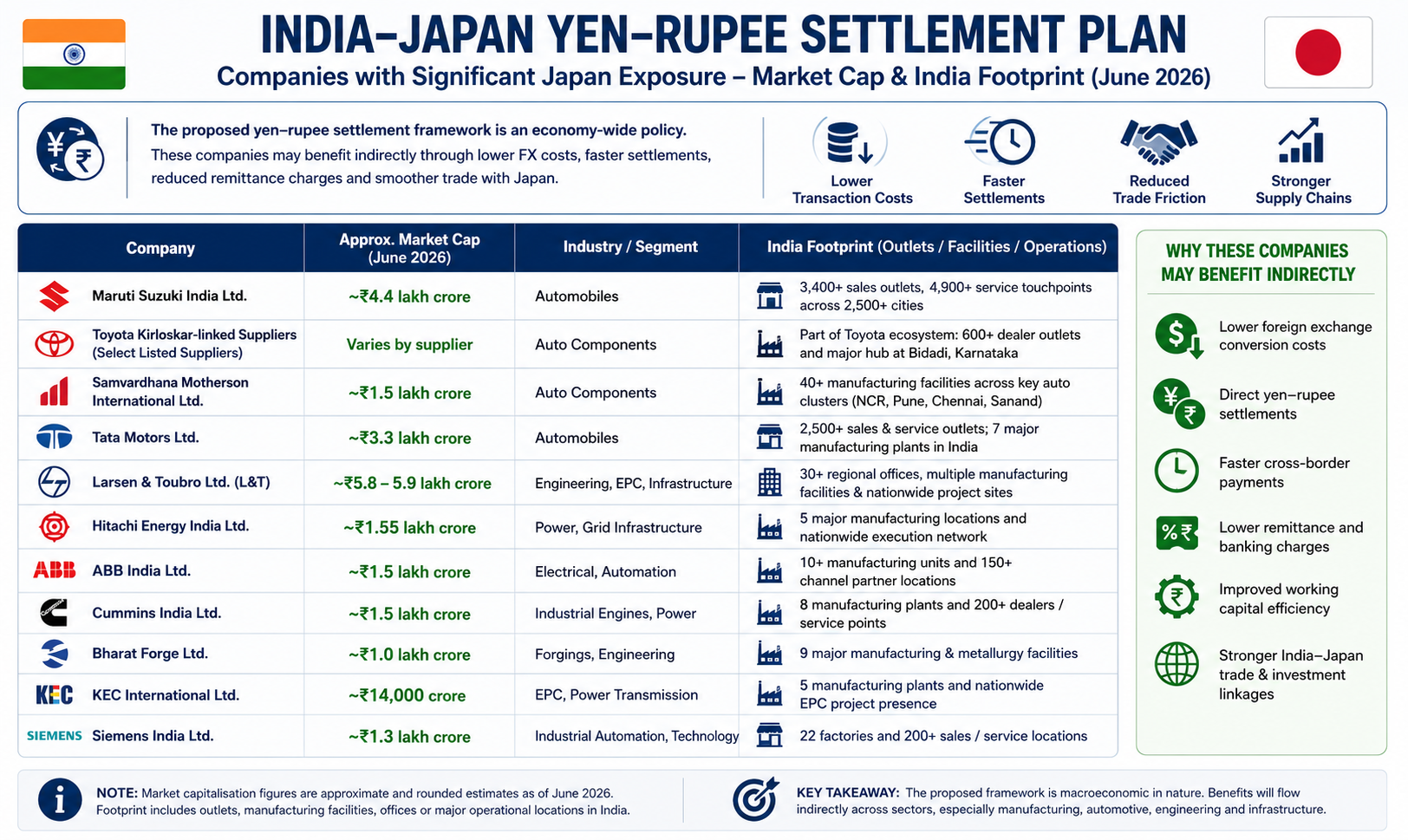
Companies That Could Benefit Indirectly from the India–Japan Yen–Rupee Settlement Plan
Note: These companies are not direct beneficiaries of the proposed framework. The yen–rupee settlement plan is an economy-wide policy initiative, meaning any benefit would likely come indirectly through lower foreign exchange conversion costs, faster cross-border settlements, reduced transaction friction, and improved trade efficiency for businesses with significant Japan-linked operations or supply chains.
Track Live : Stock Market Today
| Company | Approx. Market Cap (June 2026) | India Footprint* |
|---|---|---|
| Maruti Suzuki | ₹4.4 lakh crore | 3,400+ sales outlets, 4,900+ service touchpoints |
| Samvardhana Motherson | ₹1.5 lakh crore | 40+ manufacturing facilities in India |
| Tata Motors | ₹3.3 lakh crore | 2,500+ sales & service outlets |
| Larsen & Toubro | ₹5.8–5.9 lakh crore | 30+ regional offices, multiple manufacturing facilities and nationwide project sites |
| Hitachi Energy India | ₹1.55 lakh crore | 5 major manufacturing locations and nationwide execution network |
| ABB India | ₹1.5 lakh crore | 10+ manufacturing units and 150+ channel partners |
| Cummins India | ₹1.5 lakh crore | 8 manufacturing plants and 200+ dealers/service points |
| Bharat Forge | ₹1.0 lakh crore | 9 major manufacturing facilities |
| KEC International | ₹14,000 crore | 5 manufacturing plants and nationwide EPC projects |
| Siemens India | ₹1.3 lakh crore | 22 factories and 200+ sales/service locations |
| Toyota Kirloskar-linked suppliers | Varies by listed supplier | Toyota ecosystem includes 600+ dealer outlets and a major manufacturing hub at Bidadi, Karnataka |
*Footprint refers to dealer networks, factories, manufacturing facilities, offices, or major operational locations in India.
Why these companies may benefit
The proposed settlement framework could provide indirect advantages by:
- Reducing foreign exchange conversion costs
- Enabling direct yen–rupee settlements
- Speeding up cross-border payments
- Lowering remittance and banking charges
- Improving working capital efficiency
- Supporting India–Japan manufacturing and supply-chain integration
These benefits are expected to be most relevant for companies in automobiles, auto components, engineering, industrial equipment, infrastructure, and capital goods, where Japan is a key technology, investment, or sourcing partner.