Iran-US MoU and Hormuz Ceasefire: Did Washington Put Tehran in a Boiling Frog Trap?
The deal looked generous: relief, assets, ports and a 60-day window. But the visible US demand — keep Hormuz open — may have moved Iran from war retaliation into a compliance trap.
Iran-US MoU and Hormuz Ceasefire: Key Takeaways
- The reported Iran-US MoU looked attractive to Tehran because it promised sanctions relief, access to frozen assets, reopening of ports, and a 60-day negotiation window.
- The most visible immediate US demand was narrow but powerful: keep the Strait of Hormuz open and safe enough for commercial transit.
- Once Tehran signs such a framework, every strong response through Hormuz, Hezbollah or Gulf-linked pressure can be framed as a ceasefire breach.
- Lebanon is the missing piece: if Israel uses the 60-day window to degrade Hezbollah, Iran may comply with the MoU but lose regional deterrence.
- This is a strategic analysis, not a claim of proven US intent. The public text of the MoU has not been released, and Iran has disputed parts of the US account.
Why this MoU may not be as generous as it looked
The Iran-US memorandum of understanding looked, at first glance, like a deal Tehran had every reason to sign. According to the US account reported by Al Jazeera, the framework would halt fighting on all fronts, including Lebanon, lift the US naval blockade, open the Strait of Hormuz to maritime traffic, and start 60 days of negotiations on sanctions relief, frozen Iranian assets and a reconstruction plan. Al Jazeera also noted a crucial caveat: neither side had released a physical copy of the agreement, and Iranian officials had not confirmed the US version of the text. [1]
Reuters separately reported draft terms under which Iran would reopen Hormuz to commercial vessels while the US would lift its blockade of Iranian ports, waive oil sanctions for a period, and release $25 billion of frozen Iranian assets through a mix of cash transfers, regional cooperation and credit lines. [2]
On paper, that sounds like Iran extracted major concessions. But that is exactly what makes the strategy interesting. The strongest trap is not the one that looks like a trap. It is the one that gives the other side too much reason not to walk away.
Track Live : GIFT Nifty Live – Today Price, Chart, Timings and Nifty Opening Signal
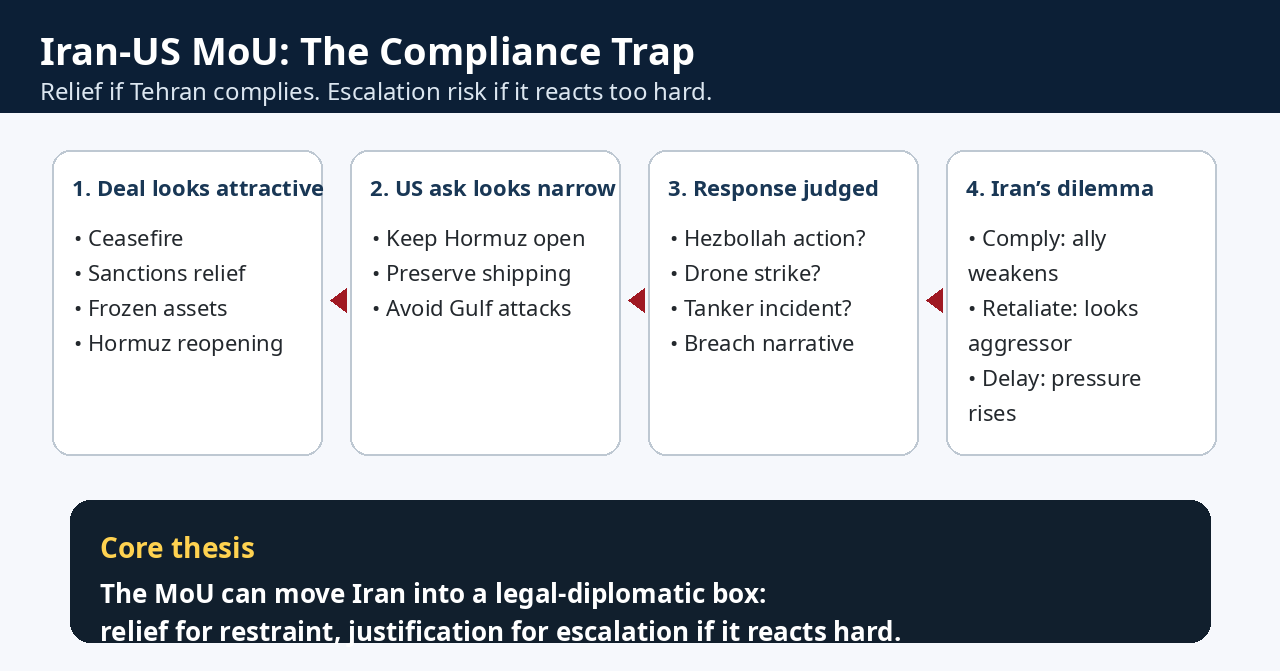
The narrow US ask: keep Hormuz open
The immediate American interest was simple and highly visible: keep the Strait of Hormuz open. Reuters reported that after US-Iran talks, the sides agreed on a communication line to ensure safe passage for commercial ships through the waterway, while Washington issued a 60-day sanctions waiver allowing Iran to sell oil and related products and receive payment. [3]
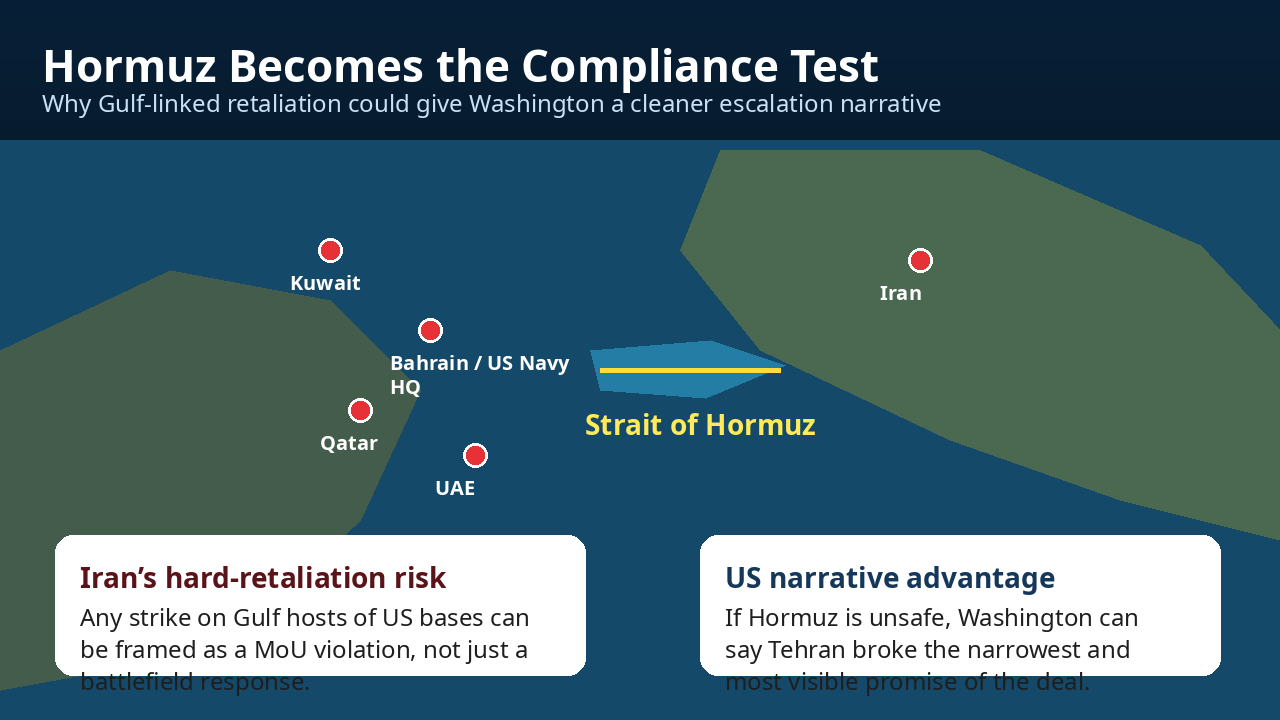
That narrow ask gives Washington a clear compliance test. If tanker traffic is disrupted, if Gulf shipping is hit, or if Iran-linked attacks threaten US-linked assets around the Gulf, the US does not need to argue about every line of a complex regional deal. It can point to one thing almost every outside government understands: Hormuz was supposed to stay open.
The boiling frog dynamic
This is where the boiling frog analogy becomes useful — but only if it is framed correctly. Iran is not unaware. Tehran likely understands the risk. The point is different: by signing a deal attractive enough to accept, Iran may have entered a pan where every move becomes more expensive than the last.
If Iran complies, it gets breathing room, oil revenue and some access to blocked money. But compliance may also restrain Iran while pressure continues on its allies. If Iran retaliates hard through Hormuz, Hezbollah or attacks on Gulf-linked US assets, Washington can frame Tehran as the side breaking the ceasefire, not merely responding to pressure.
Reuters reported on June 27 that a tanker had been struck in Hormuz, after the US and Iran traded strikes in the worst escalation since the interim peace deal. The two sides accused each other of violating the agreement. That is the compliance trap in action: the debate shifts from ‘who started the war?’ to ‘who broke the deal?’ [11]
Track Live : Quarterly Results Calendar
The assets issue: relief with strings attached
The frozen-assets dispute shows how fast a concession can become conditional. Reuters reported that Trump said unfrozen Iranian assets would be used to buy food and medical supplies from the United States, while Iran’s ambassador to the UN in Geneva said Tehran would decide how to spend that money. Washington had already agreed to waive sanctions for 60 days, letting Iran sell oil and receive payment. [4]
This matters because relief is not only economic. It is political leverage. If Iran accepts relief while remaining restrained, Washington can claim the deal is working. If Tehran escalates, the same relief can be threatened, delayed or reframed as something Iran no longer deserves.
Why Hezbollah and Lebanon are the missing piece
The central risk for Iran is not only Hormuz. It is Hezbollah. Iran can comply with the MoU, take economic breathing space, and still watch its most important regional deterrent come under sustained pressure in Lebanon.
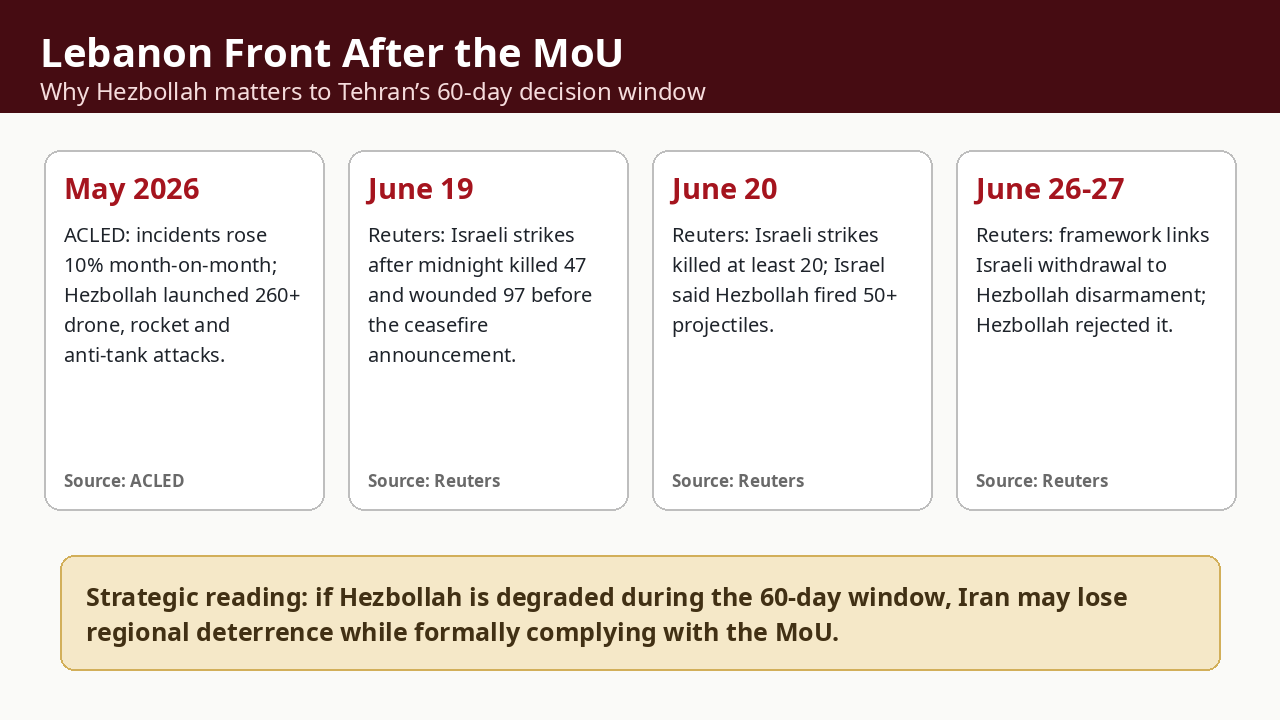
Before the MoU, the Lebanon front was already intense. ACLED reported that violent incidents involving Israel and Hezbollah surged 10% in May compared with the previous month, while Hezbollah launched more than 260 drone, rocket and anti-tank missile attacks — the highest monthly total in Lebanon since the broader conflict erupted in March. [7]
ACLED’s June overview said Israeli airstrikes intensified north of the Litani River and that Israel was unlikely to scale back operations because military pressure in Lebanon served two objectives: weakening Hezbollah and preventing its recovery, and complicating any broader US-Iran understanding that would restrict Israeli operations against the group. [8]
Read More : SEBI Opens New FPI Gateway: Can It Bring More Foreign Money Into Indian Stocks?
The post-MoU Lebanon data points
Reuters reported that Israel-Hezbollah hostilities escalated sharply on June 19, forcing a Lebanon ceasefire after fighting threatened the wider US-Iran interim deal. Lebanon’s health ministry said Israeli strikes after midnight killed 47 people and wounded 97. Reuters also reported Lebanese security sources saying Israel carried out about a dozen airstrikes in the first hour after the ceasefire began, while Israel denied that count and said it retained freedom to act against emerging threats.[5]
The next day, Reuters reported that Israeli strikes killed at least 20 people in Lebanon after the ceasefire, while Israel said Hezbollah had launched more than 50 projectiles at Israeli forces. Hezbollah accused Israel of hundreds of ceasefire violations. Lebanon’s health ministry said more than 4,000 people had been killed in Israeli attacks since March 2. [6]
On June 26, US Secretary of State Marco Rubio said the Israel-Lebanon framework set up a process to restore Lebanon’s sovereignty by disarming Hezbollah and dismantling its infrastructure. The same report said the agreement would enable Israel to return to its borders once the threat to its citizens was removed. [9]
By June 27, Reuters reported that Hezbollah had rejected the US-brokered Israel-Lebanon agreement as a ‘surrender’, and that an Israeli drone strike had hit southern Lebanon a day after the agreement. Reuters also reported that more than 1 million Lebanese had been driven from their homes by the conflict. [10]
The strategic squeeze on Tehran
Put these pieces together and Iran faces a three-way squeeze.
First, if Tehran keeps the MoU, it avoids immediate American escalation and gains temporary economic relief. But it may also be seen by its own network as accepting relief while Hezbollah is weakened in Lebanon.
Second, if Iran retaliates through Hezbollah, Hormuz or Gulf pressure, Washington can argue that Tehran broke the ceasefire. This is especially risky if attacks involve Gulf states hosting US military assets. Reuters reported on June 27 that Bahrain, which hosts the US Navy’s regional headquarters, condemned an Iranian drone attack on its territory and said Iran’s latest attacks violated the MoU. [11]
Third, if Iran tries to split the difference — small retaliation, ambiguous warning shots, indirect pressure — the US can still keep the compliance narrative alive while Israel continues shaping facts on the Lebanon front.
The one-at-a-time strategy
That is why the Hezbollah front makes the MoU more than a pause in the Iran war. It may be a sequencing strategy. If Israel can reduce Hezbollah’s rocket, drone and anti-tank capacity during a 60-day diplomatic window, Iran’s deterrence weakens without Washington needing to fight Iran directly every day.
This is speculative and should be labelled as such. There is no public proof that the US designed the MoU primarily to let Israel degrade Hezbollah. But the strategic effect is visible: Iran’s direct retaliation space is narrower, Hezbollah remains under pressure, and the US now has a peace-compliance framework it can invoke if Tehran escalates too hard.
Market impact: why NiftyTrader readers should care
For markets, the key variable is not only whether the MoU survives. It is whether Hormuz stays reliably open. The strait is one of the world’s most important energy shipping routes, and Reuters reported that tanker traffic had begun picking up after months of disruption, helping oil prices slide as supply started moving again. [3][11]
If the MoU holds, oil-risk premiums may cool, helping importers, aviation, chemicals, paints and broader emerging-market sentiment. If the MoU breaks through Hormuz or Lebanon, crude prices, shipping insurance, defence stocks and safe-haven assets can react quickly.
For India, the watchlist is straightforward: Brent crude, rupee movement, oil marketing companies, aviation stocks, paint and chemical companies, defence names, and global risk sentiment. The geopolitical question becomes a market question: is the 60-day window a real de-escalation or just a pause before a more legitimate round of escalation?
Bottom line
The Iran-US MoU may have looked generous because it needed to look generous. The visible US demand — keep Hormuz open for 60 days — was narrow enough for Tehran to accept and clear enough for Washington to enforce politically.
That is the boiling frog trap. Iran is not trapped because it does not understand the heat. It is trapped because the deal turns every strong response into a possible violation, while every act of compliance risks weakening its regional deterrence. The MoU may not only punish Iran if it breaks the peace. It may also weaken Iran if it keeps it.
Confirmed Facts vs Analysis Guardrails
| Point | Status | Source / note |
| MoU text not physically released; US account disputed/not confirmed by Iran | Reported fact | Al Jazeera [1] |
| Draft terms included Hormuz reopening, sanctions waiver and frozen-asset release | Reported fact | Reuters [2] |
| US issued 60-day sanctions waiver and safe-passage communication line for Hormuz | Reported fact | Reuters [3] |
| US and Iran disagreed on frozen-asset spending and nuclear inspections | Reported fact | Reuters [4] |
| Lebanon front remained active after the MoU; Israel-Hezbollah ceasefire was fragile | Reported fact | Reuters [5][6] |
| Israel-Lebanon framework links Israeli withdrawal to Hezbollah disarmament/threat removal | Reported fact | Reuters [9][10] |
| The MoU may function as a compliance trap for Iran | Analysis | Use language: may, could, strategic effect, not proven intent |
| US intentionally designed the deal to weaken Hezbollah first | Speculative; avoid as fact | Frame as strategic possibility, not established evidence |