JSW Infrastructure Rises as Mega Fundraising Plan Draws Market Attention
JSW Infrastructure shares moved higher on June 23 after the company launched a massive ₹7,503 crore Qualified Institutional Placement (QIP), one of the largest equity fundraising exercises seen in India’s infrastructure sector in recent years.
The stock gained more than 2% in morning trade, signaling that investors are focusing on the company’s long-term growth plans rather than the near-term dilution impact. The key question now is whether this fundraising can accelerate JSW Infrastructure’s next phase of expansion.
JSW Infrastructure Rises Despite Discounted QIP Pricing
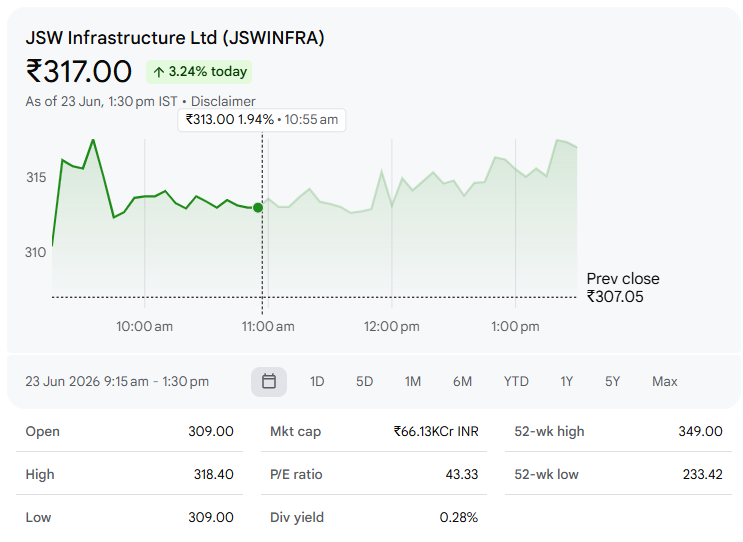
JSW Infrastructure stock rose over 2% to ₹313.35 during morning trade after the company announced the launch of its QIP.
The indicative issue price has been fixed at ₹285 per share, representing a discount of around 7.2% to the June 22 closing price of ₹307 on the NSE.
Notably, the issue price is also below the SEBI-approved floor price of ₹290.35 per share, highlighting the company’s intent to attract strong institutional participation.
Read More : Gold Falls 1.2%, Silver Tumbles 2.8% on US Inflation Data; Metal Stocks Fall
Highlights of the QIP
- Total issue size: ₹7,503 crore
- Fresh issue: ₹6,555 crore
- Offer for Sale (OFS): ₹948 crore by the Sajjan Jindal Family Trust
- Indicative issue price: ₹285 per share
- Discount to June 22 closing price: about 7.2%
- SEBI floor price: ₹290.35 per share
- Expected equity dilution: approximately 11.3% (fresh issue plus OFS)
Impact on Stock Performance
- Positive Morning Momentum: Shares rose over 2% in morning trade following the announcement, climbing above ₹313 per share.
- Relative Index Outperformance: Over the prior year, the stock logged a 3.5% gain, beating a 3.5% decline across the broader Nifty 50 index.
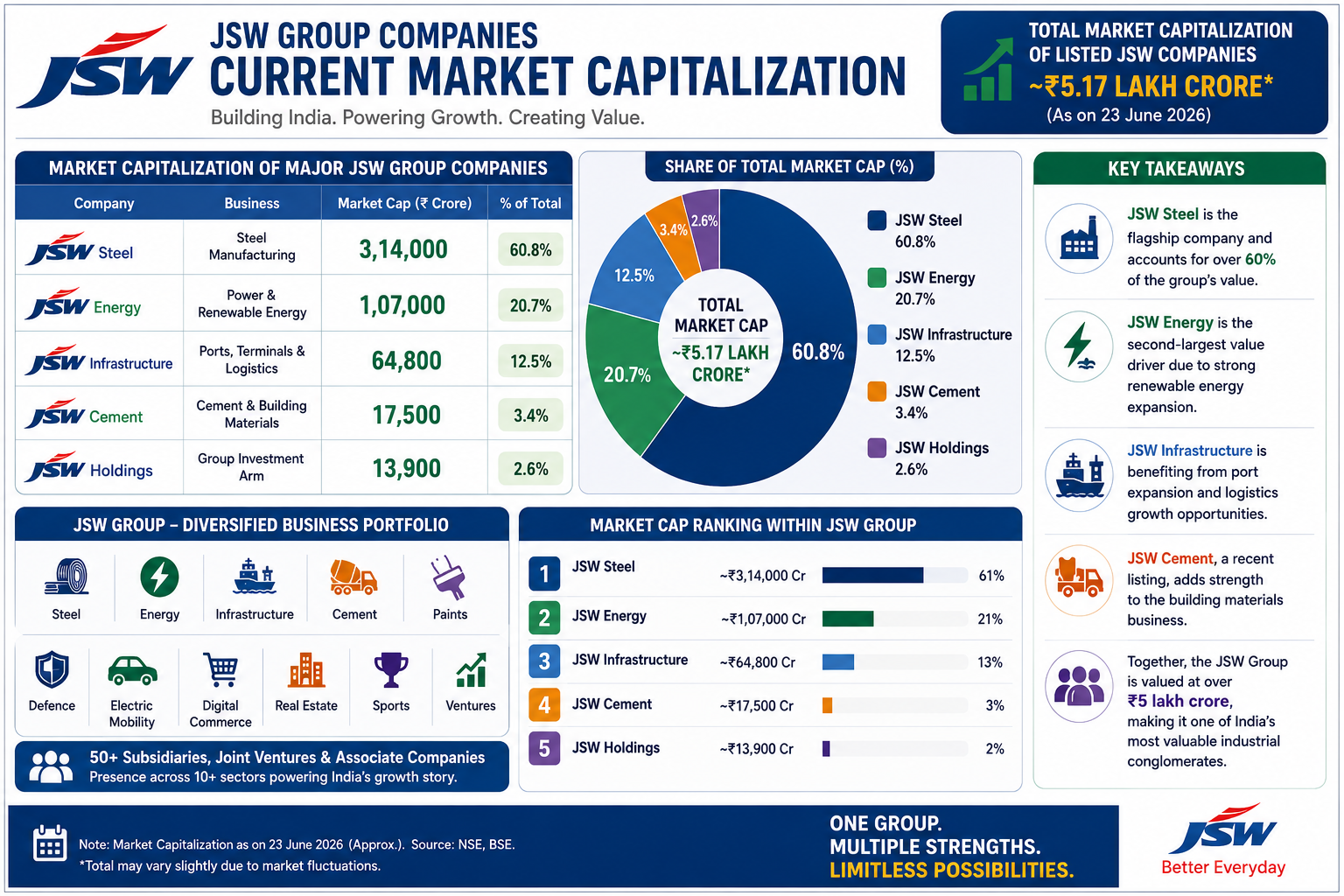
Major JSW Group Companies
Listed Companies
| Company | Business |
|---|---|
| JSW Steel | Steel manufacturing |
| JSW Energy | Power & renewable energy |
| JSW Infrastructure | Ports, terminals & logistics |
| JSW Holdings | Group investment arm |
| JSW Cement | Cement & building materials |
Major Unlisted & Group Businesses
| Company | Sector |
|---|---|
| JSW Paints | Paints |
| JSW One Platforms | B2B E-commerce |
| JSW Defence and Aerospace | Defence |
| JSW Ventures | Venture Capital |
| JSW Realty | Real Estate |
| JSW Sports | Sports & Franchises |
| JSW MG Motor India | Electric Vehicles |
| JSW Neo Energy | Renewable Energy |
How Many Companies Are There Under JSW?
Core Group Structure
- 5 Listed Companies
- 8–10 Major Unlisted Businesses
- 50+ Subsidiaries, Joint Ventures, and Associate Companies
- Presence across 10+ sectors including Steel, Energy, Infrastructure, Cement, Paints, Defence, EVs, Sports, Venture Capital, and Digital Commerce.
Largest Listed JSW Companies by Market Importance
- JSW Steel
- JSW Energy
- JSW Infrastructure
- JSW Cement
- JSW Holdings
Market Cap Ranking Within JSW Group
JSW Steel — 61% of total group market value
JSW Energy — 21%
JSW Infrastructure — 13%
JSW Cement — 3%
JSW Holdings — 2%
Why Did JSW Infrastructure Launch a ₹7,500-Crore QIP?
JSW Infrastructure launched the ₹7,503-crore QIP to fund its next phase of growth. The company plans to invest nearly ₹30,000 crore between FY25 and FY30 across ports, logistics assets, and acquisitions.
The proceeds will also help reduce debt and strengthen the balance sheet, giving the company greater financial flexibility for future expansion.
What Does the 7% Discount Mean for Investors?
The QIP is priced at ₹285 per share, about 7.2% below the June 22 closing price.
Such discounts are common in QIPs as they help attract large institutional investors and improve the chances of a successful fundraising.
Will Existing Shareholders Face Dilution?
Yes. The fresh issue is expected to dilute existing shareholding by around 9.9%.
However, investors typically focus on whether the capital raised can generate higher earnings and support long-term growth.
Why Did the Stock Rise Despite the Dilution?
The market appears to be focusing on the growth potential rather than the dilution.
Investors are encouraged by the company’s expansion plans, debt reduction strategy, acquisition opportunities, and expected institutional participation in the QIP.
Key Takeaways
Growth Drivers
- ₹30,000-crore expansion plan through FY30
- Port and logistics capacity expansion
- Potential acquisitions
- Debt reduction initiatives
Risks
- Around 10% equity dilution
- Execution risks in large projects
- Dependence on cargo volume growth
Q4FY26 Results Show Strong Operations Despite Profit Decline
JSW Infrastructure reported mixed fourth-quarter earnings.
Net profit declined 17.9% year-on-year to ₹418.3 crore compared with ₹509.4 crore in the corresponding quarter last year.
The company attributed the decline to exceptional items, including:
• Estimated ₹68 crore loss from a fire incident at the Fujairah Liquid Terminal
• Employee-related expenses linked to the new Labour Code
• Unrealised foreign-exchange losses
However, the operational performance remained robust.
Revenue from operations increased 18.6% year-on-year to ₹1,522.3 crore.
EBITDA rose 19.9% to ₹768.8 crore, while EBITDA margin improved to 50.5% from 50% a year ago.
These numbers indicate that the core business continues to deliver healthy growth despite one-time setbacks.
What the QIP Means for Investors
For investors, the QIP represents both an opportunity and a trade-off.
While the fundraising will lead to equity dilution, it also equips JSW Infrastructure with substantial capital to pursue expansion, acquisitions and debt reduction.
The positive market reaction suggests investors are focusing on the company’s long-term growth potential rather than the short-term impact of share dilution.
Going forward, the success of the QIP, deployment of funds and execution of expansion projects will remain key factors influencing JSW Infrastructure shares.
With ₹30,000 crore worth of planned investments and strong operating performance, the stock is likely to remain on the radar of institutional and retail investors alike.