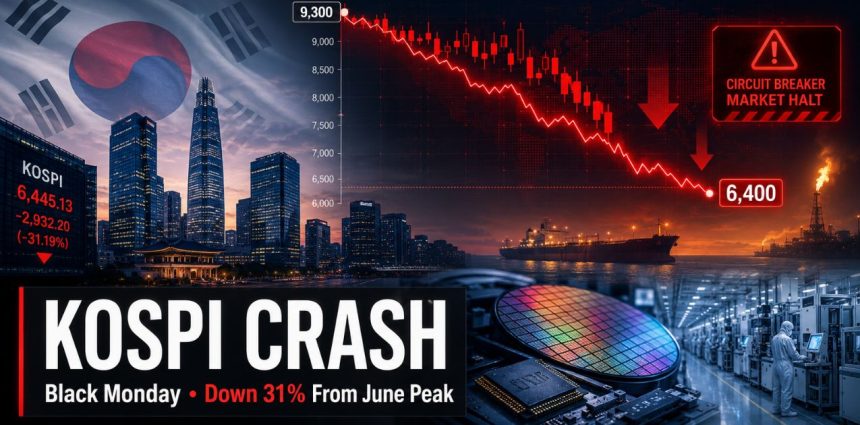
South Korea’s Kospi has suffered a dramatic reversal after its AI-driven surge, plunging 8.95% on Monday before falling as much as another 5% during volatile Tuesday trading.
The benchmark closed Monday at 6,806.93, losing 669.01 points and triggering a 20-minute market-wide circuit breaker. Local media dubbed the rout “Black Monday” as heavyweight chipmakers Samsung Electronics and SK Hynix suffered double-digit declines.
At Tuesday’s reported intraday low, the Kospi was more than 31% below its June intraday peak. Measured against the record closing high of 9,114.55, the decline was about 25%, placing the index firmly in technical bear-market territory. Despite the crash, the Kospi remained up roughly 60% in 2026, highlighting the extraordinary scale of the rally that preceded the selloff.
Kospi Crash: Key Numbers
| Metric | Verified figure |
|---|---|
| Monday’s closing level | 6,806.93 |
| Monday’s decline | 8.95% |
| SK Hynix on Monday | −15.37% |
| Samsung Electronics on Monday | −10.7% |
| Fall from June intraday peak | More than 31% at Tuesday’s reported low |
| Fall from record closing high | About 25% |
| Approximate 2026 gain remaining | Roughly 60% |
| Market status | Technical bear market |
Why Did the Kospi Crash?
The biggest pressure came from a reversal in the two stocks that had powered South Korea’s AI boom.
SK Hynix posted its biggest one-day fall in nearly two decades on Monday, while Samsung Electronics declined more than 10%. Together, the two chipmakers now account for just over half of the Kospi, meaning sharp moves in either company can overwhelm the performance of hundreds of other listed stocks.
Profit-taking intensified after SK Hynix’s Nasdaq debut. Its Korean-listed shares had more than tripled during 2026 as demand for high-bandwidth memory chips used in AI data centres lifted earnings expectations.
However, investors have started questioning whether record memory-chip prices, rapid capacity expansion and global AI spending can continue rising fast enough to support the gains already recorded by semiconductor stocks.
Middle East Tensions Add to Market Pressure
Renewed US–Iran tensions and disruption concerns around the Strait of Hormuz had already weakened risk appetite before Monday’s Korean session.
Later on Monday, after the South Korean market had closed, US President Donald Trump said Washington would reinstate a blockade on Iranian shipping and collect a 20% fee on cargo passing through the strait.
The announcement pushed oil prices higher and added further pressure to Asian markets on Tuesday. It should therefore be treated as a Tuesday-market trigger, not the direct cause of Monday’s Kospi crash.
Leverage Is Making the Swings Worse
Retail borrowing and leveraged investment products have magnified the Kospi’s movements.
Reuters reported that borrowed investment specifically in Kospi shares stood at 28 trillion won on July 14, close to the record 29.8 trillion won reached on June 24. Retail investors also purchased 42.4 trillion won of Kospi shares in June and another 13.2 trillion won during July.
Single-stock leveraged ETFs linked to Samsung Electronics and SK Hynix are designed to deliver multiples of their daily returns. These products accelerated gains during the rally but also intensified losses as chip stocks reversed.
South Korea’s financial regulators and central bank have warned that such products can encourage one-sided trading, increase market concentration and worsen volatility.
Is South Korea’s AI Rally Over?
The selloff does not necessarily mean the underlying AI-demand story has ended. Samsung and SK Hynix continue to benefit from strong demand for memory chips used in AI infrastructure, while their projected profits have increased rapidly.
Reuters noted that forward valuation multiples have declined despite the sharp rise in share prices because earnings expectations have climbed even faster.
The bigger concern is the structure of the rally. A market dominated by two companies and supported by margin debt and leveraged products can reverse violently even when long-term business fundamentals remain intact.
Foreign investors have also withdrawn nearly $110 billion from South Korean equities in 2026 while rebalancing global portfolios, leaving domestic retail investors carrying a greater share of the market’s exposure.
Read Next: Adani Enterprises Shares Rally 41% in 2026, Add ₹1.4 Lakh Crore: 6 Reasons Why
Bottom Line
South Korea’s “Black Monday” crash appears to reflect a combination of semiconductor profit-taking, doubts around elevated AI expectations, geopolitical pressure and leverage-driven selling—not clear proof that the global AI investment cycle has ended.
The next phase will depend on Samsung and SK Hynix earnings, memory-chip pricing, foreign flows and whether the market’s recovery can broaden beyond two semiconductor heavyweights.
Tuesday’s percentage moves were intraday when reported and can change before the official Korea Exchange close.
Disclaimer: This article is for informational purposes only and does not constitute investment advice.