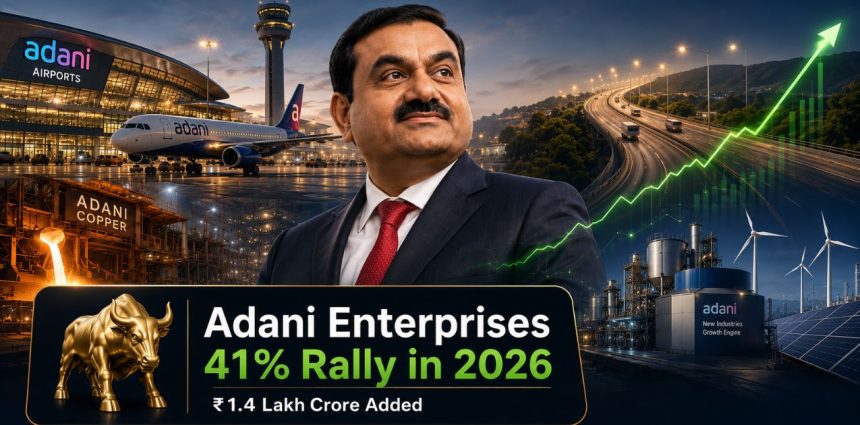
Adani Enterprises shares have delivered a sharp comeback in 2026, gaining around 41% since the start of the year and emerging as the best-performing stock on the Nifty index. The rally has added more than ₹1.4 lakh crore to the company’s market capitalisation, lifting its total market value to approximately ₹4.3 lakh crore.
The renewed interest isn’t centred on one business alone. Investors are treating Adani Enterprises as an incubator of infrastructure platforms spanning airports, roads, data centres, green-energy manufacturing, copper and mining services, with a fresh global bet added to the mix this year.
Adani Enterprises’ 2026 Rally in Numbers
| Key metric | Latest figure |
|---|---|
| Share-price gain in 2026 | ~41% |
| Market-cap addition | Over ₹1.4 lakh crore |
| Approximate market value | ~₹4.3 lakh crore |
| QIP funds raised | ₹15,000 crore |
| Bids received in QIP | ~₹38,000 crore |
| FY26 consolidated EBITDA | ₹16,464 crore |
Market-performance figures are as reported on July 14, 2026, and can shift intraday; fundraising and financial numbers are based on company disclosures and brokerage reporting.
1. Strong Institutional Demand for the ₹15,000 Crore QIP
One of the biggest confidence triggers came from the company’s qualified institutional placement. Adani Enterprises opened the issue at a base size of ₹10,000 crore but upsized it to ₹15,000 crore after receiving bids worth about ₹38,000 crore — 3.8 times the original offer. Shares were placed at ₹2,883 apiece, a 5% discount to the SEBI floor price of ₹3,034.68.
The company plans to use the capital for expenditure across its infrastructure businesses, including a PVC manufacturing project and road-related concession payments, while easing reliance on additional borrowing.
2. Airports Are Becoming a Major Earnings Engine
Adani Enterprises operates a portfolio of eight airports, including Navi Mumbai International Airport, which commenced commercial operations in December 2025. Its airport platform handles about 23% of India’s passenger traffic and nearly 29% of air cargo volumes.
The airport business reported FY26 EBITDA of ₹5,394 crore, up 55% year-on-year, nearly a third of consolidated EBITDA, on total income of ₹13,081 crore, up 28%. Aeronautical and non-aeronautical revenue grew 26% and 31% respectively, with retail, advertising, parking and other non-aeronautical streams expanding alongside aeronautical charges and rising passenger activity.
3. Three New Assets Could Lift FY27 Earnings
Management expects Navi Mumbai International Airport, Kutch Copper and the Ganga Expressway to together add more than ₹3,000 crore to EBITDA in FY27. The Ganga Expressway was completed in under three-and-a-half years, while the copper business is moving toward higher utilisation — both shifting from the investment phase into revenue generation.
4. Infrastructure Now Dominates the Earnings Mix
| Growth platform | Current operating scale |
|---|---|
| Airports | 8 airports; 95 million passengers annually |
| Data centres | 560+ MW tied-up capacity |
| Solar manufacturing | 4 GW cell and module capacity |
| Wind manufacturing | 2.25 GW capacity |
| Copper | 0.5 million tonnes annual capacity |
| Roads | 20 projects covering 5,500+ lane kilometres |
FY26 consolidated revenue came in at ₹1.03 lakh crore with EBITDA of ₹16,464 crore. Emerging core-infrastructure businesses generated ₹11,288 crore of that EBITDA, up 13% year-on-year, or 68% of the total. Including contracted services, infrastructure-linked operations account for around 80% of the company’s EBITDA profile.
5. A Global Bet: The $11.5 Billion Aluminium Push
Alongside its domestic infrastructure buildout, the group has moved into overseas heavy industry. Adani Enterprises has signed an MoU with the Odisha government and plans to form a 50:50 joint venture with International Resources Holding (IRH), an Abu Dhabi-based IHC Group company, for a proposed $11.5 billion integrated aluminium project, India’s largest-ever foreign investment in metallurgy.
The proposal broadens Adani Enterprises’ metals portfolio alongside Kutch Copper, whose 0.5 MTPA smelter at Mundra is already operational and is now moving towards higher capacity utilisation, adding a metals-and-materials leg to a portfolio that was, until recently, mostly logistics and energy.
6. Investors Are Anticipating Future Value Unlocking
Adani Enterprises has previously incubated and separated businesses including Adani Ports, Adani Power, Adani Green Energy, Adani Energy Solutions and Adani Total Gas. Management has now identified airports, roads and Adani New Industries as mature platforms that could move toward future value unlocking, though no final demerger schedule has been announced.
Morgan Stanley expects revenue and EBITDA to grow at compound annual rates of 19% and 32% respectively between FY26 and FY30, with EBITDA reaching an estimated ₹42,300 crore by FY30, backing an “Overweight” rating with a ₹3,638 target price.
Jefferies has a separate “Buy” rating with a ₹2,800 target, pointing to EBITDA growth led by the airports, copper and infrastructure segments even as reported profit has been dented by higher depreciation. The gap between the two targets, roughly ₹2,800 versus ₹3,638, illustrates how much brokerage valuations hinge on assumptions about execution speed and future value unlocking.
Check Live: Adani Enterprises Option Chain (ADANIENT) — Live OI
Risks Investors Should Weigh
- Execution risk — data centres, copper and several road projects still need to hit full commercial scale
- Leverage — net external debt rose meaningfully in FY26 as the company funded record capex; the pipeline still depends on continued access to equity and debt markets
- Legal and regulatory risk — ongoing or future proceedings involving group entities could affect investor sentiment, access to capital and valuation multiples; Morgan Stanley’s own risk list for the stock includes execution, airport-sector regulation, leverage, refinancing and commodity cyclicality
- Valuation — a large share of future spin-off value may already be reflected in the stock after this year’s rally
Bottom Line
The 2026 rally reflects growing conviction that several businesses built over years of heavy investment, airports, copper, roads, and now aluminium, are finally approaching commercial scale. The next test is whether these assets deliver the earnings and cash flows already being priced into the stock, and whether management follows through on demerger plans the way it did with Adani Ports, Green Energy and Total Gas.
This article is for informational purposes only and does not constitute investment advice.