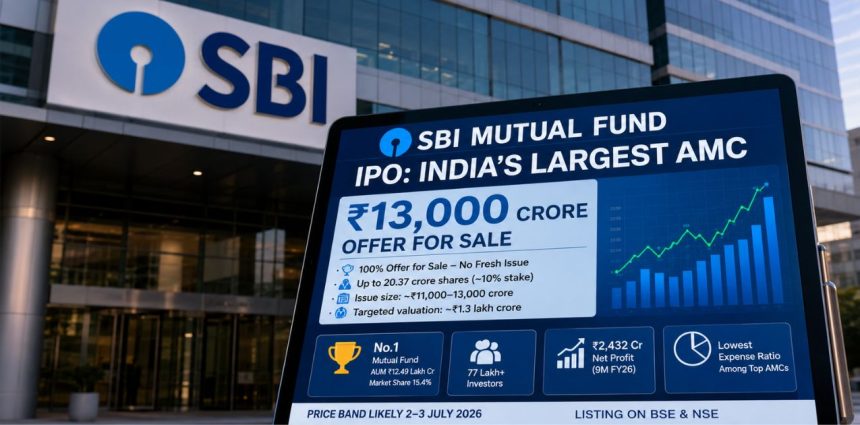
India’s largest asset manager moves a step closer to its market debut. Here’s what the ₹13,000-crore offer for sale means and how SBI MF stacks up against listed rivals like HDFC AMC and Nippon India.
Key Takeaways
- SBI Funds Management has received SEBI’s final observations on its IPO draft papers and is expected to file its red herring prospectus and reveal the price band in the first week of July 2026, with the band likely around 2–3 July, subject to regulatory and market conditions.
- The offer is entirely an offer for sale (OFS) of up to 20.37 crore shares (~10% stake) by promoters State Bank of India and Amundi. There is no fresh issue, so the AMC receives no proceeds.
- The issue is expected to raise ₹11,000–13,000 crore, valuing the company at a targeted ~₹1.3 lakh crore, which would make SBI MF the largest listed AMC in India by both AUM and market value.
- SBI MF is the country’s No. 1 asset manager, with a QAAUM of ₹12.49 lakh crore and a 15.4% market share (as of 31 December 2025), a lead it has held since March 2021.
- It would be the third SBI subsidiary to list, after SBI Cards and SBI Life Insurance.
India’s largest asset manager is finally headed for Dalal Street. SBI Funds Management, better known as SBI Mutual Fund, has cleared a key regulatory hurdle on its path to a listing.
The company filed its draft papers with SEBI on 19 March 2026 and is now expected to file its red herring prospectus (RHP) and disclose the price band in the first week of July, according to a Moneycontrol report.
Industry sources tracking the offering told ET Markets the band could be firmed up around 2–3 July, setting the stage for one of the year’s biggest asset management listings.
If it lands on schedule, this would be the first time India’s single largest mutual fund house trades on the exchanges. The shares will list on both the BSE and NSE.
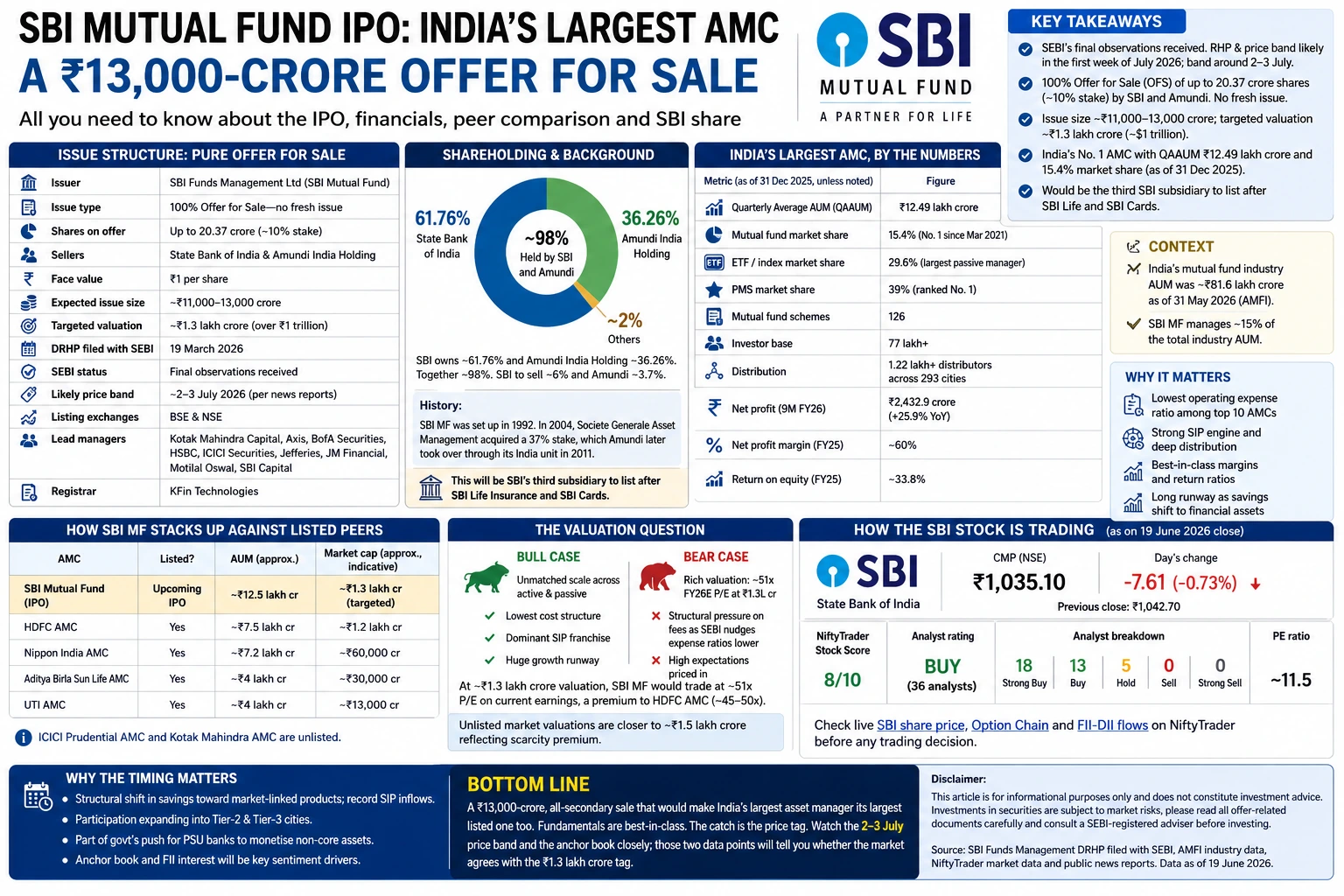
Track live IPO timelines, GMP movement, and subscription data on NiftyTrader’s IPO Calendar as the issue progresses.
Issue structure: a pure offer for sale
Unlike issues that raise fresh capital, this IPO is structured entirely as a stake sale by existing shareholders. The offer covers up to 20.37 crore shares, a 10% holding, with no fresh issue, which means SBI Funds Management itself will not receive a rupee from the listing.
| Detail | Particulars |
|---|---|
| Issuer | SBI Funds Management Ltd (SBI Mutual Fund) |
| Issue type | 100% Offer for Sale—no fresh issue |
| Shares on offer | Up to 20.37 crore (~10% stake) |
| Sellers | State Bank of India & Amundi India Holding |
| Face value | ₹1 per share |
| Expected issue size | ~₹11,000–13,000 crore |
| Targeted valuation | ~₹1.3 lakh crore (over ₹1 trillion) |
| DRHP filed with SEBI | 19 March 2026 |
| SEBI status | Final observations received |
| Likely price band | ~2–3 July 2026 (per news reports) |
| Listing exchanges | BSE & NSE |
| Lead managers | Kotak Mahindra Capital, Axis, BofA Securities, HSBC, ICICI Securities, Jefferies, JM Financial, Motilal Oswal, SBI Capital |
| Registrar | KFin Technologies |
Shareholding and background
State Bank of India currently owns about 61.76% of SBI Funds Management, while Amundi India Holding holds 36.26%, together roughly 98%. Per SBI’s board approval, the lender is paring around 6% and Amundi about 3.7%, adding up to the ~10% on offer.
The AMC has a long joint-venture history. It was set up in 1992 and became a JV in 2004, when Societe Generale Asset Management acquired a 37% stake, a holding Amundi later took over through its India unit in 2011.
This will be SBI’s third subsidiary to list, after SBI Life Insurance and SBI Cards & Payment Services, as the bank works to unlock value from its non-core financial arms. SBI General Insurance is reportedly next in line.
India’s largest AMC, by the numbers
What makes this listing matter is scale. SBI MF sits at the top of almost every league table in Indian asset management.
| Metric (as of 31 Dec 2025, unless noted) | Figure |
|---|---|
| Quarterly Average AUM (QAAUM) | ₹12.49 lakh crore |
| Mutual fund market share | 15.4% (No. 1 since Mar 2021) |
| ETF / index market share | 29.6% (largest passive manager) |
| PMS market share | 39% (ranked No. 1) |
| Mutual fund schemes | 126 |
| Investor base | 77 lakh+ |
| Distribution | 1.22 lakh+ distributors across 293 cities |
| Net profit (9M FY26) | ₹2,432.9 crore (+25.9% YoY) |
| Net profit margin (FY25) | ~60% |
| Return on equity (FY25) | ~33.8% |
To put ₹12.49 lakh crore in context, India’s entire mutual fund industry managed about ₹81.6 lakh crore as of 31 May 2026, per AMFI data, so SBI MF alone runs roughly one-seventh of the market.
It also carries the lowest operating expense ratio among the top 10 AMCs, a big reason its margins and return on equity sit near the top of the pack.
How SBI MF compares with listed peers
Four pure-play AMCs already trade in India. Once SBI MF lists, it would tower over all of them on assets and value. Market caps below are approximate and indicative, they move daily.
| AMC | Listed? | AUM (approx.) | Market cap (approx., indicative) |
|---|---|---|---|
| SBI Mutual Fund | Upcoming IPO | ~₹12.5 lakh cr | ~₹1.3 lakh cr (targeted) |
| HDFC AMC | Yes | ~₹7.5 lakh cr | ~₹1.2 lakh cr |
| Nippon India AMC | Yes | ~₹7.2 lakh cr | ~₹60,000 cr |
| Aditya Birla Sun Life AMC | Yes | ~₹4 lakh cr | ~₹30,000 cr |
| UTI AMC | Yes | ~₹4 lakh cr | ~₹13,000 cr |
Two of SBI MF’s largest rivals, ICICI Prudential AMC and Kotak Mahindra AMC, remain unlisted, so the IPO also gives public-market investors their first shot at a top-three AMC at this scale.
The valuation question
At the targeted ~₹1.3 lakh crore valuation, SBI MF would trade at a price-to-earnings multiple of roughly 51x on current earnings, a premium even to HDFC AMC, which sits around 45–50x.
In the unlisted market, SBI MF shares have been valued closer to ₹1.5 lakh crore, reflecting a scarcity premium as supply stays tight ahead of the float.
The bull case is straightforward: unmatched scale, the lowest cost structure among large peers, a dominant SIP engine, and a long runway as Indian households keep shifting savings into financial assets.
The bear case is just as clear, a rich entry multiple, plus structural pressure on fees as SEBI keeps nudging expense ratios lower. Final judgement will hinge on the price band.
How the SBI stock is trading
Since State Bank of India is the majority shareholder executing this sale, the parent stock is the most direct way to play the news. Here’s where SBIN stands:
| Metric | Value |
|---|---|
| CMP (NSE) | ₹1,035.10 |
| Day’s change | –7.61 (–0.73%) |
| Previous close | ₹1,042.70 |
| NiftyTrader Stock Score | 8/10 |
| Analyst rating | Buy (36 analysts) |
| Analyst breakdown | 18 Strong Buy, 13 Buy, 5 Hold, 0 Sell, 0 Strong Sell |
| PE ratio | ~11.5 |
Figures as of the 19 June 2026 close.
Check live SBI share price, the Option Chain and FII-DII flows on NiftyTrader before any trading decision.
Why the timing matters
The move comes amid a structural shift in Indian household savings toward market-linked products, with SIP inflows at record levels and participation spreading into Tier-2 and Tier-3 cities.
It also fits the finance ministry’s push for public-sector banks to monetise non-core assets, a trend already visible with Canara Bank’s mutual fund and insurance arms hitting the market.
For traders, the more useful lens is positioning: who is buying a marquee financial name, at what size, and how domestic and foreign institutions tilt around a large primary issue.
Anchor allocations and FII interest can move sentiment well beyond the issue itself.
Bottom line
The SBI Mutual Fund IPO is shaping up to be the year’s most closely watched financial-sector debut, a ₹13,000-crore, all-secondary sale that would instantly make India’s largest asset manager its largest listed one too.
The fundamentals are best-in-class: No. 1 in mutual funds, ETFs, and PMS, with sector-leading margins. The catch is the price tag. Watch the 2–3 July price band and the anchor book closely; those two data points will tell you whether the market agrees with the ₹1.3 lakh crore tag.
Disclaimer: This article is for informational purposes only and does not constitute investment advice.
Figures are sourced from SBI Funds Management’s DRHP filed with SEBI, AMFI industry data, NiftyTrader market data and public news reports, and are accurate as of the publish date; IPO details may change once the company confirms terms.
Investments in securities are subject to market risks, please read all offer-related documents carefully and consult a SEBI-registered adviser before investing.