
SEBI’s July F&O Study Could Reshape Option Trading; Why Every Trader Should Watch This Report
Will the SEBI July F&O Study Change the Future of Option Trading?
What if the biggest lesson for option traders in 2026 isn’t about making profits—but about avoiding losses?
That is exactly why the SEBI July F&O Study has become one of the most anticipated reports for India’s stock market.
Every day, thousands of new traders enter the Futures & Options (F&O) market hoping to earn quick profits. Social media is filled with screenshots of massive gains, luxury lifestyles and stories of overnight success. But behind those viral posts lies another reality that many beginners discover only after entering the market.
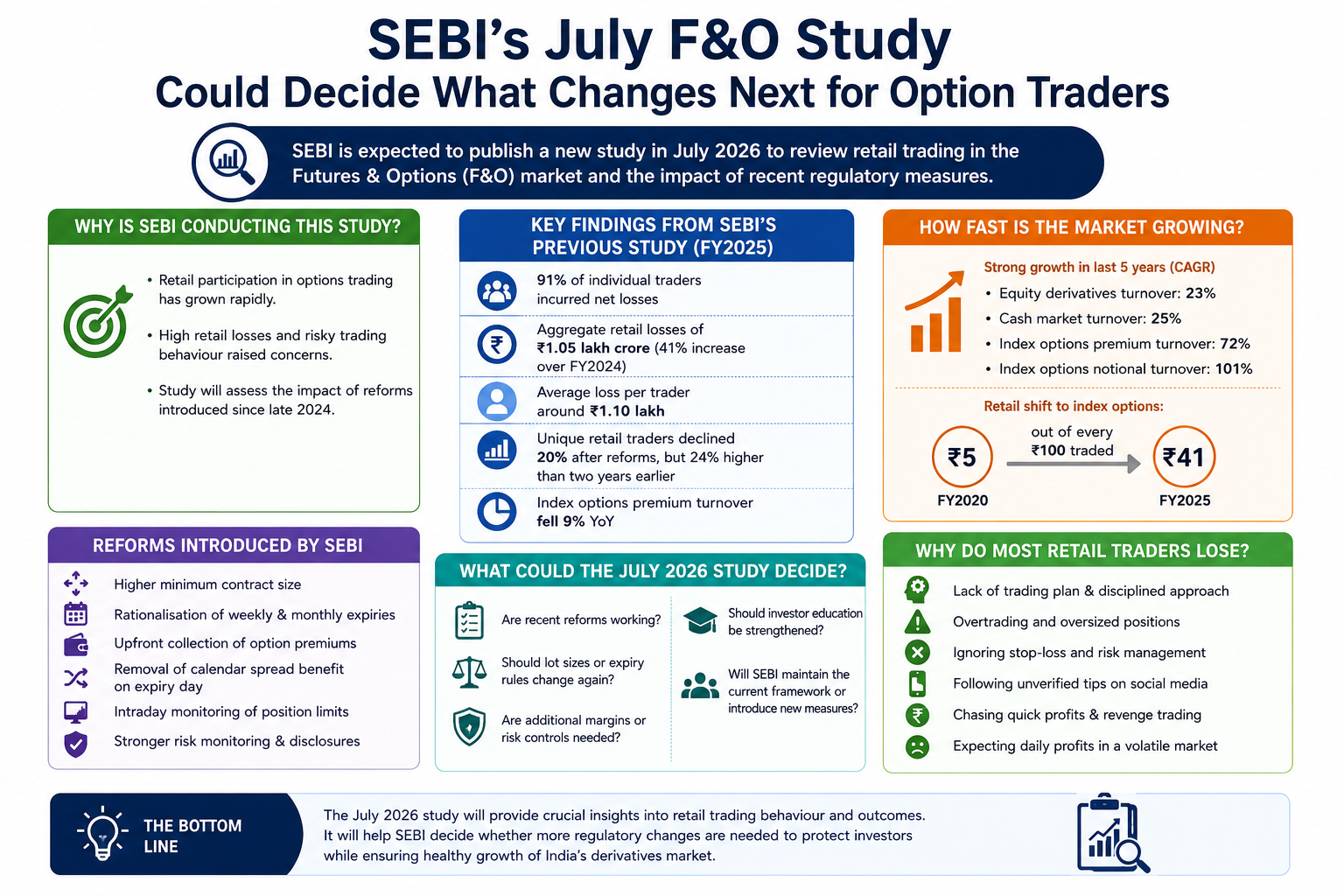
The SEBI July F&O Study, expected to be released in July 2026, is likely to examine how retail investors are trading, why so many continue to lose money and whether recent regulatory reforms are improving market discipline. More importantly, the report could influence the next phase of India’s option trading regulations.
Track Live : FII DII Data Today
Why Is the SEBI’s July F&O Study So Important?
India has become the world’s largest derivatives market by the number of contracts traded. Low-cost trading apps, easy account opening and aggressive financial content on social media have attracted millions of first-time investors.
While this growth has improved market participation, it has also increased concerns about excessive speculation and investor protection.
SEBI Chairman Tuhin Kanta Pandey has indicated that the regulator will first evaluate the impact of recent reforms before considering whether additional policy changes are required.
“The upcoming study will help assess whether recent reforms are reducing speculative trading and improving investor protection.”
For traders, the SEBI July F&O Study is not just another regulatory report. It could shape the future of option trading in India.
What Did SEBI’s Previous F&O Study Reveal?
The latest published SEBI analysis highlights why regulators remain concerned.
Some of the biggest findings include:
- Retail traders collectively lost ₹1.05 lakh crore, up 41% from the previous year.
- The average loss per trader increased to nearly ₹1.1 lakh.
- Unique retail traders declined 20% after regulatory reforms.
- Index options turnover dropped 9% year-on-year in premium terms.
- Massive Net Losses: Recent data analyses show that 91% of individual retail traders consistently face net losses in the equity derivatives segment, with cumulative losses continuing to mount.
- Speculation vs. Hedging: Data suggests the massive uptick in F&O volume is driven by speculative, last-minute buying sprees on expiring contracts rather than institutional hedging.
- The Social Media Influence: The regulator is closely investigating the psychological and emotional triggers—such as FOMO and the desire to recover quick losses—fostered by online “success stories” that drive novice traders to overtrade.
India’s Option Trading Boom Continues
Despite tighter regulations, India’s derivatives market continues to grow rapidly.
According to SEBI:
- Equity derivatives turnover recorded a 23% CAGR.
- Cash market turnover grew at 25% CAGR.
- Index options premium turnover expanded 72% CAGR.
- Index options notional turnover surged 101% CAGR.
Another striking trend is the shift in retail behaviour.
In FY2020, only ₹5 out of every ₹100 traded by individuals in derivatives went into index options.
By FY2025, that number had jumped to ₹41, showing how option trading has become the preferred segment for retail investors.
Read More : 91% of Retail F&O Traders Lost Money in FY25. The Real Story Is Who Survived
Key Potential Regulatory Shifts
- Scaling Back Weekly Expiries: In an effort to control “irrational exuberance” and speculative, high-frequency volatility, SEBI is considering phasing out weekly expiries for certain contracts and transitioning fully to monthly expirations.
- Further Tightening of Position Limits: Stricter tracking of position limits across the trading day (not just at market close) to prevent single entities from holding oversized or risky positions.
- Revising Available Options Strike Prices: Proposals have been floated to eliminate inactive, far-out-of-the-money (OTM) strike prices that often lure retail traders into high-risk, low-probability bets.
Here’s What Happened Today and Why Traders Reacted
The market’s attention is now firmly on the SEBI July F&O Study.
The report itself is not expected to announce fresh rules. However, its findings could influence future discussions on:
- Option trading regulations
- Lot size revisions
- Weekly expiry structure
- Risk management norms
- Investor protection measures
This is why brokers, traders and market experts are closely tracking every update related to the SEBI July F&O Study.
Track Live : Quarterly Results Calendar
What Could the SEBI July F&O Study Focus On?
The upcoming SEBI July F&O Study is expected to examine several important areas.
Average Losses of Retail Traders
The report may analyse how many traders consistently make profits versus how many continue to lose money.
This could help beginners understand that option trading is far more challenging than it appears on social media.
Trading Behaviour of Retail Investors
SEBI may study common mistakes such as:
- Overtrading during volatile sessions
- Taking oversized positions
- Ignoring stop-losses
- Revenge trading
- Following unverified social media tips
These behavioural mistakes often contribute more to losses than market volatility itself.
The Influence of Social Media
Social media has become one of the biggest drivers of new trading accounts.
Many beginners enter the market after watching profit screenshots or viral trading videos.
However, failed trades, emotional stress and large losses are rarely shared publicly.
The SEBI July F&O Study may also explore how online content influences retail trading behaviour.
Why Emotions Often Decide Trading Results
Successful trading is rarely about predicting every market move correctly.
Fear, greed, excitement and frustration often lead traders to make poor decisions.
Winning a few trades can create overconfidence.
A series of losses can trigger revenge trading.
Professional traders also lose money. The difference is that they focus on protecting capital before chasing returns.
As market experts often say:
“The first rule of trading is not making profits. It is surviving long enough to keep learning.”
What Changes Has SEBI Already Introduced?
Over the past two years, SEBI has introduced multiple reforms to reduce excessive speculation.
These include:
- Higher minimum contract sizes
- Rationalised weekly and monthly expiries
- Upfront option premium collection
- Removal of calendar spread benefits on expiry day
- Intraday monitoring of position limits
- Stronger disclosure and risk monitoring norms
The SEBI July F&O Study will evaluate whether these measures have started improving trading discipline.
What Could Be the Market Impact?
Although the report is unlikely to bring immediate policy changes, its findings could influence future regulatory decisions.
For traders:
- Possible changes in option trading rules
- Impact on liquidity and trading volumes
- Better awareness of trading risks
For investors:
- Stronger investor protection
- Improved market confidence
- More sustainable long-term market participation
One encouraging trend from SEBI’s previous analysis is that aggregate losses and average losses per trader declined during the fourth quarter of FY2025 after several reforms became effective.
The Biggest Lessons Every Option Trader Should Remember
The SEBI July F&O Study is expected to reinforce some timeless trading principles:
- Trading is not a shortcut to wealth.
- Risk management matters more than predictions.
- Protecting capital comes before earning profits.
- Emotional discipline is the biggest competitive advantage.
- Long-term consistency beats short-term excitement.
Final Thoughts
The SEBI July F&O Study is much more than a report filled with numbers.
Behind every trading account is a person trying to build wealth, achieve financial freedom or secure a better future.
The market offers opportunities, but only to those who combine knowledge with discipline.
Fast profits may grab headlines, but long-term survival creates successful traders.
As India continues to lead the world in derivatives trading, the SEBI July F&O Study could become an important milestone in improving investor education, strengthening market discipline and shaping the future of option trading.