Indian equities are witnessing one of their broadest market corrections in recent years as escalating geopolitical tensions in the Middle East trigger a powerful global risk-off wave.
Benchmark indices including the NIFTY 50 and the BSE Sensex have faced renewed selling pressure in recent sessions, while market breadth has deteriorated sharply across sectors.
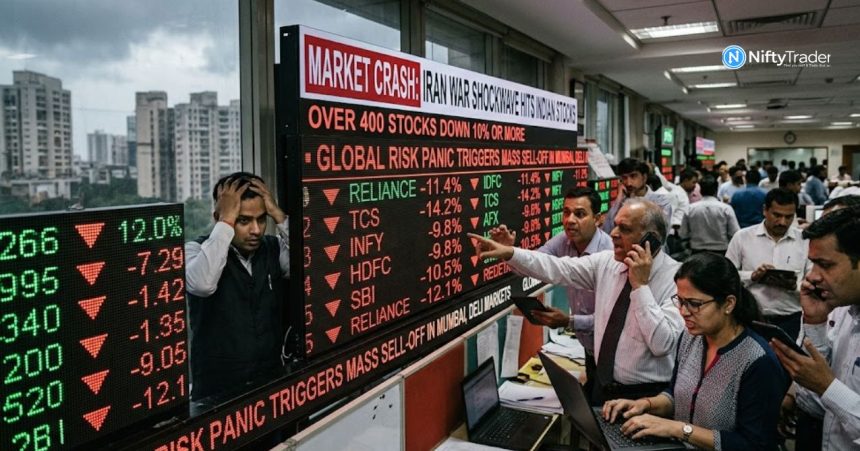
Since the outbreak of the conflict involving Iran and Western allies in late February 2026, more than 400 Indian stocks have fallen in double digits, reflecting growing investor anxiety over energy shocks, inflation risks, and potential global economic slowdowns.
The selloff highlights how quickly geopolitical shocks can ripple through emerging markets like India, where commodity prices, foreign capital flows, and global risk sentiment play a major role in determining market direction.
Market Snapshot
• 400+ Indian stocks down 10% or more since the conflict escalated
• Small-cap and mid-cap stocks seeing the sharpest declines
• Rising crude prices triggering inflation and currency concerns
• Foreign investors reducing exposure to emerging markets
What Triggered the Market Sell-Off
The immediate trigger behind the market turbulence is the escalating military conflict involving Iran that began in late February.
The war has disrupted shipping through the Strait of Hormuz, one of the world’s most critical energy corridors through which roughly 20% of global oil supply flows.
As tanker traffic dropped and supply risks surged, crude oil prices jumped above the psychologically important $100 per barrel level, reigniting global inflation fears.
For oil-importing economies like India, such spikes immediately raise concerns around the following:
• Inflation pressures
• Fiscal deficits
• Corporate profit margins
• Currency stability
These risks quickly spilled over into equity markets, prompting investors to reduce risk exposure.
How Deep the Market Damage Is
Market breadth data shows that the correction has been broad and widespread, rather than concentrated in a few large stocks.
More than 400 listed Indian companies have fallen over 10% since the conflict escalated, with selling pressure particularly intense in small-cap and mid-cap segments.
Investor sentiment has turned sharply cautious, with declining stocks significantly outnumbering gainers during several recent trading sessions.
The fall has also been amplified by foreign institutional investor selling, as global funds typically reduce exposure to emerging markets during periods of geopolitical stress.
Why Global War Matters for Indian Markets
Major geopolitical conflicts often trigger three key financial shocks that influence equity markets.
1. Oil Price Shock
India imports nearly 85% of its crude oil needs, making the economy highly sensitive to energy price spikes.
Higher oil prices raise transportation costs, increase inflation, and squeeze corporate margins across multiple sectors.
2. Foreign Capital Outflows
During geopolitical crises, global investors tend to shift funds toward traditional safe-haven assets such as:
• US dollar
• Gold
• US Treasuries
This shift often results in capital outflows from emerging markets, putting pressure on equities and currencies.
3. Global Growth Concerns
War-driven commodity spikes can slow global economic growth.
That in turn affects export-oriented sectors in India and reduces investor appetite for risk assets.
Sectors Under the Most Pressure
The selloff has been particularly sharp in sectors that are sensitive to energy costs, global demand cycles, or liquidity conditions.
Auto
Higher fuel prices and expectations of weaker consumer demand have weighed on automobile stocks.
IT
Technology companies remain under pressure amid concerns that a global slowdown could impact overseas demand and technology spending.
Chemicals and Fertilizers
These sectors depend heavily on imported energy feedstocks and are particularly vulnerable to oil and gas price spikes.
Sectors Showing Relative Resilience
Despite the broad selloff, some pockets of the market have shown relative stability.
Power and energy-related companies have attracted interest, as higher fuel prices and rising electricity demand expectations may improve their revenue outlook.
Companies tied to domestic energy production could benefit if oil and gas prices remain elevated.
What Traders Are Watching Now
Market strategists say the next direction for equities will depend on three key factors.
Oil Prices
Whether crude stabilizes above or below the $100 mark.
War Escalation Risk
Any further disruption to shipping routes in the Gulf could intensify volatility.
Foreign Investor Flows
Sustained selling by global funds could extend the correction in Indian equities.
Some global brokerages have already trimmed their outlook for emerging market equities due to rising geopolitical risks and inflation pressures.
Market Outlook: Volatility Likely to Persist
For now, the conflict has injected a powerful layer of uncertainty into global markets.
Historically, geopolitical shocks tend to trigger short-term volatility spikes, but markets often stabilize once the economic impact becomes clearer.
Until that clarity emerges, traders are likely to remain cautious as oil prices, foreign investor flows, and geopolitical headlines continue to shape sentiment on Dalal Street.