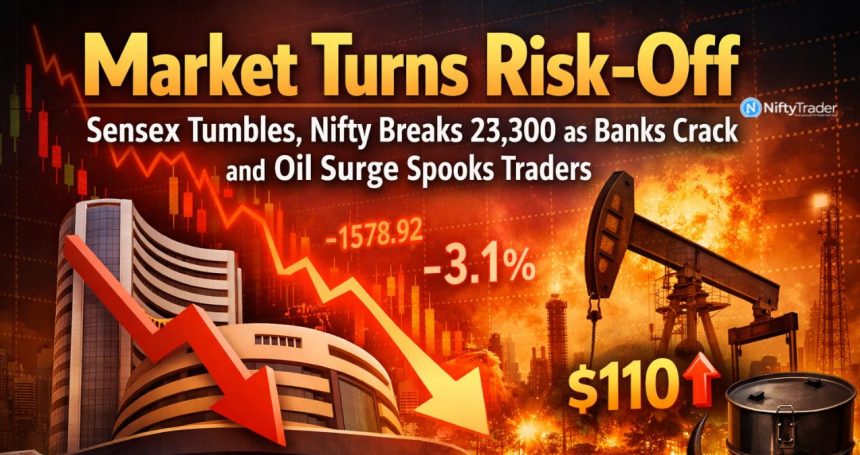
Indian equities turned sharply lower on Thursday, March 19, with the Sensex tumbling more than 1,600 points and the Nifty slipping below 23,300, as traders reacted to a harsh mix of governance worries in a heavyweight bank, a hawkish US Fed, and a fresh spike in crude oil prices. The sell-off was broad-based, with all major sectors trading in the red, showing this was not just a stock-specific wobble but a clear risk-off shift across the market.
The sharpness of the fall matters because it came right after a three-session recovery, suggesting the market was still fragile beneath the surface. Wednesday had ended on a strong note, with the Sensex at 76,704.13 and the Nifty at 23,777.80, but Thursday’s opening damage quickly wiped out that optimism.
What triggered the sell-off
The biggest immediate drag came from HDFC Bank, after the sudden resignation of part-time chairman Atanu Chakraborty, who referred to differences related to “values and ethics,” reviving governance concerns at a time when sentiment was already shaky. The stock fell sharply, and because of its heavy index weight, it amplified the fall in both headline benchmarks and the banking pack.
The second hit came from the global side. The US Federal Reserve kept rates unchanged but retained a hawkish tone, which reduced hopes of easier global liquidity. That by itself would have kept traders cautious, but the pressure intensified as crude oil surged above $110 a barrel, feeding worries over inflation, margins, and imported risk for India.
Why this fall feels heavier than a normal red day
This was not a narrow correction. Reports showed all 16 major sectors were in the red, while financials and banks dropped around 3%, and broader midcap and smallcap indices also fell about 2%. That kind of uniform selling usually tells traders that risk is being cut across portfolios, not merely rotated.
In other words, the market did not fall because one pocket cracked. It fell because traders suddenly had to price in three risks at once:
-
a governance shock in a market heavyweight,
-
a tighter-for-longer global rate backdrop,
-
and an oil spike that can quickly alter inflation and earnings assumptions.
Sector impact: where the pain is showing first
Banks and financials were hit the hardest, which is important because they had also been central to the recent rebound. Once the banking pack weakens, market confidence usually fades faster because traders see it as a signal on liquidity, leadership and index support.
Oil-sensitive sectors are also back in focus. A sustained crude spike can hurt sectors that depend on stable input costs, while raising concern around inflation-sensitive pockets of the market. At the same time, companies with exposure to the Middle East came under pressure, underlining that the oil move is not being treated as a temporary headline risk.
What this means for traders now
The key message from Thursday’s move is that the market was more vulnerable than the previous three-day recovery suggested. The rebound had improved sentiment, but it had not fully repaired confidence. Once a heavyweight financial stock cracked and global cues worsened, selling spread very quickly.
For traders, this shifts the focus from “Can the rally continue?” to “Where does stability return?” If banks remain under pressure and oil stays elevated, dip-buying may become much more selective. A weak close after such a sharp intraday fall would also reinforce the view that institutions are de-risking rather than simply reacting emotionally.
What to watch next
The next market leg may depend on three things:
First, whether the banking space stabilises after the governance shock.
Second, whether crude cools from current elevated levels.
Third, whether global risk sentiment improves after the Fed-driven reset.
Until then, Thursday’s message is quite clear: this is no longer just about a bad opening tick. It is about a market that has been forced back into capital-protection mode.
Forward-looking risk
If crude remains elevated and foreign flows stay cautious, there is a risk that the market transitions from a correction phase into a time-wise consolidation with downward bias, especially if financials fail to reclaim leadership.
Also check:
FAQs
Why did the Indian stock market fall today?
The market fell due to a combination of governance concerns at HDFC Bank, a hawkish stance from the Federal Reserve, and a sharp rise in crude oil prices.
Why is HDFC Bank impacting the entire market?
Because it has a heavy weight in both the Nifty 50 and BSE Sensex, sharp moves in the stock can significantly influence overall index direction and sentiment.
How does crude oil affect Indian markets?
Higher crude prices increase inflation risks, raise input costs for companies, and can weaken India’s external balance, which negatively impacts market sentiment.
Is this a market correction or a deeper trend?
There is still uncertainty. If key risk factors persist, the market may remain volatile rather than quickly recovering.
What should traders watch now?
Traders should track banking stock stability, crude oil movement, and global cues, especially policy signals and foreign investor activity.